Tuesday, October 30, 2018

Infrastructure Or War Spending Creates Economic Illusion


Building New Bridges Creates Jobs But Is Not Free
With America's national debt and military spending soaring it might be a good time to revisit the idea of how a country can create the illusion of economic prosperity by spending. One way a country can kick their gross domestic product higher is to build a false economy based on infrastructure or war. When a country gorges at the trough of deficit spending it can easily manipulate a big temporary boost in its GDP. One of the best examples of building an economy on a foundation of military might or a massive move to militarization was demonstrated by how Germany was turned into a war machine during the 1930s. Unfortunately, such spending quickly creates a wall of debt.

While history clouds much of past events, Hitler is often seen as the guiding force behind Germany's resurging economy just prior to World War II, how much he contributed is a matter of debate. Hitler's views on the economy were mixed and of secondary importance to his more overriding goals. In a speech, he proclaimed "we are socialists", but he made it clear that his meaning "has nothing to do with Marxian Socialism". It is reported that in private he also said, "I  absolutely insist on protecting private property... we must encourage private initiative". Of course history shows that he had no problem with the government regulating the use of that "private property" for the good of the state.

China Is Boosting Economy By Building Military "Stuff"
Remember Hitler rose to power following the hardships of World War I and Germany's historic bout of hyperinflation in the mid-1920s. The crash in 1929 and the Great Depression that spread across the world created an environment where Hitler was able to become Chancellor of Germany in 1933. Under his leadership the Minister of Economics introduced the Mefo bills (Government IOUs) that existed alongside the Reichsmark, industries were allowed to trade these bills among themselves. This was a scheme that allowed Germany to rearm by creating a huge off the book deficit and massive national debt.  As a result employment soared and wages rose. The part of this story many people forget is the prosperity was false and temporary. The fast growth only masked real problems within the economy and resulted in rationing and shortages in things like poultry, fruit, and even clothing for many of the people.

A major problem of a war based economy is the issue of sustainability. It is expensive to maintain an army and war is a destructive force. Long gone are the days of conquering your enemy then raping and plundering your way to glory and riches. At least so it seems and we can only pray that part of mankind's history is fading into the rear-view mirror. In many ways, this lessens the appeal and lowers the risk-reward ratio of war. When after winning a war if you have to pay and invest money to rebuild the enemy you defeated, war becomes rapidly unappealing. The only real winners are those manufacturing the weapons and signing massive contracts to rebuild what has been damaged. Another problem is if society takes the position the lives of their soldiers have value, the cost of lives lost and the money spent to care for the wounded and other programs for those who have served quickly adds up.

Infrastructure also has the potential to slide into the area of wasteful spending driven by political motivations rather than necessity. Much of the money slated for spending generally winds up financing boondoggles with huge cost overruns and are just a waste of money. The real test comes when questions are asked about the need for a certain project and the quality of the vision on which it is based. We must also take a deep look into how we set priorities and the payback or savings that will take place over time as a result of our investment. When looked at closely this is where large public or government building projects often fall short of our goals. It is not uncommon to find poor decision making and corruption creates projects that are overbuilt, expensive to maintain or have a lifespan far too short to afford a reasonable payback on the funds spent or worse yet come back to haunt us for years or decades.

The reason infrastructure spending can sometimes be considered part of a false economy is the number of jobs we claim are created from such spending are often only temporary and can be easy to overstate. While infrastructure spending brings the illusion of solid growth it is generally a long-term investment financed by creating debt, this debt often last for decades and long after the project is completed. Often the jobs such projects create quickly fade away. This makes it important the money is well spent or the bill will come back to haunt society and the economy over time. Sadly, many people and politicians who devise such projects are more interested in a quick fix today or spurring growth rather than focused on building a better future.

Saturday, October 27, 2018

Who Profits From Ending The Mid-Range Nuclear Treaty?

I Do Not Benefit From This, Do You?
An article questioning who benefited from ending the mid-range nuclear treaty inspired this short response. The nuclear deterrent we hold is a hundred times larger than needed to stop anyone sane or rational from attacking America, and for anyone else, an arsenal of any size will be insufficient. What we are talking about is the Intermediate-range Nuclear-Forces treaty also known as the INF Treaty which limits missiles with a range from 500 km to 5,000 km. China, Iran, and North Korea do not pose a “threat” to the United States by deploying these "short range" missiles. The INF is all about the European theater of war.

We go about our merry way thinking in the back of our minds that while someone may someday unleash a nuclear bomb that may kill hundreds of thousands or more people but the odds are it will land on someone else. The problem with this theory of survival is that a huge number of deaths will come not at the time of detonation but later. The radioactive fallout created as the explosion gathers up tremendous quantities of dust and ocean water and spits them into the atmosphere which then represents a secondary grave risk, especially in the first hours after an attack but one that remains for many years.

Like many people, I do not find what is known as the concept of Mutual Assured Destruction, or MAD to be reassuring. What the world would look like following a nuclear war is very murky, yet today it seems many people consider nuclear weapons as just another tool or option for us to use in our defense if we are attacked. In an article published by Project Syndicate, Joschka Fischer, German Foreign Minister, and Vice-Chancellor from 1998-2005 writes;
In this new environment, the “rationality of deterrence” maintained by the United States and the Soviet Union during the Cold War has eroded. Now, if nuclear proliferation increases, the threshold for using nuclear weapons will likely fall. 

"Duck and Cover" Is A Poor Strategy For Survival! (click here)
I agree with Fischer that today a great number of people have come to accept the idea of a "small or limited' nuclear war as acceptable. The reason they feel this way may center around the fact they have not given it enough thought. If enough damage is done to the world those surviving will face lives that are greatly diminished in quality. The article below delves into the massive cost of these programs.
http://Nuclear Weapons-Putting The Issue In Perspective.html

Ironically, while people know this might happen little real preparation for such an event has taken place. One of the few places to make an effort is Ventura County, located just northwest of Los Angeles, they have taken the unusual step of prepping a 250-page plan on how to respond to the humanitarian crisis that would result from a nuclear attack in Los Angeles. Their efforts even include a truly bizarre and some people might say, frightening public service announcement that instructs folks to shelter in place and cover windows with plastic.

On a more positive note, while a global nuclear confrontation is generally viewed as a bad thing, for Ron Hubbard, President of Atlas Survival Shelters in Los Angeles, it has resulted in an economic windfall as a staggering number of Californians and people even as far away as Japan have suddenly turned into doomsday preppers. The company, based in Montebello in eastern Los Angeles, sells shelters priced from $10,000 to $100,000. The shelters are designed to be buried 20 feet below ground and can sustain survivors for up to one year, depending on the size and model. This means they should give you more protection than simply ducking and covering up, that is, of course, providing you can get there in the few minutes you may have.


Footnote; Below is the link to another article related to the subject of nuclear war.
 http://brucewilds.blogspot.com/2017/08/nuclear-war-moves-up-list-of-worlds-10.html

Footnote #2; Seriously, I have to question how many of us might forget "not to look at the light" or do that "duck and cover" thingy when caught by surprise.

Healthcare Remains Life And Death Issue For Many


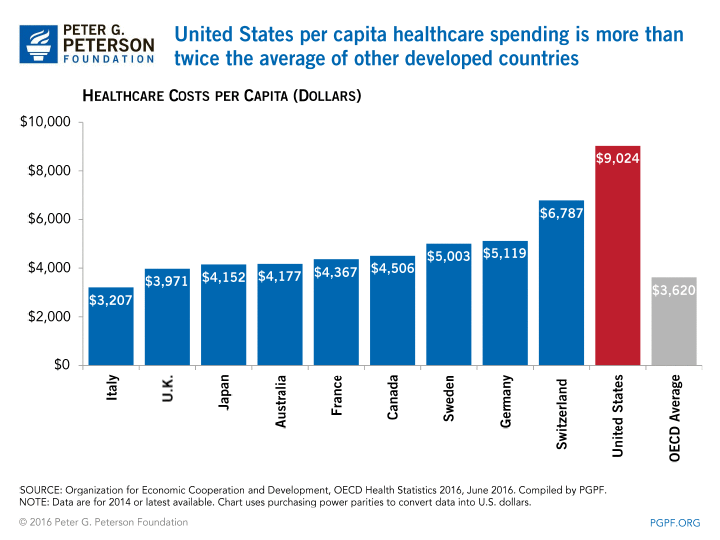
Healthcare Cost In America Highest In The World
Healthcare cost in America far exceed those of any other country and remain a life and death issue for many Americans. It is interesting how real life can bring truth front and center exposing flaws in national policy. One area that remains both a dismal failure and disaster is healthcare where in an effort to bring better healthcare to millions of Americans as  Obamacare has driven insurance premiums drastically higher. This helped Trump to get elected with his promise of a plan that would be "so good" but anyone paying a massive healthcare insurance premium will tell you the goal of reducing the cost of healthcare has totally eluded us.

Clearly when to seek medical treatment is a personal issue, but the decision is often impacted by just what kind of coverage a person has. It is a fact that across America there still exist people who are responsible, work hard, and pay their bills. This often means they think twice and often three times or more before rushing to create healthcare bills that they will have to pay. At the same time because of the crazy structure we have created in America other people use and abuse healthcare for a number of reasons. This includes things such as the psychological feeling of elevated importance it can create or because they are lonely and it is the only time anyone pays attention to them.

Higher Deductibles Equal No Care For Many
While those supporting the American Care Act (ACA) can drone on about its virtues what they fail to tell you it has probably taken more than a few lives, or to be blunt, killed more than a few hard-working Americans. If you are at a loss as to how Obamacare can take a life I will soon explain using as an example a real-life story. Before I take you there I must mention that during a talk show interview in 2015 Hillary Clinton stated we now have 90% of Americans covered by health insurance. She should have clarified the percentage means little, to be honest it depends on how you define "coverage." Obamacare has failed to drive non-emergencies to low-cost options and society is paying the price.

The crux of this article is the reality that many people have coverage with a deductible so high that they are afraid to use it. In some ways this is akin to having no coverage at all and this poses a massive problem. Today a great number of people suffer the worst of both worlds, not only have their premiums rocketed through the roof, but soaring deductibles have made using the coverage a gamble and a painful experience. Horror stories abound as to the cost of medical bills and how just a few hours of care or a short emergency room visit can quickly generate a bill costing thousands of dollars. These high deductibles are a trap set to create bills many people are forced to pay on top of their already "bone-crushing" premiums.

Cost Are Driven Higher By Unneeded ER Visits
Ironically, someone currently paying very little because of Obamacare will rush to the emergency room when they break a fingernail (minor exaggeration) while many people responsible for their own bills hang back in fear knowing they will face huge costs from things not covered. The bottom-line is that those supporting Obamacare are delusional if they think the sky high deductibles facing so many Americans do not discourage them from seeking medical treatment. High deductibles are keeping people away from hospitals and emergency rooms in huge numbers even when their lives are threatened.

The unintended consequences of Obamacare played out in a true story when someone very close to me proved high deductibles have the potential to kill, and this I know as a fact because I drove them to the hospital. One night in serious pain this person finally entered the emergency room after sitting in my vehicle for about 30 minutes waiting for the pain to subside. It came in waves so she finally conceded to the idea it was not a silly quest and succumbed to the heavy pressure upon her chest. After about an hour and several tests, they found nothing. Of course, they advised her to be admitted for more tests, but feeling rather silly and much better she declined. Isn't spending an estimated two thousand dollars enough to be told nothing.

The next night the same song began to play, again after sitting outside the emergency-room door we took it to the next level and finally entered. This time a heart attack was confirmed and it became go-time, or should I say, almost go-time. By ambulance she was shifted off to their regional center 20 minutes away where after being stabilized she waited for hours as they kicked several patients ahead of her. They were playing the "triage game" which in medical terms means assigning the order in which treatment is given based on the degrees of urgency to wounds or illnesses. It was only during surgery they discovered she was lucky the bomb within her chest had not exploded and if it had she most likely would have died. 

Her blockage was in a blood vessel called the left anterior descending artery, the area that causes a fatal attack known as the "widow maker" because of its severity. It is important to note while this was happening she only appeared stable and before entering surgery they did not know just how dire her condition was. It seems that luck is indeed a big factor in healthcare just as it is in Russian-roulette. Understand some of us take pride in not only resisting visiting both doctors and hospitals but fight such action tooth and nail. Call it stupid pride or stubbornness. It often seems much of the healthcare system would vanish if people used better judgment and were more responsible.

An example is how the father of a friend went to the emergency room because he could hardly walk due to pain radiating from his feet. After several tests the diagnosis that his new shoes were the cause of his pain proved correct. On the completely opposite side of the spectrum are those of us that avoid the whole medical community like the plague. I remember a time years ago when I seriously thought I was having a heart attack during a sales call so I quickly excused myself and went to my car to avoid collapsing in my customer's office, it turned out to be a false alarm and I never bothered to see a doctor. While several things can be taken away from this article one thing is certain, and that is our healthcare system leaves a lot to be desired.

The healthcare wars are far from over and the next skirmish seems to be shaping up around coverage related to existing illnesses also know as preexisting conditions. Still, the elephant in the room remains the idea of a basic single payer system may not be ideal because it means healthcare would have to be rationed in some way but if we want to be realist it sure as hell would in many ways be fairer than what we have today. As we continue our attempts to set this straight it is important to remember any system needs to be structured to encourage people to take more personal responsibility and also allow people financially able to buy supplemental and deluxe coverage if they like, this is currently the way Medicare operates and life really works.

Thursday, October 25, 2018

The Masses Suffer Most When The Economy Collapses

When the economy hits the wall it is the average Joe (or Jo) that suffers most because they are often ill-prepared to muddle through. Few people really think about the economy to any great degree or even try to understand it as they go about their daily existence. The average person only begins to care about "the economy" when they are directly affected or it deals them a bad hand or slaps them in the face. Without a doubt some wealthy people will take a hit, however, overall the pain will fall squarely on the shoulders of the masses. The fact is much of what happens must be viewed through the eyes of relevant value. Certainly, a few of the .01% will take a hit but even after losing a great deal of wealth most will remain wealthy and basically unscathed while the same cannot be said of the average man or woman on the street. History has shown during times of economic collapse the middle-class and the masses always suffer most and carry the brunt of the pain.

Savers And Wage Earners Often Get Hit Hardest
Do not be deceived into thinking the elite .01% play by the same rules as the rest of us. The middle-class or those who have worked and saved will see their wealth vanish and at the same time be surprised to find how resilient debt and obligations can be. Oh, the sweet allure of easy profits poses a charm or attraction that is hard to match. It draws investors like a magnet with its seductive call causing us to dance about as we drink the Kool-Aid and discount the risk we are taking. It is far easier than you might think to lose your wealth or have it ripped away by crooks because you invest in a scheme that turns sour or a slew of other "bad luck" scenarios. When a check fails to arrive the time to take action has often already passed.

Many of the "modern monetary theories" in use today have not been proven over time but reflect an attitude that we can control economic cycles better than in the past. The basis of the economy we have today is unsustainable and because it has been able to exist for so long does not mean it can continue.  The fact the system stumbles along does not guarantee that we will not suffer financial harm as individuals. Even though we are often led to believe shortcuts exist the truth is the learning curve in how to invest and protect your assets is both long and hard.  Simply reading a book, taking an investment course, learning a new charting or technical system is no guarantee you will make money. Many investors only learn this lesson the hard way and after a series of costly mistakes and errors. Again I caution, the first goal of achieving financial security is to take steps that ensure capital preservation.

The debt burdens we take on when all is well often become overwhelming during an economic pullback. The fact is most people are totally unprepared for any kind of a massive financial shock to society. This vulnerability is carried by the masses as most people do not have at their disposal the full range of investment options those very engaged in the markets have developed. You should view the economy as an economic battlefield and imagine your enemy carrying an M16 while you are armed with only a stick. Building a better arsenal is not an easy task and cannot be accomplished overnight, it takes both planning and a great deal of effort, it is also not a task that should be outsourced or entrusted to someone else, your financial survival depends on it. 

Banks Can Limit Access To funds!
The lack of investment options that many people have will leave them unable to react if and when trends dramatically shifts. The bulk of society is extremely vulnerable when an economic shift does occur and you do not want to be in this group! A major concern should be that we are often lulled into being far too complacent as to the real economic risk that surrounds us. A glaring example of this is how people just assume the bank will honor their credit lines or they will be given access to their savings during an economic crisis. As everyone rushes to the exit, it is silly to think you will be served in an orderly fashion or even fairly. Mind the "small print" in all the agreements you have signed and remember the banks are not your friend.  

It is debatable which is the lesser of two evils, the Wall Street bankers or the government when it comes to placing blame for orchestrating the coming economic trap that awaits us. Years ago President Eisenhower warned the American people about the Industrial Military complex, but nobody warned us an even more evil alliance that of the "Financial-Political Complex."   Everyone knows the Federal Reserve and other central banks hold great sway over the economy, however, when forced to ask which is the worse of these two evils the answer is very troubling. Government wins hand down because the bankers can claim their goal is to make money and it is the politicians we elect to lead, protect and guide us, we do not elect or appoint bankers. 

When the next financial crisis hits, and sooner or later it will, no one can predict and how deep and long it will be. Just as difficult is predicting the form it will take. It has been many years since pure panic has dominated our lives and filled the streets so most Americans have never faced such a situation. It is important to recognize several catalysts exist that could usher in such a scenario, but predicting such an event is impossible to time. Watershed events can occur in the blink of an eye or be spread out over weeks or even months. The base on which our economy sits is comprised of ever-growing debt that is unsustainable. Because this system has been able to exist for so long does not mean it can continue.   

The science of economics is riddled full of loops that feedback upon themselves and unexpected pitfalls based on expectations that may never take place. Many economic theories exist, but they are often baffling, confusing, as well as full of holes and conundrums. All this can become quite abstract with economist seldom agreeing and often predicting events that never unfold as expected or planned. The way people react to an overall economic policy may have to do as much with timing and perception as it does with reality. While many of the "modern monetary theories" in use today are spun to reflect an attitude that we can control economic cycles better than in the past by using newly forged tools the simple truth is they have not been proven over time. To navigate the treacherous terrain of investing without a road-map or knowledge means you travel at great risk.

As society has accumulated wealth over the years a growing trend has been to store it away in promises made on paper or existing somewhere on a computer database. This could explain why inflation has not raised its ugly head or become a major economic issue in recent years because it lowers demand for tangible products and goods. My misgivings with current economic policies are many, of chief concern is the massive debt being accumulated by governments and the rate that central banks have expanded the money supply.  If a great deal of this money would suddenly shift into tangible goods seeking a safe haven inflation would soar even as debts go unpaid and promises are left unfilled. If I'm wrong and another scenario takes place such as stagflation or deflation an even bigger problem may emerge and that is the massive amount of unpaid debt that will have to be written off, either path is fraught with peril.

Wednesday, October 17, 2018

Euro's Value Is Being Buoyed By Anti-Trump Sentiment

Currently, Euro Trades At About 1.15 To The Dollar
Italy's debt remains a "quiet roar" unnoticed by many even ignored but an unfixable problem that will not go away. We can only speculate as to how events will unfold in the continuing saga playing out in the Euro-zone between Italy and Brussels. If the populist-led Italian government backs down it will not make their debt vanish or result in an improved future for the country, it will only set back for a bit the day when all parties must face the realities of the situation. Few people deny the ingredients of a debt crisis exist in Italy, a huge amount of questionable debt, weak banks, an erratic government. and a sizable economy able to inflict collateral damage outside Italian borders.

The Italian government has no intention of backing down from their budget stance despite threats from the ECB to provoke a Greece-style banking crisis if the Italians don't yield. This should be crushing the euro. Ironically, in many ways, a great deal of the recent support for the euro has been generated as a reaction to the Trump administration's unpopular actions such as unilaterally reimposing sanctions on Iran. Acts like these are eroding the dollar's global appeal. Trump’s unilateralist approach to foreign relationships is reshaping the world in profound ways by undermining multilateral institutions. This means other countries see this as an opportunity to develop new geopolitical capabilities which play out in the currency market.

His Detractors Find Trump's Logic Challenging
The world has reacted poorly to many of the President's policies and whether his supporters want to admit it or not Trumps weaponizing the dollar has played out in a negative way for the dollar. It has also had the effect of bolstering the euro which has in the past been viewed as one of the few real alternatives to the dollar even if it means sweeping under the rug the reality that internal strife is threatening to tear the Euro-zone apart. By focusing on the media's negative spin on Trump and their reports that he can do nothing right, it makes investors more willing to speculate on the dollar falling out of bed and being shunned by one and all. Even the apparent killing of a Saudi born journalist in Turkey has been spun to feed into this narrative.  

The Dollar Remains The Only "Real Option"
The backlash against the dollar has been spurred forward by the US threatening to penalize companies doing business with Iran by denying them access to US banks. This has created a wave of speculation that such talk could hasten the dollar's demise as the main global currency. Currently, the euro is the world’s second-leading currency but it lags far behind the US dollar. Two-thirds of all loans issued by local banks in foreign currencies are denominated in dollars, compared to around just 20% in euros. More important is that similar proportions apply in the area of global foreign-exchange reserves.

It is simply not a case of many countries feeling they must question their bonds with America and whether they can continue to regard the United States as a reliable alliance partner but the pressures of a changing world that are heightening concern of currency valuations. Like all fiat money, the dollar is nothing to brag about. however, at this time the other options are even less compelling. The major Central Banks being well aware of how devastating currency moves can be have gone out of their way behind the scenes to stabilize an unstable situation which they created with a decade of QE policies.

The argument that currencies are trading in a false paradigm extends past simple manipulation and is bolstered by their being sheltered from the storm of volatility by existing in a rather closed system in which wealth tends to become trapped. The reality is that after years of doing "What Ever It Takes" Draghi must be at wit's end. No real solutions exist for the Euro-zone as it confronts the grueling challenges before it of remaining competitive in the global marketplace and the political unrest brewing within its borders only complicates the task.


Footnote; For more on the euro see visit the link below.
 https://brucewilds.blogspot.com/2018/09/the-ecb-and-draghi-are-starting-to.html

Sunday, October 14, 2018

Timing A market Top Takes A Great Deal Of Luck

Those who claim they will be able to predict a market top or crash are often delusional. Even after a market begins to tumble it often reverses and can tear the face off traders convinced they are on a one way street to riches. Only time and looking back in the rear-view mirror confirms what course the market has chosen to take. Timing a market collapse is no easy task and more than once like many market bears I have found myself writing an article predicting the wrath of reality was about to descend upon the economy to be disappointed by a bull market that seems to defy gravity and logic.

  Bull market winding down. Don't panic - 2013

Those of us who have doubted and repeatedly predicted the collapse of this so-called recovery remain wrong because we have underestimated both the breadth and size of the global intervention of central banks and governments. Nobody in their right mind would have ever anticipated the sheer magnitude and scope of what has become a worldwide phenomenon. Still, considering that since 2008 growth has been built on a mountain of debt it is a challenge to become excited and simply go with the flow. Those of us who truly understand the nature of debt and have seen the destruction it can wield fear and respect its power.

Most people work hard for their money and even harder to save a bit of it but they are often lulled into complacency when it comes to protecting it. One of the saddest things to witness is when someone who has worked very hard suddenly becomes penniless because an investment or economy turns south. I'm reminded of Ernest Hemingway's line from The Sun Also Rises, "How did you go bankrupt?" "Two ways, gradually and then suddenly." It can be used to describable just how wicked markets can be. We should remember the stock market has far exceeded the upside expectations of many bulls while the economy has not fared nearly as well in many respects.

Timing a market top is difficult, the question I again put forth is, are we reaching the turning point? A turning point can signify a historic or watershed event that is looked back on and comment upon for years, market crashes, the great depression, major economic shifts can fall into this category. In the past, I have written about the unpredictability of predictions and how a random black swan crashing through your front window plays havoc with the idea of always and never. For a decade America and much of the world has been washed along on a wave of freshly printed money and low-interest rates and while many people think it has ended, just last week the Peoples Bank Of China unleashed more support to the Chinese market.

This Chart Screams Confusion Clear And Simple
Auto sales and lease programs have flourished and housing has also been pushed along by artificially low-interest rates that distort what might be called the natural laws of economic order. The historically low-interest rates have also masked inflation by lowering payments on loans and debt. In a free market, the law of supply and demand is left to efficiently allocate capital and in doing so determine true market value and price discovery. When you factor in the corrupting force of stock buybacks ushered in by the recently passed tax package those in power have temporarily masked reality and the serious structural problems within the economy.

Several strong reasons exist to be pessimistic about the economy going forward. Washington has failed to make the reforms necessary to make America more competitive and consumers are not in a position to spend the economy forward because a large number of Americans have dropped out of the workforce or chosen to only work part-time often at jobs that pay poorly with few or no benefits. This comes at a time many retails stores are closing under the assault of growing online sales aided by our very own United States Parcel Service delivering packages under cost and even on Sundays. Sadly, the only sector guaranteed to be strong is defense based on government spending but that is not enough to carry us forward.

Circling back to the main theme of this piece which centers on just how difficult it is to time a market top and how costly being wrong can be it should be pointed out that in many ways the stakes have been raised and are much higher than usual in this cycle because it has gone longer and farther than most investors expected. Two things are certain the first is most traders are a bit nervous following the market action last week and the next few days will be fraught with uncertainty. This translates into the idea markets may be volatile and caution is in order. Remember at some point "buy the dip" will become the kiss of death.


Footnote; In my readings today I happened across a passage on another blog where the writer speculated the "Three Amigos of collapse" might be ready to converge, he described these as Murphy’s law meets the law of unintended consequences and the law of diminishing returns. The piece below written in February questions whether it was "Too  Early To Call A Market Top?" We now know it was but we have not been blessed with much in the way of good news since that time. The link to that article can be found below.
https://brucewilds.blogspot.com/2018/02/is-it-too-early-to-call-market-top.html

Thursday, October 11, 2018

Manageable Inflation Again Deemed The Desirable Goal

Our Goal Is 2% Inflation
In a recent interview with Bloomberg the French economist who served as President of the European Central Bank from 2003 to 2011, Jean-Claude Trichet, opined about his outlook for the global economy and monetary policy it was not surprising that he repeated the line declaring 2% inflation the desirable goal of intelligent central bankers and everything is "data dependent" which translates into the central banks will squash inflation if it begins to run too hot. Much of the interview was based on his feelings about the economy, near-term. Staying within the "established lines" he stated everything looked good for the next year or so. Trichet then warned that "over-leverage that exceeds levels from before the financial crisis" will if not addressed cause problems down the road.

Warnings stated by former and current bankers and contained within their talks adds an air of thoughtfulness and caution to the discussion reinforcing their image of being prudent. The fact is all these heads of central banks, past and present, seem to say the same thing. and tend to reinforce the impression that any real problems ahead should be out at least a year. This allows the speaker to hide in clear sight by simply appearing cautiously optimistic. More notable than the musings of the former ECB President were statements from FED Chairman Powell in a speech recently which was considered a bit more hawkish than the market preferred.

Our Goal Is 2% Inflation
Chairman Powell confirmed the jobless rate is running at 3.9 percent (on Friday the jobs report lowered the number to 3.7) and inflation is around the Fed's goal of 2 percent. Powell is now confronted by the fact that historically, low unemployment has fueled inflation and sometimes has forced the Fed into hiking interest rates rapidly. "While these two top-line statistics do not always present an accurate picture of overall economic conditions, a wide range of data on jobs and prices supports a positive view," Powell told economists in Boston conference. "In addition, many forecasters are predicting that these favorable conditions are likely to continue."

The manageable inflation goal of 2%. has become the "holy-grail" of central bankers, however, the 2% inflation target central banks have deemed optimum is not economically valid and is "based only on their opinion" of what conditions will best allow the economy to flourish. For a long time, the ECB and other central banks have claimed deflation drives or allows their QE policy to remain and is central to their ability to stimulate. The moment inflation begins to take root and become solidly entrenched to where it becomes a self-feeding loop their flexibility in policy is lost. What makes the future inflation argument more relevant than usual is that the average American has witnessed in the last 30 years, a growing gap between government reporting of inflation, as measured by the consumer price index (CPI), and the actual cost of living.

What the central bankers have conveniently brushed aside is that the formula that generates the numbers governments pump out was skewed in the 1990s when political Washington moved to change the nature of the CPI in an effort to reduce the federal deficit so nobody in Congress would have to register a vote that would harm the image of Social Security. For proof as to the real cost of inflation just look at the surging replacement cost resulting from recent storms and natural disasters. I further contend that inflation would be much greater if more money was flowing into tangible goods rather than paper investments and promises.

It might be wise not to become too trusting or complacent to the idea that inflation can be contained at 2% especially while deficits explode, debt builds, and central banks continue to stimulate the economy by printing money or that the economy looks good for the next year or so. In the past, I have put forth the theory that inflation could rule the day even if central banks are unable to keep the wheels on the bus and the economy suddenly collapses which is in truth beyond their control. If inflation does not become the flavor of the day the future may unleash, its sister, the powerful force known as stagflation which is also a threat to the average citizen and will devastate those improperly invested for its arrival.


Footnote; Links for the two articles related to this subject, the first about the CPI and the second focusing on inflation can be found below.
 http://brucewilds.blogspot.com/2017/07/the-cpi-understates-inflation-and-skews.html
.https://brucewilds.blogspot.com/2018/05/liquidity-traps-wild-potential-to.html