Wednesday, March 6, 2019

Trends Point To Rents Edging Higher In The Future

You Can Count  On Death, Taxes, And Higher Rents
Several trends point to the reality we should expect rents to edge higher in the future. While many economy watchers tout the line any economic crisis will result in massive defaults and deflation hidden forces may prove them very wrong. Over the last few decades, a great amount of wealth flowing into paper promises rather than tangible assets has masked true inflation but it is everywhere. One place it is most obvious is apparent in the replacement cost of buildings and infrastructure destroyed or damaged by natures fury.

Local, state and national governments need revenue and this translates into higher taxes plus a slew of new fees are about to be unleashed upon their citizens. These will take many forms but it is clear that we will see more taxes assessed upon wealth, income, and property as well as soaring utility cost often driven by government mandates. When push comes to shove we can expect the government to suck wealth out of the private sector using the "greater good" as their justification.

Most people do not realize big government acts as a wall against deflation. Over the years as the government has grown it has created a wall of rising resistance to a pullback in prices. Today with more employees guaranteed their wages will not fall and governments committed to buttressing their economies during "hard times" people have less to fear when it comes to seeing their incomes slashed. In this way, big government is more aligned to creating inflation or stagflation than adding to a self-feeding deflation loop. All these factors mean we should all begin to prepare for higher rents and expect the cost of a place to live and do business to edge ever higher with any reprieve due to high vacancy rates as only temporary.

It Comes Down To What You Can Afford
Rising property taxes and fees, utility bills, as well as increased maintenance cost, must be passed on or the supply of housing will substantially decrease. This translates into housing simply becoming unavailable which is what happens under price controls. Ever higher rents are already driving people away from expensive-coastal-cities expensive coastal areas such as New York City and San Francisco into Sun Belt cities where relatively cheap rents, nicer weather, and good job opportunities await.

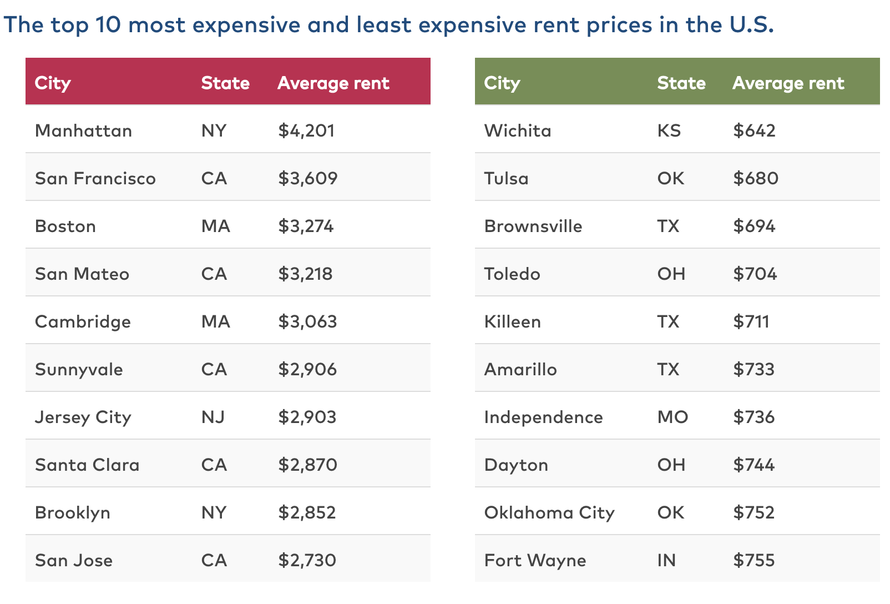
A recent monthly report from RentCafe, a nationwide apartment search website that enables renters to easily find apartments and houses for rent throughout the United States, indicates this trend is already beginning to lift the cost of living in what were often considered inexpensive areas to live. While across the nation average rents climbed only just 3.3.% year over year according to  Rent Cafe's Yardi Matrix, in January rents rose most rapidly in smaller cities such as the suburb of Henderson outside Las Vegas, Nevada. Of large metro areas, Las Vegas stood out as the city where rents saw the fastest growth (+8.3%)  with rents in Phoenix, Arizona, also seeing a large (+7.6%) increase. Still, even larger increases occurred in smaller cities like Midland, Texas (17.7%), Odessa (14.2%) and Reno (10%).
Cities
Click On this List to Enlarge!
Add to the issue, demographic trends will continue to support housing demand as older less expensive units come offline and are replaced by newer more expensive units the cost will be passed on. In the future, higher interest rates will be of little help in bringing down housing cost because the financing cost to build new rental units will rise. While this may impact what rental units sell for it does little to lower the monthly debt service of landlords which is part of their expenses that feed directly into rents as the overall cost of doing business.

As you read this article it is important to realized rising rental and housing cost is in part being driven by America's frustrating housing policy that allows or is complicit with watching roughly 80% of new apartment construction flowing into the high-end luxury market. The government holds huge responsibility for a rising share of our housing problems in low-income situations because its policies avoid dealing with the growing number of tenants that are poor. Irresponsible government housing cherry-picks the best of the low-income renters providing them with very low rents and nice apartments and dumps the rest on the private sector. The best way to address or level the playing field would be to move away from public housing and give those needing housing aid "rent only vouchers" that could be used with any landlord rather than putting these people into a quasi-government run project. 

Not only is all this discombobulating enough, even when our government funds low-cost housing it is often squandered. Fort Wayne, the city where I live, has announced another incestuous boondoggle to be built "low cost " housing using government money. Fort Wayne is on the list of least expensive places to rent and it should be noted that a slew more new apartment projects are already under construction which will pressure rents even lower. We can now add to these, Posterity Heights, a multi-phased development designed to provide net-zero housing, electric car sharing, an on-site early childhood learning center, education and job opportunities, healthy food and other amenities for traditional and single parents on a path to self-sustainability. 

The $42 million development will indeed be a monument to governments inability to act responsibly. Let me be clear, these residential units are not "plain Jane" in nature but an "over the top" effort to build an expensive monument to "affordable housing" that can act as a model for other communities. This is a cutting-edge experiment so inclusive that it even provides an electric car-sharing program for residents. This is exactly the type of project that raises the ire of hard-working taxpayers who wonder why their lower-income neighbors are enjoying new side by side refrigerators and have trash compactors while they don't. 

In the long run, rather than pouring money into the hands of those needing housing in areas that are very expensive to live, the government would be wise to encourage many of these people to relocate to where housing is both plentiful and less expensive. Over the long run, this would be a "win-win" in that it would lessen the cost of housing low-income people while supporting housing values and encourage renovation of the housing stock in these areas. The amount people pay in rent for a small apartment over three to four years in an area like New York City or San Francisco is often less than the cost of a home in some cities.

Many people that have tried out the role of being a "landlord" will testify that it really is not all that fun and the risk to reward ratio is totally out of whack. We live in a society that is becoming more progressive and bending over to protect the rights of what they call the "most vulnerable." This means the rights of property owners are often thrown under the bus for the "greater good." A difficult and expensive court system coupled with a lack of desire on the part of society to protect the rights of landlords has driven many small and private providers of housing from the market. Many of the judgments ordered paid by the courts are never paid and impossible to collect. When considering all the above it is difficult to see lower rents in our future.  

                                                                                 This blog is not written for money
                                                                                 or profit but as a way to share ideas
                                                                                 and thoughts. If you liked this post
                                                                                 feel free  to E-mail it to a friend
                                                                                 or click on the Follow button above.

Footnote: The article linked below sheds a bit of light on this issue of evictions that result in people becoming homeless. I have found the reason many people are evicted is because they do not follow the rules. This often means they become ineligible for government housing programs. By making them "ineligible" for certain programs the government shrewdly and cleverly sidesteps having to deal with these people. It must be noted, the unintended consequences of government policy that sidesteps responsibility for the dysfunctional poor only add to America's housing woes. 
http://brucewilds.blogspot.com/2016/05/evictions-in-america-plight-of-poor.html

Saturday, March 2, 2019

Nuclear War Still Atop List Of World's 10 Worst Problems

Threat Of Nuclear War Grows Larger
Generally, we see little movement in the list of the "Worlds 10 Worst Problems" as counted down from least to most crucial. In fact little has changed until now from late 2013 when this list was first composed, and when it was last updated. In August of 2017, however, some serious reshuffling occurred to reflect the drumbeats of war flowing out of Washington and the capitals of other nations. this resulted in the leap from fourth to first place for "Weapons of war and mass destruction." This is extremely significant because it can be very difficult to get this particular genie back in the bottle once it is out. Of course, when composing this list the term "most crucial" is very subjective, meaning that it depends greatly on an individual's interest and priorities. 

In some ways, it is ironic that angst between President Trump and North Korean leader Kim Jong-un had a great deal to do with moving nuclear war into first place. That was replaced by a budding  "bromance" between the two boys and two face to face meetings. Sadly, the most recent in Vietnam has broken-down, still, those daily threats of lobbing bombs at each other have been replaced by promises of turning a more friendly North Korea into an economic growth machine. Unfortunately, other problems have recently intensified. Along the border between Pakistan and India, the potential for major war to break out continues to build as the disputed border region of Kashmir again becomes an issue. Both countries have nuclear bombs which elevate fears of a major conflict. last but not least tensions remain very high in Ukraine where warmongers continue to push Russia and Putin which has no intention of backing down.

Like many people, I do not find what is known as the concept of Mutual Assured Destruction, or MAD to be reassuring and see little potential in thinking we will peacefully resolve these issues by starting a new arms race. What the world would look like following a nuclear war is very murky, yet many people now consider nuclear weapons as just another tool or option for us to use in our defense if we are attacked. The nuclear deterrent America holds is a hundred times larger than needed to stop anyone sane or rational from attacking America, and for anyone else, an arsenal of any size will be insufficient. The sad fate that conventional warfare unleashed upon Mosul and Aleppo where death and destruction turned once proud cities into rubble stands as a monument of man's inhumanity towards man, however, this pales to the devastation a nuclear attack would wreak.

Future Generations Depend On Us
The greatest problems faced by mankind impact the shape of our lives' and our very existence. Most of these are issues that center on our sustainability which means we must begin to address these many problems with long term solutions. Sadly, politicians do not deal well with such things leaving mankind without a great deal of direction. As we look at the human condition we can let fate take us where it may choose or we can take control of our future by proper planning and by guiding it as best we can.

Below is a list of the world's ten most crucial problems. Remember the position a problem holds on this list can shift from time to time as events take place, but expect most of them to remain on the list. Unless a black swan event such as a meteor heads our way this is what you have. Some problems have been grouped with the collateral issues associated with them, this may include the current "buzz words" used to describe their importance. Different people would group these issues in a variety of other ways and move about their priority. As always your comments are welcome.

10.   Demographics of an aging population;   As the population grows older euthanasia and the quality of life will become an issue. This must be handled in a fair, honest, humane, and compassionate way. The alternative is to simply let many older people wither and die hungry while existing in pain and squalor.

9.  Creating an environment that allows and encourages people to develop fulfilling lives;  This means improving the educational system and having an opportunity to find fulfilling work, seek happiness and express their individuality. It also means ending corruption and extending equal protection and fairness under the law.

8.   Hunger and starvation;    Severe malnutrition can make life unbearable and because of it many people only go through the motions of being alive. People that are starving cannot learn and take a role in society. Starvation and addressing the need of basic sanitation must be addressed.

7.   Income inequality and economic stability;   The uber-rich should not become exempt from all common woes and untouchable. The uber-rich and political elite should not comprise a special class who are immune and able to ignore the rules of society. Nor should the masses be placed into a situation where they are deemed deserving of what fruit society creates merely by being born. Fairness in handling the world's economic systems and currencies that allow for a solid way to exchange goods and services is necessary or other world support systems will suffer or fail.

6.   Man's inability to take control of his future by creating responsive and responsible governments;   The masses have been lulled into complacency, in many ways we are all slaves, this is not a new role for man. But we can think and should make an effort to do so, we must push our chosen leaders to do the right thing and make long-term plans that are sustainable. We must shape our future and the values of the society in which we live. Sadly, a sharp rise in Orwellian trends which lead to police states is threatening the concept of freedom in countries across the globe.

5.   The last few years stand as proof of man's cruelty to man. Strife between religions and tribes must end;   We need to develop a new tolerance that allows people to live in peace. A safe place to live for a person and their family is one of man's most basic needs. The political elite must not be held harmless for the grief and death they cause over large swathes of mankind. War crimes cannot be tolerated. While this is easy to say deciding exactly who is responsible for these crimes is often easier said than done.

 4.    Wasting Earth's limited natural resources by not conserving and the continued destruction of our environment;   I contend that many of the "green solutions" being proposed such as ethanol fuel are not a solution at all and just ways for business to profit. A solution is not truly green unless the environmental cost of "maintaining" it is very low.

 3.    Pollution and the resulting climate change it may bring;   This is showing up in oceans that are sick and being depleted of life. This also may result in rising oceans and crop failures. Either scenario will mean massive suffering across the world and could tear the social fabric and alter our day to day lives.

 2.    Overpopulation;   This is the overriding problem facing Earth and the most difficult to address. If the problem of overpopulation is not addressed all the other problems on this list will most likely become much greater. Many people still rejoice in the idea that we should be "fruitful and multiply" ignoring or oblivious to the problems it creates in the long-run. The quality of life in many ways is more important than quantity.

 1.    Weapons of war and mass destruction;   This not only includes nuclear bombs and chemical weapons but drones and the killer robots now being developed. One big mistake or going down the wrong path in developing new weapons could change life as we know it!

While people and their families go about life each day having children and doing the things we all associate with our day to day existence most people concede that something is wrong with a world where many people lack even basic sanitation and watch their children die before the age of five. I'm not saying developed countries should give everything away or bring all the people of the world up to an American standard of living. It is not our responsibility to do so and probably impossible.

In my book, Advancing Time I highlight and bring focus to the massive changes that have taken place over the last two hundred and fifty years. History viewed in the framework of man's time on Earth forms the crux of my perspective. The oldest fully developed humans based on DNA research supports the theory that Africa was the area man first inhabited between 200,000 and 140,000 years ago. In 1800 the population of the world was around 900 million, by 1900 it had soared to 1.6 billion since then it has exploded to over 7 billion.

When you chronicle the journey from the beginning of man to our current state it becomes clear that the world has never before experienced such rapid change. This perspective helps us make sense of our fast-changing chaotic world while illuminating and clarifying the responsibilities society faces. It is important we recognize this ever-quickening pace of change and keep in mind that if these problems are not addressed there may be no future for mankind or it may be much shorter and difficult than many people expect.

Wednesday, February 27, 2019

Generational Conflict Is Posed To Dramatically Increase

Most People Don't Save Enough (click to enlarge)
Chalk the situation before us up to poor planning, greed, or simply a case of governments promising far more than they can provide, this means conflicts between the generations are set to explode. We should expect the stress and tensions between today's youth and those of older citizens to increase as demands for government help grow larger from both groups. In short, this translates into a fight over where entitlement money is spent. The needs of these two groups are very different and real so it is only logical that conflict will arise but society may be surprised at the potential size of the collision these special interest pose and should prepare for a major clash in the near future when reality hits.

Different generations sport a completely different set of priorities with the younger generation concerned about getting help starting out, paying on their student loans, raising children, and in finding a nice place to live. Those nearing retirement, the so-called, "baby boomers" and older Americans that have already retired or are looking forward to kicking back, often with little in the way of savings this group wants to know the government will be there to help make them comfortable and take care of them in coming years. The myth that funds have been set aside to provide for the social security payments and the medical needs of older Americans will soon be laid bare and the bill for such things is about to be laid at the feet of today's youth. Call them what you want but Generation X, the Millennials and their younger "Generation Z" counterparts are in for a rude awakening when handed the bill for all that has been promised.

The siblings of “Generation Z” owe a great deal of their generational identity to Generation X. Born between 1960 and 1980 in the United States the Generation X is now between the ages of 34 and 54 years old. These are the people who laid the political, intellectual, social, creative and personal ground upon which the youth of today walk, talk and text. Sadly. they also did little to promote an environment of political reality by halting baby boomers from leveraging their clout into favorable policy that they will enjoy in later life. In fact, in the 1980s our government slashed tax rates to revitalize the flagging economy just as boomers approached their prime earning years. The average federal tax rate for a median American household, including income and payroll taxes, dropped from more than 18% in 1981 to just over 11% in 2011.

The Sad Truth Is Many Older Americans Are Broke!
This means nothing was set aside to pay out the generous benefits boomers have bestowed upon themselves, programs like a prescription drug benefit paired with inadequate premiums are set to cause deficits to explode in coming years. Today an American born in 1945 is receiving nearly $2.2m in lifetime net transfers from the "state" far more than they pay in, and far more than any previous group. A study by the International Monetary Fund in 2011 compared the tax bills of what different age citizens pay over their lifetime with the value of the benefits they are forecast to receive and found the boomers are leaving a huge bill. Those aged 65 in 2010 may receive $333 billion more in benefits than they pay in taxes. This is a huge obligation the government must meet and will be a heavy burden placed upon the shoulders of our youth.

For over 35 years, the Administration on Aging (AOA) has provided home and community-based services to millions of older persons through the programs funded under the Older Americans Act (OAA). These include but are not limited to transportation, adult day care, caregiver supports, and health promotion programs. The Office of Nutrition and Health Promotion Programs manages health, prevention, and wellness programs for older adults. This includes behavioral health information, chronic disease self-management education programs; diabetes self-management, disease prevention, and health promotion services ( “Title IIID”), falls prevention programs; HIV/AIDS education, nutrition services, and oral health promotion. All this cost money and this is only the tip of the iceberg when it comes to money being thrown at making the lives of older Americans better.

The Number Of Older Americans Is Growing
As senior citizens make up an ever-greater proportion of the U.S. population, a range of economic and social shifts will change American society. For example, total health care spending will rise significantly: In 2010 those 65 and older spent about $18,424 per person on personal health care, about three times more than the average working-age adult and about five times more than the average child. The cost of caring for elderly persons with dementia is also predicted to grow substantially in the coming decades, Alzheimer’s care alone may exceed $1 trillion annually. A report titled, 65+ in the United States paints a detailed picture of the over-65 demographic in the United States and this group is central to recent policy debates on the Affordable Care Act and even extending into the area of physician-assisted suicide.

It is predicted that as people age the cost of caring for them will dramatically increase and this will create real problems for our budget. Sadly, the arithmetic leaves few ways out of the mess, the numbers are ugly and much of it is only now becoming visible in our soaring National Debt. Faster growth would help, but the debt left by the boomers adds to the drag of slower labor-force growth. Carmen Reinhart and Kenneth Rogoff, two Harvard economists, estimate that public debt above 90% of GDP can reduce average growth rates by more than 1%. Meanwhile, the boomer era has seen falling levels of public investment in America. Annual spending on infrastructure as a share of GDP dropped from more than 3% in the early 1960s to roughly 1% in 2007.

Austerity is another option, but the consolidation needed would be large. A report from the IMF estimates that fixing America’s fiscal imbalance would require a 35% cut in all transfer payments and a 35% rise in all taxes. This is clearly too big a pill for our creaky political system to swallow. Fiscal imbalances rise with the share of the population over 65 growing and with partisan gridlock, this is troubling news for America, where the over-65 share of the voting-age population will rise from 17% now to 26% in 2030. As this voting block grows and strengthens it is unlikely they will loosen the noose.

This leaves the third possibility: inflation. A few years of 5% price rises could help households reduce their debts faster. Other economists, including two members of the Federal Reserve’s policy-making committee, now argue that with interest rates near zero, the Fed should tolerate a higher rate of inflation and try to speed up recovery. The generational divide makes this plan a hard sell. Younger workers are typically debtors, who benefit from inflation reducing real interest rates, older people with large savings dislike it for the same reason. A paper by the Federal Reserve Bank of St Louis suggests that as a country ages, its tolerance for inflation falls.  

At a time when robots and automation are eliminating jobs, it could be argued that younger people are facing a difficult labor market when it comes to wages. This means that people are having to price themselves into jobs and that there continues to be a cut in the "real value" of pay as inflation remains higher than pay increases. Youth unemployment is weak, many jobs are only part-time, and workforce participation has dropped. In 2013 the Congressional Budget Office reviewed the implications of providing long-term services and support for older Americans, while the Pew Research Center looked at trends in caregiving, with an emphasis on the “sandwich generation” that is assisting both older children and aging parents. After a review of these reports, it is easy to arrive at the conclusion that the squeeze is just beginning.

Monday, February 25, 2019

History Should Be Growing More Important To Our Culture

Historic Chicago Theater - A Link To The Past
With the world changing so rapidly, continuity and history should be moving to the forefront of cultural values. Modern values when measured are often found lacking and that is why history is proving so important in its ability to link us to our roots. Sadly, this is not happening fast enough to save many of the fine buildings our ancestors have built over the years. People have the need to feel more connected and anchored to the places where they grew up, being able to say “I played under that tree” or “we use to swim in that fountain” fills an important emotional need. The cities of Europe and many other parts of the world fill that need in a special way that many American cities can't.

Over the years as American cities renovate they have shown a tendency to do so with a heavy hand. Often after the architects and planners have their way little or none of the original structures remain standing. This confirms our status as a throwaway society where strong and growing government intervention, ADA requirements and ever-changing building codes add substantially to the cost of remodeling but add little or often detract from the utility value of the end product. Sadly, this tends to make buildings prematurely obsolete.

The Shambles In York England
This effort to embrace our history in recent years has spurred cities all over the world to tear out and replace asphalt streets and concrete walks with stone. Monuments that had been dismantled and chucked into corners somewhere during changing political climates are being dusted off, restored and returned to where they had once stood. A new appreciation of our history is growing, for without our links to the past, we are adrift in a sea of meaningless change. This often means that in place of contemporary lighting, “antique style” fixtures are back in vogue, wrought iron is again replacing stainless steel. Nowhere is this more obvious than in the heart and core of the worlds oldest cities where people flock to experience the bonds to our past.

Here in America, a trend has begun to take hold where those who value our cultural ties to the past and history have started to move back into the grand old urban neighborhoods that have deteriorated over time. This process of renovating old and tired neighborhoods by introducing an influx of more affluent residents is referred to as gentrification. Some people see this as a controversial topic in politics and in urban planning but if gentrification can improve the material quality of a neighborhood and save many of the structures from the wreaking-ball the fact some residents and businesses might find they are forced to relocate because of rising rents is a small price to pay.

In a country where much of the new residential construction is built in the cookie-cutter urban sprawl variety, it is easy to understand why unique hand-built older homes are becoming more valued. In our modern era, a great deal of new building is driven by what is in the interest of big developers and not the buyer or society. Developers generally seek a clear canvas and cheap land on the edge of town on which to build. Builders garner savings from mass production factory-like building methods with sites that are in close proximity that reduces travel time for workers. They also love to transfer the cost of upgrading the infrastructure to access the new community to the government. All this skews the direction of growth as business rushes to locate near these new opportunities gutting areas developed only decades ago.

In the Beginning, Everything Is New
In the beginning, a great deal of money is spent on building the infrastructure necessary for communities, this includes roads, bridges, utility lines, and moving dirt. All this may go on for many years as homes and commercial buildings are constructed, all this creates jobs and new investment opportunities. Still, at a certain stage of development logic dictates that a "natural progression" should take place as an economy matures and we reach a tipping point where the nature of how we spend our resources change. Over time, as developments mature a greater percentage of outlays should be spent on things like maintenance, updating, and upgrading existing buildings and infrastructure as needed. Rather than pouring money into strictly new construction, replacing windows and roofs weathered by nature and repaving and resealing parking lots becomes the sensible way to proceed. 

As an economy matures its rhythm changes, this means the focus of society should transition into sustaining and maximizing what has been created by extending its use. With all this in mind, it is important to realize much can be learned about man and his history if we look at how these early cities developed and why. When you travel it is often possible to break down into several categories what you will be seeing, old cities, new cities, and natural wonders and beauty. America needs to adjust codes and policies to help preserve historic structures and allow them to be financially competitive. Thoughtful individuals that appreciate diversity are voting that they have seen enough of our cookie cutter cities that all look alike, with the same stores, restaurants, and shops. With that in mind, we should make sure we do not underestimate the lessons our older cities have to offer.

Saturday, February 23, 2019

Unbridled Market Euphoria Rooted In Optimism And Hope

A Trade Agreement Is Not A Silver Bullet
After a terrible December stock markets have soared with renewed vigor tearing the faces off bears that thought their time had come. A great deal of the market advance has been based on optimism a new trade deal will occur between America and China paving the way for future growth even while data continues to emerge confirming economies across the world continue to slow. It seems much of the current market fervor based on optimism and hope could fall into the category of "irrational exuberance" a term that Allen Greenspan has in the past used to describe unbridled enthusiasm.

Since reaching a trade agreement with China is not guaranteed or a silver bullet to our economic woes, it is likely that many of those bullish on stocks and predicting markets are about to move into new record high territory have allowed their projections to be influenced by the fact China unleashed a huge amount of new credit into the market. In January, Beijing injected a staggering $685 billion in new credit into its financial system and this money continues to leak out of China causing assets to rise across the globe. Simply put, bulls surmise that since this form of QE has worked in the past it will continue to work in the future. Whether they want to admit it or not this again puts China front and center in their future growth scenario.

China's Economy Is Dependent On Stimulus
Over the year many people have come to see China's economy as invincible, however, that myth may soon be tested. Today China continues to prop up what many China watchers, economists, and investors see as the unpropable, and yes, while no such word exists, when it comes to China's economy it should, for "unpropable" describes the financial collapse that can only be postponed but not stopped. For years, battle-lines have been forming as to whether China's economic growth is sustainable and its future role as a global player. The previous article on this website titled; "China Continues To Prop Up Its "Unpropable" Economy" argued it is not.

As the efficiency of credit has continued to wane across the globe, new money and stimulus pumped into the system has resulted in ever diminishing returns. In short, each new wave of money has resulted in shorter bouts of prosperity. During this long bull market we have witnessed huge numbers of investors adopt the mantra of "buy the dip" and the "fear of missing out" has replaced prudence. While most people work hard for their money and even harder to save a bit of it they are often lulled into complacency when it comes to protecting it and that appears to be where we are today. The big question is how long it will take for this current bout of glee to play out and for us to return our focus to a rise in late cycle indicators, moderating growth, tightening credit, declining earnings, and sliding consumer confidence as inflation continues to rise. 

Currently, it is only massive and unsustainable deficit spending that continues driving our economy forward. We are in the midst of a "false economy" and it is only by the grace of this huge deficit spending that we are not languishing at the bottom of a deep economic pit. Deficit spending has never proved to be a silver bullet without consequences and with each step forward we get closer to the end of the road. This is why investors would be wise not to accept America's recent GDP as verification the economy is hitting on all cylinders. History has proven that while government spending can supplement the economy, such action combined with central banks pouring new credit into markets are poor substitutes for the free market in allocating capital to where it is most effective. Activities driven by deficit spending often do not reflect true economic growth but simply a method of borrowing from the future.

Debt Does Not Create A Strong Economy
Much of what we see today as investors enthusiastically dive into the market is rooted in the so-called "everything bubble" caused by massively expanding credit and debt, we have allowed loans to be stacked upon other loans which has until now floated all boats. It would seem prudent to ask whether we have started a major reset of asset valuations, and if not, when we finally will as well as how such an event might unfold. Following a dismal Philly Fed and a disappointing durable goods number, the PMI recently missed expectations hitting its lowest reading in 17 months. This indicates the recent rebound in manufacturing won't last. So far, while the market at times seems concerned we are seeing nothing resembling panic but as it becomes evident that we are approaching the end of an era, watch out below.

When optimism and hope finally collide with reality a few of the .01% will take a hit but even after losing a great deal of wealth most will remain wealthy and basically unscathed while the average man or woman is decimated. If you view the economy as an economic battlefield the rich and powerful are carrying M16s while the rest of us are armed with only sticks. A total lack of investment options will leave the majority of us extremely vulnerable when an economic crisis does occur. Because we have continually underestimated both the breadth and size of the global intervention from central banks and governments those of us who have repeatedly predicted the collapse of this so-called recovery have remained wrong. Timing such an event is difficult but as sure as the moon follows the day it will occur.


                                                                                  This blog is not written for money
                                                                                 or profit but as a way to share ideas
                                                                                 and thoughts. If you liked this post
                                                                                 feel free  to E-mail it to a friend
                                                                                 using this link. E-mail to a friend

Sunday, February 17, 2019

China Continues To Prop Up Its "Unpropable" Economy

China's Debt Soared After 2008 (click to enlarge)
Near the end of 2017, Zhou Xiaochuan, the governor of the People’s Bank (PBOC), spoke of “fierce market reactions” and a possible Minsky Moment, the tipping point when credit cycles break and euphoric booms collapse under their own weight. Mr. Zhou told China Daily that asset speculation and property bubbles could pose a “systemic financial risk” made worse by the plethora of wealth management products, trusts, and off-books lending taking place throughout the country. Today China continues to prop up the unpropable, and yes, while no such word exists, when it comes to China's economy it should, for "unpropable" describes the financial collapse that can only be postponed but not stopped.

A recent article published by ZeroHedge contends that in the brief period since the financial crisis Chinese bank assets, and by implication liabilities, have exploded by an astounding $15 trillion, bringing the total to over $24 trillion. In other words, China has expanded its financial balance sheet by 50% more than the assets of all global central banks combined and that today China's debt has become the biggest wildcard for the stability of the global financial system. Continuing along this "one-way path," in January, Beijing injected a staggering $685 billion in new credit into its financial system, greater than the GDP of the 21st largest country, Taiwan.

Many of us are drawn to a good illusion and in some ways, it could be said that our culture has become obsessed with avoiding what is real. With this in mind, we must remember that politicians and those in power tend to go to extreme efforts to avoid taking responsibility for the problems they create. History shows that one way a country can kick their gross domestic product higher is to build a false economy based on infrastructure or war. China's version of this is apparent in its "ghost cities" but when a country gorges at the trough of deficit spending that generates a big temporary boost in its GDP it also quickly creates a wall of debt. One of the best examples of building an economy on a foundation of military might or a massive move to militarization was demonstrated by how Germany was turned into a war machine during the 1930s.

China watchers, economists, and investors have been forming battle-lines for years as they debate the true strength and sustainability of China's economy and its role as a global player. Those of us that paint a picture of future collapse and a day of reckoning are often accused of spreading "doom-porn" when we claim that the Chinese have masked over their dire situation by continually expanding credit. It is important to note that over the years each new wave of money has begun to lose its impact as the efficiency of stimulus waned and more and more of the credit was absorbed in supporting existing debt. The fact is few good investment opportunities currently exist in China which has caused more and more money to leak across the border inflating asset bubbles in other countries.

 China Is A Small Player (click to enlarge)
Much of what is occurring in global currency markets is getting scrubbed away by our complex financial system that tends to soften the edges of any harsh move until it can no longer be hidden. This may seem wildly unlikely to many people that think such things move and unfold in a logical way but viewing the currency market as a manipulated scheme by central banks to create the illusion of stability makes sense. For a long time, I have maintained the view that currencies are trading in a false paradigm created by the coordinated collusion of the major central banks which busy themselves sheltering currencies from a storm of volatility. The central banks know a strong hint of weakness in any of the world's four major reserve currencies could destroy the myth that major currencies are immune to the same fate that has haunted so many currencies throughout history.

It is important to understand that in our modern world wealth is mostly contained within a rather closed system.system of fiat money which includes laws and rules that by their nature discourage freedom of movement into tangible assets. History shows that when the nations granting a currency have proven unable to control their budgets and are crushed under the weight of debt bad things happen. The rubber will meet the road as more countries that export to China begin to solidly question the value of the Chinese currency and demand payment in another form. The rumors we hear of central banks and countries buying gold may be the canary in the coal mine and a warning that investors should get ready for a rude awakening because we are about to see a huge shift in wealth due to changes in currency values.

                                                                                  This blog is not written for money
                                                                                 or profit but as a way to share ideas
                                                                                 and thoughts. If you liked this post
                                                                                 feel free  to E-mail it to a friend
                                                                                 using this link. E-mail to a friend

Saturday, February 16, 2019

Washington Has Again Diverted Our Eyes From Deficit

The Ugly Reality Of Our Spending
By linking recent budget talks to the controversy over building a wall Washington has again diverted the eyes of our nation away from the wild deficit spending taking place. After telling reporters that he was "not happy" with the compromise border-security bill which reportedly included only a small amount of the funding he requested for "a barrier," President Trump set aside his dissatisfaction and stated he would sign the bill anyway in order to avert another shutdown. Then, in rapid fashion, Congress passed and the president signed the pork packed deal by the Friday deadline so all the players could take their victory laps and claim democracy works.

The bipartisan agreement puts less money towards border security than Trump requested but, sadly, added to most other line items in the budget. The new appropriations package which combines seven different spending bills allocates $328.6 billion in discretionary spending a huge $54 billion increase from the White House's 2019 budget request. While some conservative members of Congress think the agreement spends too much the spending package which will fund the government through September 30th is nevertheless expected to be passed with overwhelming support from both Republicans and Democrats.

Remember in the overall scheme of things and the amount America spends each year the 5.7 billion Trump requested for wall construction is peanuts also it is fairly easy to make a case that America will get a good economic return on money spent on a barrier that will work 24/7 year after year. Most taxpayers, if asked, would see this as a far better investment than paying government workers to stay home week after week as we did during the recent partial government shutdown. 

While the president demanded $5.7 billion for his border wall, the deal reached includes just $1.375 billion for the wall, this means the President will carry through with his threat, or promise, depending on how you feel about the wall, of declaring a national emergency and pulling money from different areas of the budget. Speaker Nancy Pelosi has already warned this will prompt a lengthy legal challenge. This will cost the taxpayer even more money and continue to divert eyes and time from far more important issues and problems facing our nation.

Senator Rand Paul one of the very few politicians in Washington concerned about wild government spending and things such as border security wrote;  

    I’m disappointed with both the massive, bloated, secretive bill that just passed and with the president’s intention to declare an emergency to build a wall.
    I, too, want stronger border security, including a wall in some areas. But how we do things matters. Over 1,000 pages dropped in the middle of the night and extraconstitutional executive actions are wrong, no matter which party does them. 

The fact is the wall issue has taken our eyes off the deeper immigration problem of fixing a costly inefficient immigration system that the American Action Forum (AAF) found cost American business close to $30 billion in annual regulatory compliance costs, it has also pulled our eyes away from a soaring budget deficit. these and many other important matters are busy cutting away at the future of our youth. The bottom-line is that Washington has become a hostile and unfriendly environment for those interested in good governance.

Sadly, it is only massive this massive unsustainable deficit spending that is driving our economy forward. We are in the midst of a "false economy" and it is only by the grace of this huge deficit spending that we are not languishing at the bottom of a deep economic pit. The budget deficit is set to widen significantly in the next few years and in 2020, is expected to top $1 trillion even with healthy economic growth, according to new projections from the nonpartisan Congressional Budget Office. This means the national debt of around $22 trillion will soar to more than $33 trillion in 2028.

A trillion dollar deficit translates into America spending $3,333 more than it takes in for every man, woman, and child in the country. To clarify, this is each year and every year but also fails to include State and local deficits as well as a slew of "off book" promises and spending that are also being made. This spells big problems going forward if we do not begin to face up to reality and get in front of our problems we will soon find ourselves solidly behind the eight-ball. Today late cycle indicators are on the rise, moderating growth, tightening credit, declining earnings, the peak of consumer confidence, rising inflation and more. 

History shows government spending is a poor substitute for the free market when it comes to allocating capital to where it is most effective and it is not economic growth but simply a method of creating a false economy by borrowing from the future. Deficit spending is not a silver bullet without consequences and with each step forward we get closer to the end of the road. Does this mean we should be thankful for a dysfunctional government in Washington? I think not.