Sunday, May 26, 2019

Economic Growth Does Not Equal Economic Strength

Our Economy Is Full Of These!
While grabbing a handful of junk newspapers for recycling I could not help but notice the headline, "Indiana Needs Immigrants For Growth." It should be noted the publication in which the article appeared was one of those small pesky unprofitable government supported rags distributed to spread propaganda on the local level. These can be easily recognized by the fact you receive them for free as a service to you rather than by subscription and they are filled with ads from quasi-government entities and nonprofit organizations receiving government grants. Another commonality is all the articles within are focused on putting a positive spin on current and planned boondoggles in the area.

Boondoggles are an economic distraction that in the end creates little of quality. The fact is when money is plentiful and interest rates low economic growth is fueled by projects that never should of, or would never have been conceived during normal times. For decades the government in an effort to put a bright face on the economy has spread a message that we need economic growth to move forward. This propaganda has been accepted and institutionalized. With it comes the idea such growth will result in "economic strength," it is implied that without such growth we will wither on the vine.

Quality Is Very Important!
Let me be clear, it is very important people understand that economic growth does not equal economic strength. Quantity simply does not make up for poor quality, we are talking about two totally different animals. While economic growth appears robust and a solid GDP number can result in a feel-good moment that builds consumer confidence it can also mask growing weakness in various parts of the economy. We should be careful we are not sold a bill of goods or mislead by those promoting a message that "all is well" and using the term “economists say” implying these people are experts but at the same time failing to give greater details or even mentioning their names.

Circling back to the article that claimed we need immigrants for growth, the problem I had with it is that it was based on two myths. The first being economies are held captive to population growth, part of the quantity argument that more is good. More troubling is the second myth which is built around the idea the average immigrant, or person, is a plus to the community and country ignoring the fact they can also be a drain on social services. This is often based on claims they are needed in the workforce and have skills that will allow them to rapidly be assimilated into the community. This can be spun into a more people, more demand for goods and services scenario or bigger is a better way of viewing the economy.

The trend towards replacing workers through automation and with robots means that human labor will most likely drop in value in coming years. This makes the argument that simply adding more people to grow our economy far less is logical. It is important we question this view and we should be troubled when our growth is created by money flowing from the government in the way of entitlements, however, immigration policy is a subject for another article. The false narrative that simply growing the size of an economy even by using deficit spending undercuts the importance of a solid economic and the long-term stability of the financial system. We must question whether the numbers work in the long run and whether when people retire the money will be available to fund their pensions and fulfill other promises made to them by society.

This article is to highlight and point out that we are forgetting the important element quality plays when it comes to economic growth while ignoring the many structural issues that haunt America's competitiveness. These roadblocks to growth far outweigh the benefits of lower taxes over the long-run. Currently, American companies have little reason to bring jobs home. The logic that lowering corporate income tax will create a massive flow of jobs to our shore is flawed. The tax bill Trump served up did little to level the playing field between low wage countries and predators such as China. It merely encouraged companies to spend money doing stock buybacks driving their share value ever higher. Issues such as healthcare cost and over-regulation continue to act as barriers to doing business in America.

 The Ugly Legacy Of Growing Debt!
Only massive and unsustainable deficit spending is driving our economy forward. This over the top spending coupled with a series of one-offs is why investors would be wise not to accept America's recent GDP as verification that the economy is hitting on all cylinders. It has the opposite effect in that it creates a "false economy." Deficit government spending is not a silver bullet but rather a poor substitute for the free market in allocating capital to where it is most effective.

This tends to become another method of borrowing growth from the future. After criticizing Obama and the Democrats for taking us down this road we find Trumponomics is little different. The ugly reality is that Trumponomics like Obamanomics is built on perception rather than substance. This will become obvious over time as we continue to witness political preferences feeding money into large sanctioned concerns such as Amazon and away from small local businesses. This trend of government driving demand is a huge reason inequality has continued to worsen.

It is dangerous to confuse the notion that getting bigger will balanced budgets and that financial restraint can simply be cast aside. In fact, government policies of austerity have been given a bum rap and gained the reputation of being the "flawed medicine" for out of control spending. Again, we must focus on the quality of economic growth. Quality becomes apparent when we look at a failed project versus a successful one that cost the same to build but pays dividends for many years. Sadly, much of the money being spent in the American economy flows into the area of greasing the wheels of commerce rather than creating real growth. By not properly directing more of our spending into areas that return long-term benefits and maximizing prior investments we are squandering our resources. 

Governments across the globe have gone to embracing an attitude of borrowing from future growth by financing current projects by a series of Ponzi schemes that delay paying for them until some future date. Any notion that as a no-nonsense businessman Trump would halt wasteful government spending and go about setting our house in order is gone. The problem disenchanted Trump supporters have with the current state of the union is that they have no real alternative to him. Voters were asked to choose the "least miserable choice" and he is what we got.

Wednesday, May 22, 2019

Preservation Of Capital Must Remain Job One!

Capital Preservation Must Be Job One!
Again, with so many investors growing more complacent it is a good time to revisit the importance of capital preservation. Today when it appears many investors are falling victim to what is being described as the "fear of missing out"  it is imperative to focus on the long game. Above all other issues it is crucial we remember that capital preservation is job one! Capital preservation goes beyond retaining the same number of dollars, the concept extends to retaining the same amount of buying power and options. The first goal in achieving financial security is to take steps that ensure the capital you have saved is not lost.

Investors and anyone that has worked hard to save and build a nest egg never want to face having to start back at square one or even worse dig their way out from under a pile of debt. It is far easier than you might think to lose your wealth or have it ripped away by crooks. Investing in a scheme that turns sour or a slew of other "bad luck" scenarios can turn your financial world upside-down overnight. Do not expect your governments or banks to have your back if markets and the economy encounter problems. They have moved in the opposite direction instituting laws allowing for "bail-ins" where they can seize depositors accounts when an institution fails and even expanded rules allowing clawbacks.

We live in a world where the value of things are constantly changing and being affected by outside factors. A number of baffling and confusing economic theories that contain loops that are capable of feeding-back upon themselves coupled with a growing number of unexpected pitfalls magnifies the risk of calamity. This means we cannot just bury our money in a hole in the ground and think all will be fine. Obtaining financial knowledge and showing the discipline to take action when necessary are key ingredients in achieving a safer financial future. Also, a little good luck goes a long way in keeping us out of trouble in this dangerous world.

Many of the "modern monetary theories" in use today have not been proven over time but reflect an attitude that we can control economic cycles better than in the past. The basis of the economy we have today is unsustainable and while it has been able to exist for so long does not mean it can continue.  The fact the system muddles through does not guarantee that we will not suffer financial harm as individuals. The policies being put forth by central bankers have massive implications for both investors and society, this is more than a game and it directly affects the lives of people everywhere. The crux of this article is not to present a recipe for achieving a safe financial future but to remind you how important capital preservation is and urge you to elevate it as a priority.

While reading this blog or any article where the writer feels the need to express an opinion, it is wise to remember nobody is right all the time, but they can be wrong all the time. I have had the good fortune of doing far better than most people in building what appears to be a solid base and reasonable future but this is no guarantee of how I will fare going forward. The road ahead often takes twists and bends that we can neither foresee or predict. One thing has become crystal clear over the last few decades and that is the economic landscape is constantly changing this means we really are no safer today than in the past. One day you can be a hero and the next day a goat. 

One of my largest reasons for concern is that I feel the numbers being presented to us do not make rational sense, the "numbers don't work." Newly formed entitlements mean an American born in 1945 can expect nearly $2.2m in lifetime net transfers from the "state" and far more than they pay in. A study by the International Monetary Fund in 2011 compared the tax bills of what citizens pay over their lifetime with the value of the benefits that they are forecast to receive. When you realize if a person toils for forty years earning twenty-five thousand dollars a year they only make one million dollars then the numbers become both frightening and surreal.

A term that I absolutely despise that has come into use by television moderators and the financial media in the last few years is "risk on and risk off day."  The world is not that simple and we should not try to change direction on a whim. As the world has grown more complex and interconnected the financial system has created new risks of contagion and "debt bombs" capable of wreaking destruction are often hidden just out of sight. For a long time, I have been saying "debt does matter" because when debts are erased from one column or entity it is often instantly reflected somewhere else as a drop in net worth. The investment world is becoming an increasingly dangerous place. This leaves all of us vulnerable if the current financial system breaks down and has to be rebooted or restarted under a new or drastically different set of rules.

Saturday, May 18, 2019

The Mind Of The Common Millionaire Is Worth Studying

The Mind Of The Common Millionaire Is Worth Studying
This article focuses on a subject few people approach with a sound plan. Laying the foundation for financial independence is critical if you want to achieve success.  For those who want to accumulate wealth and enjoy the economic freedom that comes with financial security, it is important to develop a plan of attack  Years ago I learned that many people make the mistake of not approaching this endeavor with a goal and a plan. A lot of people set before them the goal of becoming rich but forget a goal without a plan to achieve it and taking action is just a wish.

One of the best ways to gather ideas that will move you forward is to read and what you read is important. I was moving around some books the other day and opened a book by the name of “The Millionaire Mind”. The author Thomas Stanley also wrote the book  “The Millionaire Next Door” which was a best-seller a few years back. The people he studies are financially secure. This book takes a deeper look into how these people think and make their money. It slashes through the false images of wealth often portrayed by mainstream media of private jets and homes on remote islands and deals with the real world.

Unfortunately, it would be disingenuous not to mention that a major stumbling block to becoming rich today is the force of inequality washing over the world. When I look back at what many older Americans have accomplished over the years a strong argument could be made that their feats would be far more difficult to pull off in the economic environment we have today. Also, we should note that the term "millionaire" used to be thrown around as the definition of the "wealthy" in the United States, but that line is or has since been redrawn. According to Charles Schwab’s annual Modern Wealth Survey which sampled 1,000 Americans between the ages of 21 and 75. it appears many people now feel that in order to be "rich", they need to be worth an average of $2.3 million.

How Much Money - To Be Wealthy (click to enlarge)
This amount is more than 20 times the actual median net worth of U.S. households, according to Bloomberg, and down from $2.4 million that was arrived at during the previous two surveys. It seems the older someone gets, the higher their bar goes for what they consider as "wealthy". Baby boomers now claim a person needs have $2.6 million to be "wealthy", which is 35% higher than what millennials think. as for being considered "financially comfortable" the threshold falls significantly. The average amount needed to be "comfortable" was $1.1 million, and those in Gen Z believed that under a million ($909,600) was acceptable.

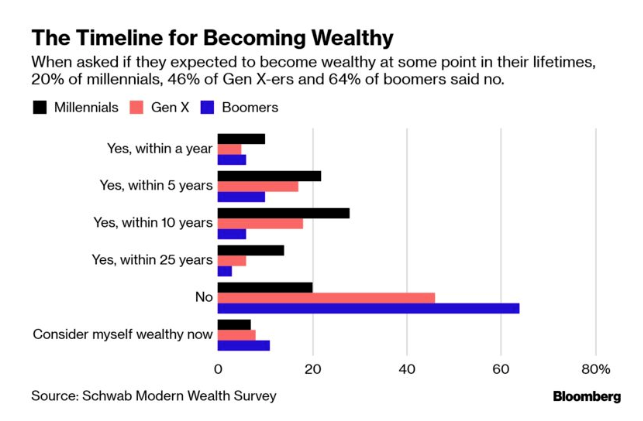
Many millennials, those roughly age 22 to 37, are now at the point in life where the "fickle" topic of wealth, what it is, how much you need, and such has become very important to them. Interestingly more than 75% of this group surveyed indicated their personal definition of wealth was "really about the way they live their lives, rather than a discrete dollar amount." Another sentiment they voiced was their desire to own real estate. Unfortunately, it is difficult to reconcile the fact that 60% of the millennials say they believe they will be wealthy "within 1 to 10 years" considering that 59% of those surveyed said they still live paycheck to paycheck.

Expectations For Becoming Wealthy Are Often Unrealistic
Sadly, the views many people hold as to how they can become wealthy are very unrealistic. The average person's dream they will ever become is often a "vision of grandeur" and nothing more. Today, many people admit to falling under the influence of overspending on things they stumble across on social media. Even with the current economic growth and low unemployment, society must square the fact the largest U.S. banks are now seeing losses on credit cards that outpace those of auto and home loans at a rate not seen in at least ten years while credit card interest rates sit at all time highs.

Circling back to the book, “The Millionaire Next Door.” far from what many of us might think after a great deal of study and research Stanley found the huge majority of millionaires are a real down to earth people. In his book, Stanley looks at where these people live, their favorite leisure activities, and the different factors that make them wealthy. Somewhat obscure and not just off the press this book is an excellent read and a manual for those of us wanting to get ahead. While it is not full of razzle-dazzle get rich quick schemes it is packed with a realistic view of how people build wealth and how they don't.

While the world is full of hype and false images, in his book, Thomas Stanley reminds us how people really become wealthy. He also advises us to remember that you can’t judge a book by its cover and that the fella you see mowing his yard or sitting next to you as you fly in coach may be a multi-millionaire. The book is about making and saving money the old fashion way, not through winning a lottery. Accumulating wealth does not mean a person is greedy but often a reflection of hard work, planning, and being responsible. The picture painted in Stanley's book is a far more realistic look at the rich and wealthy in America than the hyped and unhealthy fixation the media has which is often focused on billionaires.

Thursday, May 16, 2019

Another Reshuffling Of The "Worlds 10 Worst Problems"

AI Is Moving Up The List Of "Dangers" We Face
Another Reshuffling Of The "Worlds 10 Worst Problems" is in order. Generally, we see little movement in the list as counted down from least to most crucial. In fact, little has changed until now from late 2013 when this list was first composed. The list of the "Worlds 10 Worst Problems" was last updated to reflect the growing drumbeats of war flowing out of Washington and the capitals of other nations. This resulted in jumping "Weapons of war and mass destruction" from fourth to first place. This is extremely significant and highlights the fact it can be very difficult to get this particular genie back in the bottle once it is out.

Of course, when composing this list the term "most crucial" is very subjective, meaning that it depends greatly on an individual's interest and priorities. Today's change is the huge leap from ninth to fifth for Creating an environment that allows and encourages people to develop fulfilling lives. This is an issue that has recently been turned upside-down do the rapid expansion of artificial intelligence (AI) and robots being introduced into society. Using the metaphor of a double-edged sword that cuts both ways, this technology has both advantages and disadvantages for mankind. With AI there exists great potential but also the dangerous possibility and risk that technology could create an environment where mankind is rendered redundant.

The angst between President Trump and North Korean leader Kim Jong-un had a great deal to do with moving nuclear war into first place. That situation has cooled but other problems have recently intensified. Between Pakistan and India the disputed border region of Kashmir again becomes an issue. Both countries have nuclear bombs which elevate fears of a major conflict. Also, tensions remain very high in Ukraine where warmongers continue to push Russia and Putin which has no intention of backing down. Last but not least it seems some people are now hellbent on escalating the bad blood with Iran into a full-fledged conflict that once initiated might spin out of control. Mosul and Aleppo are examples of how death and destruction can turn once proud cities into rubble. They stand as monuments to man's inhumanity towards man, however, these were the result of conventional warfare which pales next to the devastation a nuclear attack would wreak.

Future Generations Depend On Us
The problems facing mankind impact the shape of our lives' and our very existence. Most of these are issues that center on our sustainability which means we must begin to address these many problems with long term solutions. History has shown politicians do not deal well with such things leaving society without a great deal of direction. As we look at the human condition we can let fate take us where it may choose or we can take control of our future by proper planning and by guiding it as best we can.

Below is a list of the world's ten most crucial problems. Remember the position a problem holds on this list can shift from time to time as events take place, but expect most of them to remain on the list. Unless a black swan event such as a meteor heads our way this is what you have. Some problems have been grouped with the collateral issues associated with them, this may include the current "buzz words" used to describe their importance. Different people would group these issues in a variety of other ways and move about their priority. As always your comments are welcome.

10.   Demographics of an aging population;   As the population grows older euthanasia and the quality of life will become an issue. This must be handled in a fair, honest, humane, and compassionate way. The alternative is to simply let many older people wither and die hungry while existing in pain and squalor.

9.  Hunger and starvation;    Severe malnutrition can make life unbearable and because of it many people only go through the motions of being alive. People that are starving cannot learn and take a role in society. Starvation and addressing the need for basic sanitation must be addressed.

8.   Income inequality and economic stability;   The uber-rich should not become exempt from all common woes and untouchable. The uber-rich and political elite should not comprise a special class who are immune and able to ignore the rules of society. Nor should the masses be deemed deserving of an equal share of the wealth society creates merely by being born. Fairness in handling the world's economic systems and currencies that allow for a solid way to exchange goods and services is necessary or other world support systems will suffer or fail.

7.   Man's inability to take control of his future by creating responsive and responsible governments;   The masses have been lulled into complacency, in many ways we are all slaves, this is not a new role for man. But we can think and should make an effort to do so, we must push our chosen leaders to do the right thing and make long-term plans that are sustainable. We must shape our future and the values of the society in which we live. Sadly, a sharp rise in Orwellian trends which lead to police states is threatening the concept of freedom in countries across the globe.

6.   The last few years stand as proof of man's cruelty to man. Strife between religions and tribes must end; We need to develop a new tolerance that allows people to live in peace. A safe place to live for a person and their family is one of man's most basic needs. The political elite must not be held harmless for the grief and death they cause over large swathes of mankind. War crimes cannot be tolerated. While this is easy to say deciding exactly who is responsible for these crimes is often easier said than done.

5.   Creating an environment that allows and encourages people to develop fulfilling lives;  This means improving the educational system and having an opportunity to find fulfilling work, seek happiness and express their individuality. It also means ending corruption and extending equal protection and fairness under the law. Today many people see expanding the ability of machines to actually think might help us achieve this goal but there also exists the possibility that a machine might reach the point of self-actualization and become a threat to our existence.

 4.    Wasting Earth's limited natural resources by not conserving and the continued destruction of our environment;   I contend that many of the "green solutions" being proposed such as ethanol fuel are not a solution at all and just ways for business to profit. A solution is not truly green unless the environmental cost of "maintaining" it is very low.

 3.    Pollution and the resulting climate change it may bring;   This is showing up in oceans that are sick and being depleted of life. This also may result in rising oceans and crop failures. Either scenario will mean massive suffering across the world and could tear the social fabric and alter our day to day lives.

 2.    Overpopulation;   This is the overriding problem facing Earth and the most difficult to address. If the problem of overpopulation is not addressed all the other problems on this list will most likely become much greater. Many people still rejoice in the idea that we should be "fruitful and multiply" ignoring or oblivious to the problems it creates in the long-run. The quality of life in many ways is more important than quantity.

 1.    Weapons of war and mass destruction;   This not only includes nuclear bombs and chemical weapons but drones and the killer robots now being developed. One big mistake or going down the wrong path in developing new weapons could change life as we know it!

While people and their families go about life each day having children and doing the things we all associate with our day to day existence most people concede that something is wrong with a world where many people lack even basic sanitation and watch their children die before the age of five. I'm not saying developed countries should give everything away or bring all the people of the world up to an American standard of living. It is not our responsibility to do so and probably impossible.

In my book, Advancing Time I highlight and bring focus to the massive changes that have taken place over the last two hundred and fifty years. History viewed in the framework of man's time on Earth forms the crux of my perspective. The oldest fully developed humans based on DNA research supports the theory that Africa was the area man first inhabited between 200,000 and 140,000 years ago. In 1800 the population of the world was around 900 million, by 1900 it had soared to 1.6 billion since then it has exploded to over 7 billion.

When you chronicle the journey from the beginning of man to our current state it becomes clear that the world has never before experienced such rapid change. This perspective helps us make sense of our fast-changing chaotic world while illuminating and clarifying the responsibilities society faces. It is important we recognize this ever-quickening pace of change and keep in mind that if these problems are not addressed there may be no future for mankind or it may be much shorter and difficult than many people expect.

Monday, May 13, 2019

Tesla, What Is The Company Worth? Nobody Knows!

Tesla Is Encountering Obstacles In Its Path
Tesla's stock price continues to hang on but continuing signs of the company's demise continue to leak out. With over 100 different electric cars expected to hit the market by 2025 it is difficult for a realist to envision Tesla being able to remain viable. The rapid approach of real competition into the rather small Electric vehicle market is occurring at a time of falling auto sales. This could translate into tight profit margins and a situation similar to what we witnessed in 2008 when the automobile industry fell off a cliff resulting in a government bailout of GM and Chrysler.  Simply put, the mismanaged, money-losing, cash-burning company led by Elon Musk may be only months away from a major transition into something far different from the Tesla we see today. Most likely such a transformation will leave behind a slew of broken promises and a great deal of financial carnage.

Ironically up until now, Musk's greatest strength may have been that so many investors doubt his ability to perform. This means that a slew of impatient clowns have shorted Tesla stock in search of quick profits. Like Musk, these bearish investors have continually shot themselves in the foot at every opportunity. They do this by constantly finding reasons to rush to the exits in short covering panics that invariably brings the share price back up. We tend to forget but Tesla's fortunes dramatically changed years ago following the report it made its first quarterly profit, it's market value soared to more than $10 billion largely because people that had short positions in the stock were caught in a short squeeze and forced to buy back their stock. At the time Musk said, “I thought it would be quite difficult to raise the capital for Tesla.” he went on to state his realization the electric-car maker could retire its U.S. loan nine years early didn’t arise until that unexpected surge.

Since that time Tesla's fortunes have moved in lockstep with a surging stock market. I have written several articles about Tesla and Musk over the years. In an overview in early 2017, I wrote about how as I continued my research for the update my eyes literally began to glaze over at the magnitude of the subsidies that Musk had been granted. Government support is a theme of all his companies, and without it, none of them would exist. Also, there was the issue of "corporate incest" and Tesla's acquisition of ailing SolarCity in an all-stock $2.6 billion merger. At the time Musk owned 22% of SolarCity which was founded by his cousins. The merger was promoted on the idea that Tesla's mission since its inception was part of Elon Musk's overall "Secret Tesla Motors Master Plan" to expedite the world's transition to sustainable energy and away from a fossil fuel economy.

As for the value of Tesla, and where the stock price is going, it seems predictions are all over the board. Ark Invest chief Catherine Wood is holding firm on her thesis on Tesla. She believes could run to $4,000 a share or higher. Others of us continue to agree with David Stockman. He wrote in May of 2015, In a world saturated with excess automotive capacity and dominated by some of the most formidable engineering, manufacturing and marketing organizations on the planet—Toyota, BMW and Ford, to name just three–There is no way that an amateurish circus barker like Elon Musk will ever make a profit selling electric vanity cars to the 1%. Stockman went on to state, You might describe Tesla as $30 billion of capitalized hopium, but that would be too generous. In an honest free market, Tesla would have long ago been carted off to the chapter 11 junk shredder. While Stockman's timing may have been off many investors continue to echo his sentiments.

Circling back to the issue driving this article which is the fact that Tesla is about to become overwhelmed by this new wave of  "Tesla crushers" that are only months away from hitting showrooms. A recent Bloomberg article pointed out how the initial response to Volkswagen's new ID.3 electric hatchback designed to bring EVs to the mass market has been so overwhelming that it "overloaded" Volkswagen's IT systems. Over 10,000 people shelled out around $1120 to be placed in line for the Volkswagen electric hatchback, this far exceeded. expectations. For Volkswagen the ID.3 marks the beginning of a rollout of more than 20 battery powered models over the coming years. Their goal is to sell more than 1 million electric cars annually by 2025.

Volkswagen Is Taking Orders On The ID.3
The first deliveries of the ID.3 are planned for mid-2020 with assembly starting later this year. Volkswagen has a target of 100,000 sales per year of the new model. The first "limited-edition" run of the ID.3 is priced at less than €40,000 and have a range of 260 miles. A "basic version" will have a range of 180 miles while a "top-of-the-line" model will be able to travel 330 miles. Volkswagen has made it clear that unlike Tesla, profitability is important and that they plan to and must make money in the EV market. it also moves forward thinking the time is arriving where EVs are about to break through to the mass market which has yet to occur.

Not only has the overall market continued to move higher with each wave of new central bank stimulus but with low interest rates and easy money, Tesla has continued to find investors willing to buy its bonds allowing it to postpone its day of reckoning. Like many people that are predisposed to discount, and have actually grown a massive aversion to "media hype" you should color me skeptical about Tesla's ability to survive the coming onslaught of competition. The city where I live, like many others across the world, have a long list of bold men herald and declared to be "gods gift to industry"  but then flew too close to the sun only to crash and burn. This is what I envision to be the fate of Mr. Musk when all is said and done.


Footnote; Another electric car company that was not as lucky as Tesla and saw its fortunes fall was Fisker Automotive. For those interested in politics please note the connection to Vice President Joe Biden to what might be called the "Fisker folly." The link to that article can be found below.
               http://brucewilds.blogspot.com/2013/04/fisker-automotive-another-government.html

Sunday, May 12, 2019

Viewing Television As A Window On Society

I Was Hoping For Something A Little Bigger!
A few weeks ago I found myself drawn to and watching a show about real estate and home-buyers in search of their "dream house". It was as if I could not look away and similar to how many people slow and linger at the site of a gruesome accident wanting to soak it in. As I pondered my attraction to this massive time waster I realized it was in a way a reflection on the attitudes of society or what we might refer to as the masses.

It should be noted this and other programs create a self-feeding loop that skews our expectations. Are we not just as good or better than these people? The answer to this question is, "better I would say," thus it is logical I would deserve even more of life's bounty, yeah, more and then some! This mindset is infectious. All across America, people are buying into this logic that they deserve it all. This is evident by the number of new cars being purchased every day with sub-prime loans. I must admit it was rewarding and a relief to view an episode where the house was not over the top and the cost reasonable.

The priorities buyers set for themselves and delighted in while searching for a home often highlighted the immaturity of youth dosed with a loose connection to reality. To me, it reeked of a society hellbent on overindulgence and entitlement. As a footnote, I do recognize my way of looking at the world is more than a tad different from the average Joe, and I do not say that with pride. Many of us who walk to a different drummer will admit we often stumble because we are out of step. The clean-swept sterilized visions of litter-free highways and well-manicured lawns often presented in commercials and such are very misleading. This should be considered harmful especially to our youth because they create false expectations of what they should expect in the real world.

Being very involved in real estate and design I found it important as a reminder never to forget what makes perfect sense to one person is pure nonsense to another, and often very expensive nonsense at that. Many times on these shows I heard the phrase, "that has to go, I couldn't live with that." Sadly, these references were about the color of a granite counter-top or the fact the appliances were not stainless steel. It seems to me buying a house for $300,000 then replacing an $8,000 three-year-old counter-top hinges on the edge of insanity.

Another phrase that roused my ire was "oh, this is really dated." sometimes this statement was directed at a house built only ten years ago. This was often followed by "it will have to be totally gutted." All I can say is God bless our throw away society. With many people across the globe living in poverty and squalor sometimes without plumbing, clean water, and even dirt floors this begins to become surreal. I realize this is a television show edited to maximize the viewer emotions, but my experience in real estate confirms what we see on these shows is not abnormal behavior. Seeing some of these self -indulging buyers gorging at the trough of their own self-importance made me pray their day of comeuppance was not far off.

Click To Play Peter At Tiffanys
It is not uncommon to have someone interested in leasing a property make outlandish and economically impossible demands oblivious to the fact you have already decided you do not want to lease to them. Usually, it is because of a deep-seated feeling they are unlikely to be able to financially fulfill any lease or contract they would sign or because it is simply a bad fit. When it comes to a commercial property such as office space an example of this is the person who is busy carrying on about all their cars and traffic to their business in an area where parking is already almost nonexistent. I have found the world is full of people who gain massive self-importance from wasting our time even when they might not have two nickels to rub together. To those readers familiar with the show "Family Guy" I'm reminded of the scene where Peter Griffen goes shopping at Tiffany's.

With the equivalent of only 4.28% of the total world population, Americans operate one-third of its automobiles. This translates into the USA using about a quarter of the world’s fossil fuel resources, burning up nearly 25 % of the coal, 26 % of the oil, and 27 % of the world’s natural gas. taking this to the next level by combining the issue of population and energy consumption we find the population is projected to increase by nearly 130 million people. This is the equivalent of adding another four states the size of California by the year 2050. With roughly forty percent of births reported as being unintended, it is difficult to paint a picture of America as being a country made up largely of self-aware and enlightened folk.

Bottom-line is television sometimes is more of a reflection of society than we might like to admit. In some ways, the shows we find ourselves watching are somewhat responsible for helping to create the values our society holds, rational or not. In life it is important we understand we are not the center of the universe. One thing I learned from my viewing before I put this diversion behind me and shut off the television was that at times it appeared the less deserving a person was the more demanding and arrogant they became. It was as if some strange perverse reverse law of physics had locked hold of their personality, understanding and gaining a little more insight as to what makes these people tick has some merit.

Saturday, May 11, 2019

Fair Trade Is Key To Global Economic Sustainability

America Imports Far More Than It Exports
Trade policies have massive long-term ramifications on the strength of a nation's economy. How these policies develop and take shape are generally the result of many factors coming together and not always well planned.  Americans should expect the politically heated debate over trade agreements to continue. Many articles support and praise the way trade has grown over the years and how it has raised many people out of poverty and misery. This does not mean free trade is the answer to all our economic woes. I contend many people fail to note the distinct difference between free and fair trade.

Critics of existing policy say these trade deals over the years have added to environmental problems across the world and exacerbated economic inequality within many economies as manufacturing jobs have been outsourced to low-wage countries. Some activists also weigh in with claims these deals can curb freedom of speech on the internet and other detractors say it incentivizes currency manipulation. As we view the global economy we should consider that much of the "free trade" movement is driven by mega companies desire for larger markets and greed. The desire of companies to both develop and control future rules has caused them to lobby individual governments into giving up control and becoming subservient to corporate “efficiency.” 

In many ways, the global economy has become an ill-regulated business model tilted to favor big business and giant conglomerates. The controversial TPP created as a new U.S. led Pacific trade pact pointedly excluded China, however, that was not just about trade but a tool designed to cause China to lose influence and key export markets. While signatories championing the benefits TPP claimed it would kick-start sluggish global growth, much of America's political motivation revolved around the idea it provided a strategic bulwark to China’s growing economic and military power. It is important to remember that China is a state-run economy based on a business model that is geared to expand by crushing the competition. A key part of China's plan centers around both state-owned and private firms investing in and acquiring foreign companies for the purpose of stealing their technological innovations. Subsidizing those companies working within its system in a multitude of ways helps China achieve this goal and its practice of exporting goods at slightly below cost in exchange for manufacturing jobs is not stupid but it is predatory and we in America are their prey.

The Trade Deficit With China Is A Big Problem
Still, many people viewed the Trans-Pacific Partnership (TPP) that was pushed by the Obama administration and a slew of corporate allies as a blatant attack on labor, farmers, food safety, public health and even national sovereignty. Details of the TPP agreement had broad implications that were kept largely secret and while being negotiated even members of Congress didn't know much of its details because it is mostly the product of corporate lawyers. Making the agreement even more controversial was the belief held by many Americans that bad trade deals with low-wage countries have contributed to our current economic woes.

When Massachusetts Senator Elizabeth Warren, came out strongly against these agreements Obama said the Massachusetts senator was “absolutely wrong” and accused her of speculating about the contents of the emerging 12-nation trade deal for personal gain. Senator Warren and those concerned that a trade agreement with low wage nations will not be a great job creator for America have history on their side. Circling back to the TPP, Economist Dean Baker said of it, “This really is a deal that’s being negotiated by corporations for corporations, and any benefit it provides to the bulk of the population of this country will be purely incidental.” It is worth noting that in 2008, as a presidential candidate, Obama boasted, “I voted against CAFTA, never supported NAFTA, and will not support NAFTA-style trade agreements in the future.”

Trade can be used as a stealth weapon resulting is massive shifts in wealth and jobs that create massive problems. Partisan politics also plays into this, in the past, it has been Republican politicians that have been most inclined to approve these deals while job protecting Democrats backed by unions railed at them. Often those supporting past trade agreements use low consumer prices as a battle flag around which to rally. This is very short-sighted. An article titled; "Higher Prices On Import Goods A Fair Cost For Jobs" points out that trading away jobs for lower prices today is as stupid over time as burning the furniture to keep the house warm.

NAFTA Greatly Altered Our Trade With Mexico
Historically, trade laws are geared to enrich the “mother” country and was often used to build a nation. Following World War II free trade arguably benefited the economies of the countries involved. This changed starting with 1994’s North American Free Trade Agreement (NAFTA), which recognized that capital is now mobile, it moves about the world and owes allegiance to shareholders rather than loyalty to any one country. At least it can be argued that NAFTA was intended to improve our own neighborhood and that as Mexico and Canada benefited, America would gain some degree of "safer borders" and a mutual interest would be served. NAFTA is the paradigm of what are most accurately called deregulation deals. It promised better jobs in both the United States and Mexico.

American trade policies have caused well-paid workers in the United States to lose their jobs to low-paid workers in Mexico. We have also seen badly paid Mexican workers lose their jobs to those in China who would work for even less. This has resulted in a loss of wages and opportunities for workers in the United States. We should not lose sight of the fact that while free trade is important, fair trade is far more critical and must be the goal. Developing a long-term sustainable economic system that is balanced would contribute to both global cohesion and the world economy. Nationalistic exploitation of trade agreements has occurred throughout history and it is naive to think such schemes will suddenly end. It is evident the changes brought about by the development of the global economy have been hard for many and the promise of widespread prosperity has fallen short.

At some point, the damage from continuous massive trade deficits may become irreversible. The trend of businesses and businessmen to cast away our nation's best interest for a place at the table of the global elite has come at a great cost. Considering this, it is little wonder trade has become such a contentious issue. Another system or legal framework for long drawn out arbitration that dispenses solutions that neither thrill or satisfy is not the fix. The promise that increased trade will create new jobs has turned out to be largely a myth and politicians playing the "fear card" with statements such as "We can’t let countries like China write the rules of the global economy” imply we are powerless to control our own fate and are about to be devoured, I reject this premise.