Sunday, June 23, 2024
Advancing Time: A Few Thoughts About The State Of The Economy
Advancing Time: A Few Thoughts About The State Of The Economy: Below are a few current thoughts and takes about the "State Of The Economy." The world and markets seem to be on autopilot. There ...

A Few Thoughts About The State Of The Economy

Recently I have not been writing as much as in the past. Like many of you, the business of daily life has been consuming all my time. Like a frog in a pot of water that is rising in temperature, the average American is complacent and remains in a state of denial. Inflation is meandering along with a small drop in consumer goods, but that does not mean it is dead. People, whether passively or actively continue to invest in intangible assets. By not buying tangible and real items they help to minimize inflation by diverting money from physical assets like machinery, vehicles, and buildings.
 |
| What And Where We Buy Matters! |
History shows that when consumers feel more financially secure and confident they spend
more freely, the reverse is also true. Get ready for the "reverse wealth
effect" to kick in. If this happens it will be a real ball breaker. The
wealth effect is a behavioral economic theory based on people
spending more as the value of their assets rise. Even decades after its economic bubble popped, Japan stands as a monument to the devastation the reverse wealth effect can unleash.
Some of us, long ago predicted inflation would increase and the economy drop away. The flaw in our thinking was underestimating the size of the stimulus the government would put in the pipeline. This massive infusion of money into the economy has only postponed the collapse of the financial system. Still, many investors are
basing their investments on more intervention from central banks and
governments to pull another rabbit out of their hats. It still remains a possibility that currencies will be debased and inflation may soar at the same time the global economy sinks into a funk.
 |
| Used, This Item Has Little Resale! |
How weird has all this become? We might throw into this mix what could be called the "garage sale factor." You can call this the used items market if you like. This is where a little-used Keurig coffee maker that costs well over $100 is likely to sell for only around $10. In short consumer goods having little or no resale value highlights the fact we already have way too much stuff and could go a long time before needing to buy more. This also supports the idea a loss of the wealth effect will result in a devastating drop in demand for consumer goods. There is a big difference between need and want.
One of the biggest X factors investors and the masses face is corruption
in government and the fact that we have no real say or input into how
things will be resolved in the case of a crisis. Systematic corruption
means things will unfold to do the least damage to those in charge.
Another big issue is world affairs, with conflicts sprouting up in so
many areas, we have little reason to get overly comfortable. The fact
government debt has exploded and the soaring use of the T word,
"trillions" alone is problematic. It is best to remember that when a currency is debased the biggest losers are the masses.
(Republishing of this article welcomed with reference to Bruce Wilds/AdvancingTime Blog)
Monday, May 27, 2024
Advancing Time: The Economy Has Not Been Fixed, Big Problems Ahead
Advancing Time: The Economy Has Not Been Fixed, Big Problems Ahead: In recent years, the government's expenditures have soared and the national deficit has exploded. This has caused the national debt to e...
The Economy Has Not Been Fixed, Big Problems Ahead

In short, nothing has been fixed or repaired, we have not created a sustainable economy. Printing and creating new money is not fixing the problem, instead, it has created an economy addicted to printing and creating even more new money. We here in America need to focus on the American economy, if that is strong it will help galvanize the country's future.
An example of our failure is seen in how China got a big boost with the passing of Biden's 1.9 trillion dollar relief package and the American taxpayer is the big loser. Buying junk from China will do little good when it comes to creating jobs in America. When looking at the policies flowing out of Washington it is clear many politicians seem to have no idea that all consumer spending and purchases are not created equal.

Purchases and investments should bounce around a community sparking future
economic growth that enriches everyone. Amazon's growth is a sad example that others give money wings allowing it to exit not only the community but often the
country.
Damn near every economist and analyst seem oblivious to the point that what and where consumers buy matters a great deal. An article that delves into spending and its impact on the economy claims, "Where
money flows and who it enriches is a key component of economics. The
failure to consider this is a blind spot many people have." Much of what
has been registered as growth over the last few decades does not necessarily transfer into economic
strength.
This point is something that has been covered time and time
again on this blog in articles such
as, Healthcare Spending Wrongly Feeds Our GDP, and Economic Growth Does Not Equal Economic Strength. Many of our economic problems stem from consumers making poor decisions. The least responsible
consumers tend not to fulfill
obligations but to take on new debt and squander every penny they
can lay their hands on. Online shopping and companies such as Amazon are
like heroin to an addict when it comes to promoting spending that
destroys real economic strength.
Another huge issue is that inflation is not just prevalent in manufactured consumer goods but inflation also occurs in the area of fees, tolls, and taxes. People tend to forget just how much of government spending is done on the local and state levels where simply printing more money is not an option for eliminating revenue shortfalls. This translates into a slew of revenue-driven schemes that come back around to become a huge driver of inflation.
When we look at where inflation has occurred during the last decade or so we find it centered in areas where the government has expanded its influence. Two that rapidly come to mind are in the areas of healthcare and education. The skyrocketing cost of even basic health tests and medicine, as well as tuition at universities, screams inflation. This dovetails with claims by politicians that leveraging local dollars to match federal and state resources is not always a win for the residents.
Many people fail to grasp just how much government has expanded over the years. Much of this growth has been masked by "outsourcing" a great deal of the work done by government workers. Another place this sneaks under the radar is in the huge growth of "quasi-government " entities such as airport authorities and downtown improvement districts which are able to levy special taxes. Utility companies, often monopolies carrying out government mandates under government supervision, also can be placed in this category.
The theory that a lot of future inflation will flow from governments is tied to local governments' need for revenue. Local and state governments have hidden and masked the size of its growth and financial promises from the public. Since state and local governments lack the federal government's ability to print money and buy back its debt they must pay higher interest based on their credit rating.
It is a fact that businesses and landlords eventually must pass on to consumers the added cost forced on to them often through higher prices. Another way to do this is by transferring responsibilities, limiting warranties, or reducing goods and services that had been previously provided. A city forced to cut costs or increase revenues often chooses to plow snow only when three or more inches fall, reduce the number of times it picks up leaves, or increase fines for such things as parking violations or ticketing drivers for violations caught on camera.
An unnoticed but very important part of the inflation puzzle is that so many people are willing to invest in intangible assets. The Fed should be ecstatic about this, in not increasing demand for tangible and real items they help to minimize inflation. Intangible assets are often "useful resources" that lack physical substance. Examples are patents, copyrights, trademarks, and goodwill. Such assets produce economic benefits but you can’t touch them and their value can be very difficult to determine.
Another example of quasi-intangibles are stocks, when you buy a share of stock what do you really have? For a long time, I have taken the view that many "financial assets" have slipped into the intangible class. Assets such as stocks, pensions, and annuities all harbor many of these qualities. These are things we can not touch and often live in the land of future promises. Over the years the growth in such assets has exploded. Intangible assets stand in sharp contrast to physical assets like machinery, vehicles, and buildings.
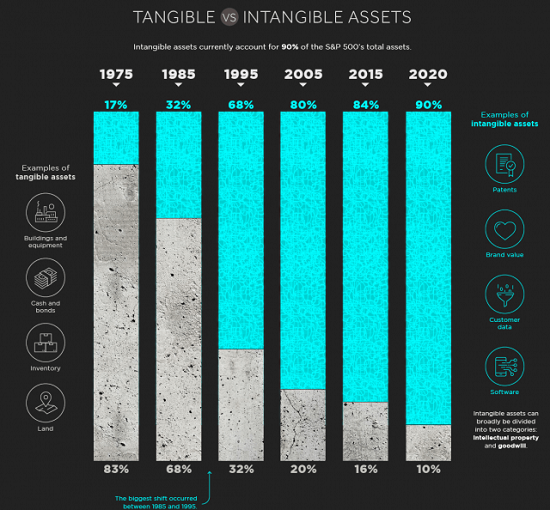 |
| This Chart Could Be Considered Very "Troubling"! |
The growing danger resulting in policies encouraging
people to invest in intangibles does lessen inflation. When money is
created or printed it has to go somewhere, and this has been fueling the
"everything bubble." Yes, the wealth effect creates more spending but it is not the key driver of inflation. The
main reason all the newly created money has not resulted in even more inflation is rooted in the fact it is being diverted from goods most people need to live and into intangible assets. The theory that investments in intangible assets minimize inflation may
be a chief reason government savings and wealth-building programs are
centered on driving money into such assets.
Many people and even economists have real misconceptions as to how the economy works. Where money flows and who it enriches is a key component of economics. The failure to consider this is a blind spot many people have. Fans of Keynesian economics that encourage government spending to stabilize the economy tend to discount the importance that savings plays in a balanced economy, or that small local businesses are the heart and soul of the economy. Where and how money is spent matters a great deal. In the end, we will all be forced to pay the price of this "cost-shifting" by suffering a lower standard of living.
(Republishing of this article welcomed with reference to Bruce Wilds/AdvancingTime Blog)
Wednesday, May 15, 2024
Advancing Time: The Powerful "Think Tanks" We Seldom Think About
Advancing Time: The Powerful "Think Tanks" We Seldom Think About: Most of us have given little thought to Think Tanks. This includes their purpose, how they are funded, why they exist, and those pulling the...
The Powerful "Think Tanks" We Seldom Think About
Sometimes are lack of pure attention or simply misreading a headline or title results in taking us down a road we might have not taken. Recently, I misread the title; "WTF Do You Think Tanks Actually Do?" Thinking it was referring to the use of tanks and their role in warfare I decided to take a closer look. I expected to find something about tanks being used as line breakers, like shock troops or heavy cavalry in ancient/medieval times. Instead, I found information about Think Tanks and their role in creating public policy.
It was reported near the end of 2021 that the United States now has 2,203 think tanks, a more than two-fold increase since 1980. These institutions generate new ideas for policy-making, assess existing policies, and draw attention to neglected issues. Much of the work Think Tanks do is done behind the scenes, off the record, or in briefings that are not touted publicly. Part of the reason many avoid the light of day is they operate to simply justify every and anything for money.Think tanks take donations and then generate the reports and studies that inform and influence the government and those making our laws. Their expensive studies could be described as "vetting the truth in the name of profit." This is a slippery slope. The reports, data, and information they generate often dominate the laws Washington imposes upon us. This should be apparent from the fact they often write a great deal of the legislation.
In some ways, Think Tanks are, the government lobbying the government. Many of those people taking jobs in Think Tanks are paid very well and are former government employees or politicians. It could be argued that Think Tanks are, the government lobbying the government. With reassuring names such as the. "Institute For The Study Of" or The "American Foreign Policy Council" these groups formulate road maps going forward.
Their input shapes the future of society and our culture carrying with them huge ramifications. Think Tanks are often used as weapons in the battle for our hearts and minds. About eight and a half minutes into the video that took me down this road, the producers of the piece give an excellent example of just how much this matters. Big Pharma, agriculture, the fast food industry, and weapon manufacturers, all huge sectors of the economy, use Think Tanks to skew information that promotes their goals.
 |
| Sounds Like, "Power And Money" |
The material these groups generate flows directly into the media, in fact, it is often their job to pump it out in a way that promotes an agenda whether right or wrong. The material is often presented to intentionally skew or create conflict that can halt positive change. Much of this is rooted in securing or maintaining the financial position of those funding the studies.
The comments below were under the video I watched. While slightly altered they represent the thoughts of other viewers;
- Think tanks are like corporate consultants: they may have started as an independent insight, but have since gotten co-opted into inventing justifications for their sponsor’s predetermined decisions and act as a hired scapegoat if those decisions don’t pan out.
- Finding out that big pharma and big food are fighting is the kind of good news I didn’t know I needed today. This is a "Proxy war" of sorts and we are the pawns.
- Think tanks get money from the military-industrial complex. This is why somehow defenseless countries with weaker weapons are threats.
- The fact scientists could look at the same data about lead in the environment over time, and some arguing lead in gasoline was fine with others arguing it was a catastrophe waiting to happen. All this makes a person think that 'trust the science' and just listening to one lab, school, think tank, or organization means you're ultimately listening to the opinion of someone who has money linked to things going their way.
- Think tanks take a medium amount of money from big business and talk to
the Government.
Then, they convince government authorities to contract with big
businesses for massive contracts. Also, a medium amount of money flows
to government authorities in this step.
This all results in big businesses making disgusting amounts of money
producing expensive parts, maintaining heavy equipment, or providing a
"service" for the government that the people never asked for.
In the end, we, the people pay absurd amounts of money to the
government.
Considering how much Think Tanks influence government policy, they
deserve much more thought. Things like, where they get their money or
funding matters. Who they employ, and who employs them is also
important. Think Tanks are tied to the hip with lobbyists, big companies,
power, and more. Whether working for a foreign government, big pharma,
or the military-industrial complex, the bottom line is Think Tanks are not
working for you and me. A final thought, life is odd and the people determining our fate are scary.
Wednesday, May 8, 2024
Advancing Time: Difference Between Fair Trade And Free Trade Hits ...
Advancing Time: Difference Between Fair Trade And Free Trade Hits ...: It is finally being acknowledged by main stream thinkers there is a difference between fair trade and free trade. Those who have taken for ...
Subscribe to:
Posts (Atom)