Revisiting an issue on occasion is necessary to recognize trends. At the beginning of 2015, I wrote an article concerning the millions of Americans
who have made gaming the system a national pastime. A program riddled
with such players is Supplemental Security Income also known as SSI.
Often misunderstood and sometimes confused with Social
Security Disability insurance many people are not even aware this
program exists as a separate entity. Looking back on this subject I had
hoped to find some updated cost figures to see how much the program had
grown over recent years. What I found instead was several slick
government sponsored websites promoting the program and promising those
who sign up aid.
Once
on these programs it is often hard to get someone off of them, on the
contrary getting on one program often helps a person qualify for
another, then another. The fact is that today our government has layered
layer upon layer of programs on top of each other in an effort to help the poor and needy. To quote part of a detailed
article written in 2013 by a group supported by the Cato Institute, "Policymakers have liberalized eligibility standards for SSI's benefits
over the years, with the result that many people who are capable of
working are making the choice to remain idle and receive benefits
instead." Still, while many people support such programs praising how they help the poor and
downtrodden they usually will tell you the programs fail to go far
enough.
The SSI is a Federal government program originally created to provide
"stipends" and help low-income people who are either age 65 or older,
blind, or disabled. The program is administered by the Social Security
Administration and funded by funds from the treasury and not social
security taxes.
SSI is a massive program that tends to lay just below
the surface out of sight of many hard working Americans busy trying to
earn a living. It has become the go-to "sweet spot" for aid. Unlike food
stamps, SSI is structured like the earned-income tax credit and
unemployment
insurance in that it delivers benefits in the form most poor people find
most
useful, cash.
 |
| Growing Number Of Children Get SSI Benefits |
Of particular concern to many policy wonks is the
growing number of children who
are qualifying for SSI on the basis of a mental or behavioral
disability. Many children who are capable of becoming productive
working adults are being lured into long-term government dependency. I
personally have heard of how parents push teachers into placing their
child into this category knowing it will qualify the child for special
financial benefits the parent will control in their role as guardian.
Another issue is how even attorneys have reached their grubby paws into
siphoning money from this system.
This is part of what an ad from a local attorney has to say; "Social Security Disability and Supplemental Security Income
applications and the review process are time-consuming and detail
driven. The value of an attorney can make a
difference in the outcome of your case. You need not be elderly to apply for Social Security
Disability or Supplemental Security Income. We
will work with you to make sure the proper documentation is submitted
to support your application. We will attend your administrative hearing
and present the evidence contained in the record to help you qualify for
benefits. Under
current Social Security Administration rules and regulations, our fees
are paid upon obtaining benefits for our clients, so you pay for our
services if we are successful in obtaining a favorable decision for
you." This appears to give attorneys a strong incentive to "overreach" and push hard for benefits justified or not.
 |
| SSI A Program Gone Wrong! |
What is Supplemental Security Income?
Supplemental Security Income (SSI) is a Federal income program funded by general tax revenue;
It is designed to help aged, blind, and disabled people, who have little or no income; and
It provides cash to meet basic needs for food, clothing, and shelter.
To
see if you are eligible for SSI benefits you merely have to link onto
a government screening tool and take 5 to 10 minutes to answer a few
questions. This also will tell you if you are eligible for other
benefits. For a little background on this program, SSI was created in
1974 to replace federal-state adult assistance
programs that served the same purpose. The restructuring of these
programs was intended to standardize the eligibility requirements and
level of benefits. The new federal program was incorporated into Title
XVI (Title 16) of the Social Security act. Today the program has grown
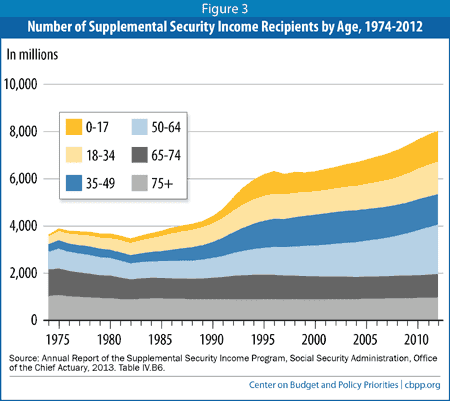
to provide benefits to well over eight million Americans. I found it difficult to get current numbers because any website about SSI is so riddled with ads touting the program and how easy it is to apply for benefits.
One requirement for SSI is that the individual's resources are
below a certain limit. This amount is $2,000 for a single individual and
$3,000 for an individual and their spouse (whether the spouse is
eligible for SSI or not), $4,000 for a child applicant with one parent
living in the household, and $5,000 for a child applicant with two
parents living in the household.
However, conditional benefits may be paid if a substantial portion of
the resources are considered non-liquid, resources that cannot be sold
within 20 working days if they agree to sell the resources at their current market value
within a specified period and repay the money after the non-liquid
property is sold.
However, it should be noted that not all actual
resources are counted in calculating an individual's or couple's
resources for SSI purposes. The numbers below show the rising cost
of this program.
- 1990 - 4,817,127 - $16,132,959,000
- 1992 - 5,566,189 - $21,682,410,000
- 1994 - 6,295,786 - $25,291,087,000
- 1996 - 6,613,718 - $28,252,474,000
- 1998 - 6,566,069 - $29,408,208,000
 |
| Chart SSI Spending 2000-2013 Cost Is Soaring! |
As the number of beneficiaries has increased so has spending on this
program. Supplemental Security Income spending has risen from $33
billion in 2000 to an estimated $57 billion in 2013. This is a 70
percent increase. In real (after-inflation) dollars, the increase since
2000 has been 29 percent.
This could be interpreted to mean that when you get older you will
not be forced to live "within your means" existing solely on your meager social
security if you have saved nothing. If you are younger the same fact and possibility of "more" income may apply. The SSI program, or Title XVI of the Social Security Act 1611, provides
monthly federal cash assistance of up to $698 for an individual and
$1,011 for a couple (as of 2011) to help meet the costs of basic needs
of food, shelter, and clothing. In most states, SSI eligibility usually
assures concurrent access to important medical coverage under the
various state Medicaid programs and sometimes access to section 8 housing benefits.
In some states, supplemental payments are made by the
state, increasing the cash assistance available through SSI. For
example, the state of California, through its State Supplementation
Program (SSP), increases the cash assistance by $171 per month for a
disabled or aged individual with access to cooking facilities in 2011,
making the total SSI benefit $845 per month. So while supporters hail SNAP as a key income support for the working poor,
seniors and the disabled, as well as an “automatic stabilizer” it must be noted the government already has
programs, and bureaucracies, for each of those groups and policy goals.
This means as an example, a third of the seniors living on food stamps also get
Supplemental Security Income (SSI).
A big question is whether once on SSI a person will ever start looking
for work again in time. Look at U-6
unemployment over recent years and it suggests many of the
people on the edge of the labor force have hit the exit.
One explanation for that may be government benefits directly affect
incentives to look for work. This means more generous unemployment
benefits tend to elevate
participation rates since workers must be looking for work to qualify.
With disability insurance (DI), however, the opposite applies: to
qualify applicants must generally demonstrate that they cannot work. In
theory, disability and unemployment should not be correlated and for
many years they were not. Due to changes in 1984 DI eligibility criteria
were eased so that applicants could
qualify based on a combination of conditions rather than just one.
Since then, highly subjective conditions such as back pain and mental
illnesses have grown to account for most DI beneficiaries, and claims
have become more correlated with unemployment. This strongly suggests
that many workers find a way to qualify for DI
when other benefits have been exhausted. Although DI recipients may
initially have climbed because
the economy was weak, their numbers will almost certainly not decline
as it strengthens. Past figures show only 4% of beneficiaries return to
work
within ten years. The proportion of working-age adults on DI has risen
from 1.3% in 1970 to 4.6% in 2013 and while the participation rates
appear cyclical at first it is beginning to look more structural. Europe
may hold some important lessons as to what we face going forward.
In
the 1970s DI became
more generous in the Netherlands, and caseloads exploded. Had the
increase in disability numbers shown up in unemployment instead, the
Dutch unemployment rate, which was 6% in 1980, would have surged to
13.4% says a 1992 report. The
crushing expense of DI eventually forced the Dutch government to make
reforms years ago that made employers bear more of
the expense of employees who end up on the system. Since then, caseloads
have dropped. In America, the DI trust fund was expected to run dry
in 2016 based on current trends. This would lead a person to see the
long term implications of people not working but turning to more
government aid will become a heavy burden for society.
Footnote; Other
related articles may be found in my blog archive, thanks for reading and
comments are encouraged. Below are a few of those on a similar subject.
http://brucewilds.blogspot.com/2013/06/living-on-dole.html
http://brucewilds.blogspot.com/2013/10/food-stamps-and-snap-to-get-squeezed.html