Monday, March 13, 2023

The Navy's Future, Are These Ships Sitting Ducks?


Having a navy is very expensive but carries with it a bit of prestige. It projects power and can also intimidate rivals. The Navy's future in a shrinking world is a subject of much debate. Warfare is changing and undergoing a major transformation. this may make ships sitting ducks. All trends are pointing to this happening and many of us have been predicting this for years. An issue that merits some thought is whether this could happen rapidly making even our newest ships obsolete or even worse turn them into death traps.

Throughout history when fleets collide the outcome of a naval battle has often proven decisive in which country eventually wins a military conflict. Today ships face a new challenge. Both Russia and China are now in possession of hypersonic weapons. China has not been shy in letting us know these weapons are intended to repel American ships if the need arrives. Several of its highly maneuverable anti-ship weapons hypersonic missiles are reported to be capable of reaching delivery speeds of Mach 10.


Still, countries are continuing to invest in their navies. America’s newest aircraft carrier, the USS Gerald R. Ford, was deployed for the first time in October of 2022. The $13.3 billion Ford is the largest and most expensive warship ever built. Its sprawling five-acre flight deck stands more than nine stories above the waterline. The Ford weighs 97,000 tons and its airpower exceeds that of at least 60 nations. 

The role of maned ships in future combat is a matter of great debate. It does not take a rocket scientist to realize this, however, we are not yet at the point where the negatives of warships outweigh their positives. Most of this debate centers around three issues, vulnerability, cost, and, simply put what is seen as the possibility of a huge loss of life at one time. 

The fact that in a war millions of people could die in one incident lasting a few seconds does not lessen the pain that would be felt by the families of those lost when a ship is sunk. The issues mentioned have turned our interest to protecting these ships but that may be a battle that cannot be won. Intercepting even slow-moving missiles in flight is a complicated task. 

Knowing that missing even one incoming weapon can spell disaster is a frightening proposition. The DF-ZF’s speed and unpredictable path makes it almost impossible to stop this threat with existing defenses. The fear is that while the Ford and ships like it have a battery of antimissile defenses, none are adequate to protect it in a prolonged battle against China’s latest weapons. One of the few defenses against attacks from swarming drones and hypersonic missiles may be high-powered lasers.

Unfortunately, China’s hyper-sonic weapons aren’t the only challenge. There is also the threat posed by batteries of anti-ship cruise missiles. Like any weapon, when fired in high numbers, these can overwhelm a ship’s defenses. As the face of war changes, we should realize, large numbers of relatively cheap weapons such as suicide drones also make carrier groups vulnerable.

Battleships Are No Longer King Of The Sea
Like the aircraft carriers today, decades ago, battleships were considered the largest and most powerful vessels on the high seas. That changed long ago when within a few minutes of each other two of these mighty ships became the first major warships in history to be sunk by aircraft. Replace the attacks from airplanes with drones and high-speed missiles, and the predicament the Navy faces today becomes clear.

Aircraft carriers sail with strike groups made up of an armada of 10 or more cruisers, destroyers, frigates, and sometimes submarines. Some of those vessels specialize in air defense using powerful onboard radars to detect targets more than 200 miles away. These ships armed with surface-to-air missiles and the Navy’s Phalanx CIWS (Close-In Weapon System) use radar-controlled 20mm 6-barrel Gatling cannons capable of firing 4,500 rounds per minute. 

A huge problem is what the Pentagon calls a “depth of magazine” problem. This occurs when a ship runs out of interceptors to fire, which must be stored and then restocked after the battle. Some munitions can be replenished at sea while others, such as missiles, often mean returning to port. Running out of ammo makes a ship defenseless and this is a problem enemies can exploit with swarming attacks.

This is why many experts say the best defense against swarming drones, is one based on lasers. If powered by nuclear reactors, lasers can potentially fire thousands or even tens of thousands of times at incoming munitions. Since laser beams travel at the speed of light they can track and target unpredictable weapons like China’s hypersonic DF-ZF better than missiles. Another strong reason to turn to lasers is firing a high-powered laser will cost somewhere between $1 and $10. This is far less expensive than the $1 million to $10 million that defensive missiles cost.

The Navy installed a laser on a ship for sea trials in 2014 and in 2022 it installed its first permanent laser on a destroyer. The weapon developed by Lockheed Martin has a 60-kilowatt power output that integrates with the ship’s advanced AEGIS radar and weapons control system. The Navy calls it HELIOS, or High-Energy Laser with Integrated Optical Dazzler and Surveillance system. Lockheed Martin says the weapon could eventually scale to 150 kilowatts, at that strength, it will be useful against drones and small surface ships.

The real challenge will be stopping a barrage of cruise missiles or a hypersonic weapon barreling toward a ship, the Navy estimates that it needs at least a 300-kilowatt laser. Not only do they face the issue of size and speed, but their nose cones are also made out of such materials as pyrolytic graphite or Pyroceram ceramics. This means lasers will not only be able to target them as they travel at over a mile a second but be able to rapidly burn through those heat-resistant substances as the laser adjusts for atmospheric turbulence.

Currently, China claims sovereignty over nearly all of the South China Sea, extending thousands of miles from its own shores. International law recognizes territorial claims only 12 nautical miles offshore. China's claims have forced America’ and its allies in the region to rely on our naval presence to maintain free shipping lanes. This has placed America's Pacific Fleet within range of China’s anti-ship missiles and drones.

At this point, China is our biggest worry but soon other countries will be added to the list. As some of these weapon systems find their way to smaller countries or into the hands of terrorist organizations the risk of a ship being taken out will increase. At this point, it appears the future of military conflict is all about drones, lasers, and super-fast missiles that are becoming more accurate every day. 


(Republishing of this article welcomed with reference to Bruce Wilds/AdvancingTime Blog)

Monday, March 6, 2023

China's Pension System Screams Corruption And Failure

It is important to understand how China's pension system works because it reflects just how flawed the Chinese system is. The fact is China's population is rapidly getting older partly as a result of the one-child policy the country had for many years. This is a time bomb that will leave many older Chinese living with nothing. Having faith in a corrupt system generally yields little.

Most of the older people in China had better prepare themselves to work until they die. In this video, https://www.youtube.com/watch?v=_I5THbP6qqc China Insights, puts a spotlight on how China's pension system is in big trouble. The numbers, even those from China's government, do not bode well or bolster the argument that life in China will be kind or soon get better for the average Chinese citizen. 

As an example, in one Provence the pension of some government and institutional sectors, which of course includes members of the CCP is around 25 times that paid to the average urban resident. Adding to the problem is that little money has been set aside to fund these pensions in the future, which means they are being paid "out of pocket" by a government that already has a slew of budget problems. 

The Graph Above Shows China Has An Aging Population

Chinese pension funds had a deficit of over 600 billion yuan ($93 billion) last year, due to tax cuts to help struggling firms amid COVID-19, according to the financial magazine Caixin. Recently the former President of China's central bank acknowledged the existing pension base is not good because of the large and aging population. The shortage of available pension funds means older people will need to rely more on "personal pensions" to supplement their income in the future. By bringing this up and letting the public know, he may have been testing the waters for a change in policy. 

The unfairness of China's pension system combined with funding issues is a bit ironic. Pension payments as low as one hundred yuan or about $14.60 do not go far. It is a slap in the face to all those loyal citizens raised believing in communism with the belief all the people of China would share equally in the wealth they helped to create. With this in mind, we have to think, the poor people living in rural areas should be prepacked to fend for themselves.

This dovetails with the failure of the Chinese Communist Party ( CCP ) to protect its citizens from bank fraud. In China, even when deposited in a bank, a saver's money can vanish in the blink of an eye with nobody taking responsibility. Considering how many Chinese investors have lost money during the housing collapse, the overall message is that the CCP does a poor job of protecting the money of its citizens. In short, when all is said and done, like most governments, China gets a big fail when it comes to taking care of its elderly.


(Republishing of this article welcomed with reference to Bruce Wilds/AdvancingTime Blog)


Friday, March 3, 2023

The Face Of Housing Ownership Is Changing

Mortgage rates have doubled over the past year and this has hit housing affordability hard. How much housing prices will retrench is still up in the air. Consider the whole premise housing prices in America are about to fall like a stone may be overdone. Hard economic times could very well take a greater toll on the price of intangible assets and paper promises than on things like housing.  

Whether a person is better off renting or buying is often directly linked to rental rates that are related to cost. Feeding into what a landlord charges are things such as taxes, insurance, maintenance, utilities, and a slew of fees. If landlords cannot make money, they exit the business and the number of housing rental units is reduced. This puts a bottom under the market and/or drives rents higher. Yes, a lot of new rental units are coming online but how easy will it be to rapidly fill them with good tenants? Simply filling a unit at a huge discount or with tenants that want a new unit but fail to pay or tear the hell out of it does not work. 

What many renters fail to consider is that landlords have far more to risk than tenants. It is the kiss of death to lower your standards just to fill units up. Doing so simply destroys a property's reputation while creating a slew of evictions, costly turnover, and an explosion in maintenance costs. Adding to this ugly path forward is the fact our costly legal system has lost its teeth when it comes to collecting on small claim judgments.

Much of the problems we see in housing stem from a lack of starter homes and new small houses at a reasonable cost. Several reasons exist for this situation. First and foremost is that builders and realtors like bigger more exotic homes because that is where the money is. Another factor is zoning, this includes tightening rules and restrictions in plotted additions. These are often intended to keep standards and values high. People are seldom excited to see less expensive homes being built in their area. 

Millennials Have Been Locked Out Of Buying Because Of Affordability 

The cost of shelter has skyrocketed and the face of housing ownership is changing. Over the last several decades starter homes have become a thing of the past. This has created a shortage of low-cost housing that will put a floor under housing prices. The areas where housing will drop the most are areas where prices have increased the most with the bigger most expensive houses taking the brunt of the hit. This is partly because they cost more to maintain and are more heavily taxed.

Low-Interest Rates Have Pushed Prices Higher
The decision of the Fed to buy mortgage-backed securities years ago added to soaring prices and the mess we face today. Buyers are out there, many are speculators and inflation believers, these buyers are circling each new listing like hungry sharks. They are driven by the idea interest rates will soon fall and they will be able to refinance. If rates drop prices are likely to soar again. This could put a strong floor under most of the housing market. 

One problem causing an issue for those looking at the low end of this market is that lenders have little interest in making small dollar loans because they are less profitable. This means these properties are often picked up by cash buyers. Many of these now go to big players that at times may buy without looking at the property but simply have it inspected by a company that sends them a report. Others are sold on contracts that often give the buyer little protection. 

As stated many times in previous articles here at AdvancingTime, it could be argued the government holds huge responsible for many of America's housing problems. Our government makes the rules by which builders and landlords must play. This includes some of the factors I have moaned about in the past, a big one is that roughly 80% of new apartment construction has been for the high-end luxury market. 

The government has its finger prints all over the housing sector and also causes problems for renters. This is because its policies avoid dealing with the growing number of tenants that are irresponsible. In short, Government housing cherry-picks the best of the low-income renters providing them with very low rents and nice apartments while dumping the worst of these renters on the private sector. (http://brucewilds.blogspot.com/2018/02/housing-policy-feeds-and-hides-growing.html)This makes housing more expensive for the rest of the population.

The number of units being built during inflationary times with higher interest rates also plays into this market. Who buys homes greatly depends on who can afford them and how these buyers envision the future unfolding. In short, if buyers think prices will continue to rise this is very supportive of higher prices.  

And then, there is the decision of the Fed to buy mortgage-backed securities years ago, this has added to soaring prices and the mess we face today. Following 2008, big money from Wall Street got behind a move to have Fanny Mae and other big lenders bundle foreclosed properties. Selling them in packages eliminated and locked out small concerns and individuals from participating in buying. In recent years, a small but mighty group of corporations have purchased hundreds of thousands of homes. 

These Wall Street funded corporations are just one of the forces shutting people out of the home-buying market and locking them into being perpetual renters. When it comes to financing, short of some government giveaways to certain segments of the population, Wall Street has a huge advantage over individuals. This is why even though managing the renting of individual houses is challenging, Wall Street may not retreat from the task. It is important to remember this is about the real rate of inflation.

Not only have institutional buyers with deep pockets hijacked some markets by buying whole neighborhoods but the market is changing in other ways. The U.S. housing market has become a speculative investment and now homebuyers are competing with I-Buyers that have lots of low-cost capital. An I Buyer is an "Instant Buyer" in the real estate industry who uses data-driven online home value assessment tools to determine what your house is worth and then makes you an offer.

Returning to the subject of inflation and the benefits of buying tangible assets as a way to protect ones buying power, as it becomes more obvious inflation is only going to get worse, those that can afford to buy houses will continue to do so even at higher prices. The point is, we should not be surprised if housing prices prove far more resilient in a slowing economy than many experts think. In an inflationary environment, these houses fall into the category of a tangible asset capable of earning a positive return. Few investments meet this criteria and those that do will be in strong demand. 

Note, housing prices are much higher in many parts of the world. One thing for certain, it will be interesting to see what happens next. Before you just assume housing prices are going far lower consider who will be buying those units that come available. All of what you have read above feeds into why those homeowners that have a low-interest rate mortgage may not be in a hurry to sell their home if they are not in distress. Expect how people handle their investments in the future to play a huge factor in future housing values.


(Republishing of this article welcomed with reference to Bruce Wilds/AdvancingTime Blog)

Sunday, February 26, 2023

The Vulnerabilities Of A High-Tech Society

In the title of this piece, I use the term, "high tech" however this is about the vulnerabilities of any advanced civilization. Such societies tend to be specialized with their members dependent on services and jobs being carried out by others in the community to provide the basic necessities they need. If people were suddenly faced with losing the things they need to survive it is easy to envision a situation where survival of the fittest became the mantra of the day and things would rapidly become quite dicey. 

High-tech societies are particularly vulnerable to collapse due to their population being dependent on both the system and others to provide the basic items they need to survive in everyday life. Electricity, food, water, sewer systems, phone and computer connections, transportation, and healthcare fall into this category. Just about everything else we have come to expect and experience as we go through our day depends on technology. 

Life has become more complex as we transferred the task we did in the past to machines, and this could come back to haunt us. Our growing dependence on computers and devices such as smartphones and computers has dumbed down society. This has compromised the skills we need to endure and survive. We have reached the point where many people can not do simple math or read a map.

A video by City Prepping reveals just how difficult it would be to survive following a massive disaster where no help or aid comes forth. Imagine being forced to exist for months on your own. The video points out many people will die if such a situation would arise. Would you know what to do? Even if you do, many of the things that would help you and your family survive are easier said and done. 

The video gives ideas and details on how to survive the first 90 days following a major widespread society-altering catastrophe. It also makes clear and helps drive home the reality that even after that time things would probably not improve rapidly, but that is an entirely different subject. This idea dovetails with previous AdvancingTime articles warning that the government, or governments in general, are incapable of taking care of its population during a major widespread disaster.

Most People Are Ill-Prepared To Face A Major Disaster

It does not help that most people are ill-prepared to face the obstacles and miseries such conditions would heap upon them. Then there is also mother nature which is very capable of pounding them with additional challenges. While this blog is not a "preppers destination" and generally focuses on cultural and economic issues, it also notes the idea of a total collapse of our society and support system must be considered. This includes the notion of an electromagnetic pulse knocking out and destroying all electronic devices.

Flowing into this is that military analysts have long warned about the threat of electromagnetic pulses, such a blast of radio waves could burn out most electronic devices. The most extreme version is a nuclear EMP from a high-altitude explosion. It is suggested a ‘ Pearl Harbor’ surprise attack might disable power systems across the continental U.S. and render most electronic equipment unusable. In such a situation, we are talking about a disaster complete with planes falling from the sky and automobiles hopefully coasting to a stop.

Rebooting Our Systems Would Be Difficult
Ironically, I have to wonder why those going to great lengths and costs to protect certain devices do not think follow-up EMPs would not affect those protected devices as soon as they were removed from their protective bags and put into use. This all feeds into the reality that we would all be screwed. Follow this thought with the Herculean task of ever rebooting our systems.

Even if you don't take the threat seriously of such a life-altering event occurring, watching the video I refer to at, https://www.youtube.com/watch?v=OEBVVVTNFAY  merits a few minutes of your attention. Simply being aware of some of the issues you might someday be forced to face could save your life. Basic survival skills are important and being prepared is linked to thinking about what is often considered the unthinkable. 

The video also addresses the issue of making the important decision as to whether to flee the area or try to move to what you think will be a safer location following a disaster. This is often referred to as "bugging out." It points out that if you choose to move, relocating should be done sooner than later. After the first few days as people become desperate, unrest and violence will most likely surge making travel unsafe. Still, the matters of where to go, what to take, and how to get there remain. In my opinion, those city-dwellers living in dark high-rise apartments will find little comfort in their choice as the hallways and stairs become dangerous to navigate.

Well, that is enough doom-porn for one day, and following this post I will be returning to subjects more in line and related to the world we are more likely to face. Still, remember, even local governments urge people to prepare when a storm is forecast in the offing. Being prepared for an event that may never happen is both a pain in the ass and can be expensive. It also takes a great deal of discipline. Still, when all is said and done, it may be the most important thing you ever do. 


(Republishing of this article welcomed with reference to Bruce Wilds/AdvancingTime Blog)

Tuesday, February 21, 2023

The Problem With Wealth Is It Is Easy To Lose

A problem with wealth is it is easy to lose. This is far more likely to happen than most people think, and that lies in the fact that if you have wealth, other people want it. Ironically, people often work hard to save and accumulate wealth and forget that it is just as important to protect it. In our modern age where so much of our wealth is held in financial instruments and paper promises buried in a computer or high up in the clouds, we should expect a slew of new ways to surface making this a reality.

https://cdn.banyanhill.com/wp-content/uploads/2022/03/30105845/shutterstock_1472902808.jpg

This is not something investors and savers want to face. Risk matters but is often ignored when greed and the "fear of missing out" take over. This is why it is important to remember the nasty lesson the failure of FTX recently brought into focus. It reminded investors that one minute it is there and the next minute it is gone. The fact the financial and financial retirement industry is often in cahoots with Wall Street and Washington in siphoning off your wealth does not help.

As a person that is dubious of paper promises, I view the more than 100,000 claims against FTX as a monument to how easily even really smart individuals can be duped out of their money. Of course, the crypto "industry" or sector is an animal of a different color and contains a special kind of risk far beyond what many investors wish to deal with. 

Annuities, pensions, stocks, and such promises of future payment tend to dominate the list of favorite vessels in which people turn to store their wealth. Many of these are leveraged to maximize returns and garner higher yields on our investment. Cash is another option but holding it in your possession leaves one open to theft and means the money will earn no interest. What is often missing or overlooked are tangible fully-paid for items and things that are likely to hold their value. People tend to avoid tangible assets in their control because they are often inconvenient. Valuables can be a pain to have about and they often need to be insured which also calls attention to their existence.

Capital Preservation Must Be Job One!

Truth be told most people are not overly endowed with discipline this includes many people that amass a fortune. This often means that many wealthy people tend to "misplace" or lose track of where they have placed their wealth. More often than we wish to admit, wealth is simply put into a system that is on autopilot and left to fend for itself. The famous quote attributed to Warren Buffet that "You only learn who has been swimming naked when the tide goes out." Comes as a word of warning to those who have grown complacent.  

When you subcontract out control of your wealth or turn it over to a money manager you often get promises but no ironclad guarantee. Confidence in a money manager can quickly be dashed, all the people invested with Bernie Madoff discovered just how suddenly things can go south and promises turn hollow. While it has become both fashionable and common in recent years to let someone who knows and specializes in financial planning and markets to control this segment of our lives I feel it is a big mistake and a dereliction of duty. If wealth came with a warning notice it would say, "Holder Beware, This Commodity May Vanish, Spoil, Or Grow Obsolete At Any Time!"

When it comes to preserving our wealth, eliminating our financial vulnerabilities may be just as important as getting ahead. At times while "cruising" down the highway of life we become so focused on our destination we become oblivious to the dangers around us. Sometimes the enemy is complacency and at others a sense of invincibility. Adding to this feeling is the fact that many predictions of problems ahead fail to live up to the hype they receive. Regardless, when it comes to our finances, it would be wise for all of us to ask, where can I get hurt? This should be followed by actions that eliminate the danger.


(Republishing of this article welcomed with reference to Bruce Wilds/AdvancingTime Blog)

Saturday, February 11, 2023

Ugliness Awaits Many Boomers Nearing Retirement

Ugliness awaits most boomers nearing retirement, not only have they been lied to, but they also have to deal with rigged markets, corruption, and incompetent advisors. Boomers make up the second-largest generation in American history, it consists of over 72 million individuals. Those that haven't already retired are getting ready to. A big problem is most have little in the way of savings. 

Adding to this problem is that the generations following the baby boomer generation are even worse off and America's economic picture is less than rosy. It does not help that Americans have been encouraged over the years to spend and incur debt rather than save. This encouragement comes from politicians hooked on the idea consumer spending creates a strong economy. 

This results in many people retiring with little savings and dependent on a government already deep in debt to care for them in their older years. Those of us that have studied the numbers come to shaking our heads in horror, simply put, something has to give and most likely promises will be broken, When words like unsustainable and insolvent have been muttered they simply get brushed aside by daily life.

For years those in power have hidden and sheltered Americans from the harsh truth that the numbers simply do not work but history shows politicians would rather kick the can down the road than deal with reality. To the many people that have been looking forward to a comfortable and leisurely life in their older years. The fact that things could be worse is not something that will cause most retirees to leap with joy.

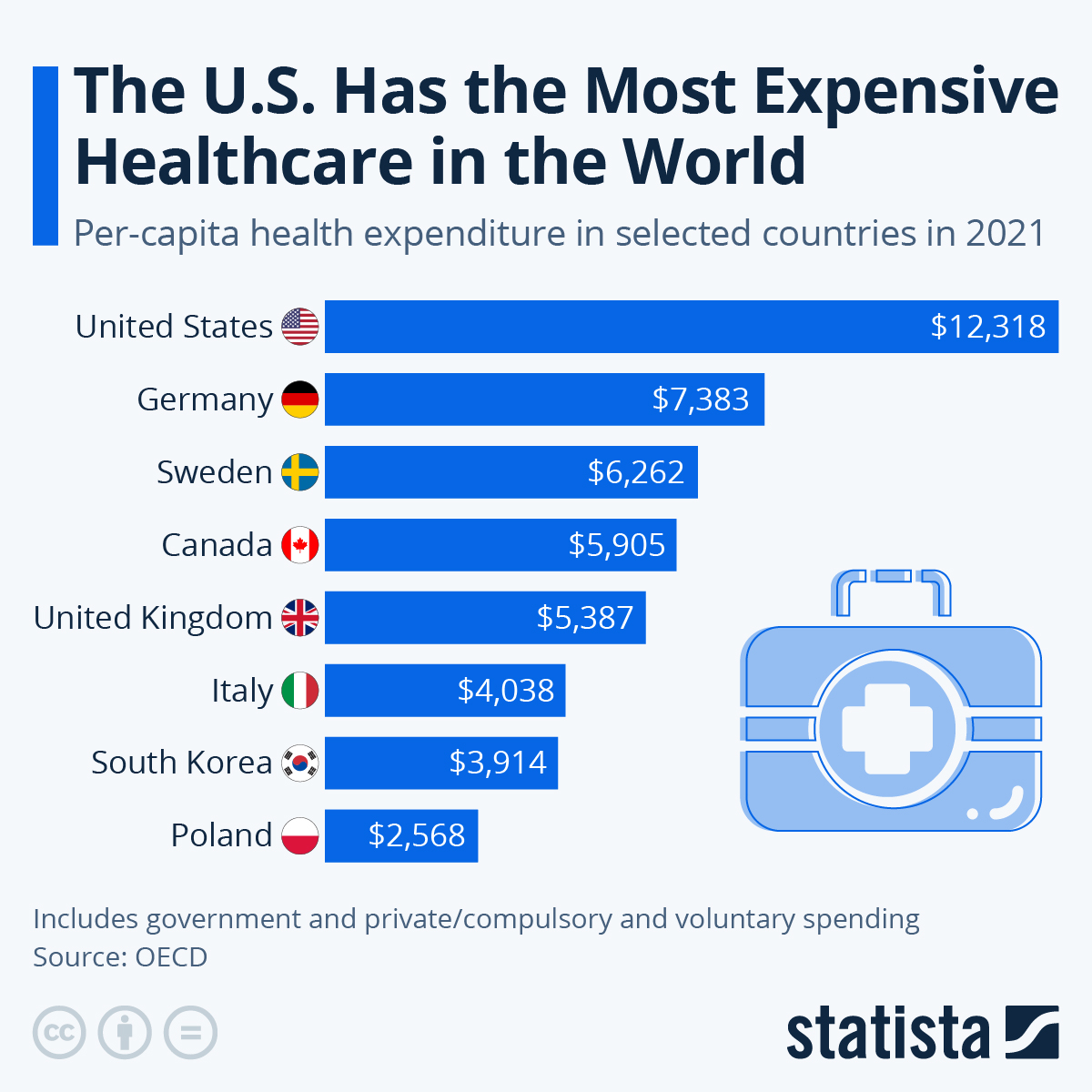
Infographic: The U.S. Has the Most Expensive Healthcare in the World | StatistaAn example of what we face is evident in healthcare. this is a sector of the economy that Washington has pledged to fix and even claimed it has. The chart put out by Statista shows the U.S. has the most expensive healthcare system in the world. This matters if you consider it as a tax on the American people and realize that healthcare is a major expense for people as they age. This hits medicare directly in the heart meaning as cost soar for the program something will have to be done. That something generally comes in the form of cutting benefits and charging recipients more.

While there is more to life than money, few people choose to live in poverty. Unfortunately, even most Americans that have saved over their lifetime and done the right thing are in peril.

Over the years, the Fed has inflated the money supply and in doing so it also inflated asset prices, including stocks, bonds, and real estate. Much of this is the result of ballooning debt. Make no mistake about it, the government has fed at the debt trough and it has made our future less promising. Yes, we are roughly 33 trillion in debt, not counting the unfunded liabilities of social security, medicare, and Medicaid. 

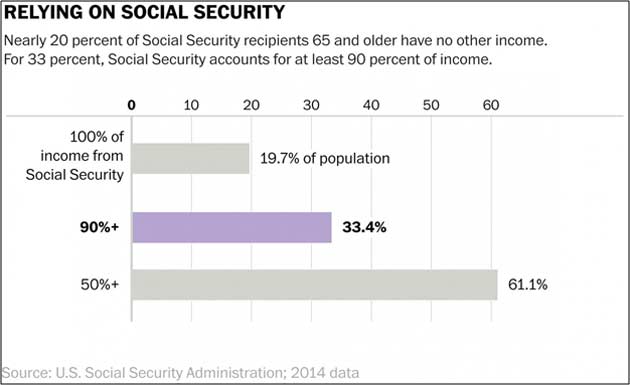
While This Is An older Chart, Little Has Changed. Reality Is Not Pretty

With the current trajectory of economic policies and inflation running above the return savers can earn from safe investments things will only get worse for retirees and those close to retirement age. Considering the amount of debt already amassed, the government is going to have a difficult time putting together generous new aid packages to come to the aid of those dependent upon its programs.
This will result in conflict as both the young and the old are forced to fight over the few scraps it can provide.

All this has created a situation where if the money supply now contracts a huge number of defaults will occur and both businesses and investors will incur big losses. This threat to 401Ks and pension plans is real and would make many boomers collateral damage in any effort they make to correct the mess they have created. Those in or nearing retirement should make an extra effort to reduce risk and keep their savings safe. 


(Republishing of this article welcomed with reference to Bruce Wilds/AdvancingTime Blog)
Thursday, February 2, 2023

China's First Large Homegrown Airliner The Comac C919

An example of China's progress and increasing ability to manufacture complex machinery is apparent in its new domestic aircraft the C919. Largely ignored by many Americans is the fact China has quietly been going about building its own aircraft industry. China's C919 has taken flight and will be strong competition for Boeing and Airbus in coming years. Yes, China's first-ever large homegrown airliner made by state-owned aerospace manufacturer Commercial Aircraft Corporation of China (Comac) has now been delivered to its first customer.  

This is the first delivery of five C919 jets for China Eastern, which will be operated by its low-cost subsidiary OTT airlines starting next spring. The delivery comes just a month after the C919's public debut at China's Zhuhai Airshow where it appeared alongside Boeing and Airbus. Reuters reports the 164-seat aircraft will fly its inaugural flight from Shanghai to Beijing. It also will serve cities such as Guangzhou, Chengdu, and Xiamen.

It is now here, it is now real. Watch out Boeing. While this came after lengthy delays, China has over the years made it clear it knows how to ramp up production quickly, and it will. It is important to remember China has to turn somewhere to replace the economic punch it has lost due to its housing bust. Housing had in recent years been said to have made up close to 30% of China's GDP. It now must fill this hole it finds in its economy,

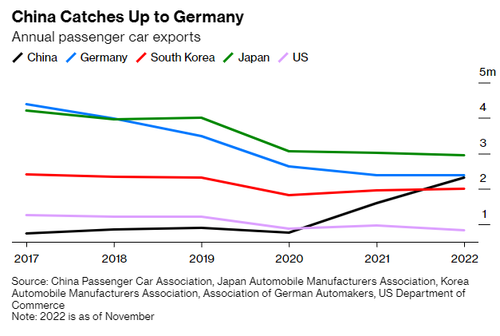
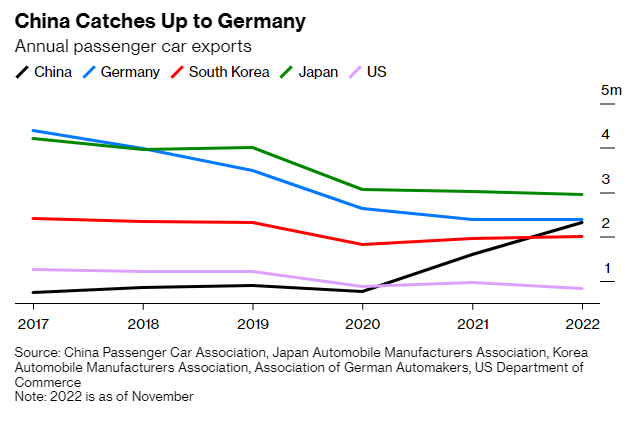
The motivation for this article came from a news piece by Bloomberg, that reports China is on its way to becoming the No. 2 exporter of passenger vehicles in the world. It has done so by passing both the U.S. and South Korea and is about to soon overtake Germany. This will leave only Japan ahead of it in passenger car exports. Bloomberg claims Chinese brands have become "market leaders" in the Middle East and Latin America. This reflects that cars from Chinese companies are getting better at the same time manufacturing overcapacity in China requires them to push exports.

Shipments of vehicles manufactured in China to other countries is up threefold since 2020

While the chart above tells the story it fails to highlight the ramifications of what is happening. This event highlights China's effort to exit low-end manufacturing and work its way up the food chain. In doing so it brings together several trends. This all ties into its master plan covered in the two-part series titled; China's Future Remains Cloudy And Uncertain. It lays out many of the challenges China faces in carrying out its plans for world dominance. These are the links to those articles.

 https://Chinas Future Remains Cloudy And Uncertain (part-1)html

 https://China's Future Remains Cloudy And Uncertain (part-2)html

Expect China To Rapidly Ramp Up Production

As usual, when it comes to China, politics plays a big role in its desire to play the "plane game" and the country has no qualms admitting its big role in developing the country’s aviation industry. Miao Wei, the former vice-minister of industry and information technology, has been quoted as saying the government encourages the development of export-oriented aviation products. The C919 has been a long-term project. Technical difficulties and supply issues delayed the development of the C919 for years. Comac was greatly impacted by restrictions imposed by the Trump Administration in 2020. It blacklisted shipments of things like fight controls and jet engines to China. 

Still, it is difficult for anyone to claim this would not come to pass. The arrogance of western countries to think they were guaranteed a lock on passenger airplane production may be about to come back to haunt them. The worldwide market for these planes is huge and the duopoly of Boeing and Airbus is about to fall by the wayside. The sales of jetliners are very important because they play into the bigger picture of world trade and trade imbalances and China has been a massive battleground for Boeing and Airbus because of the sheer size of its market. 

China's air travel market is expected to surpass the United States by 2024, according to the International Air Transport Association. Translate that into orders for planes and you’re looking at something on the order of 2,800 new planes with a book value of $329 billion. In the past, Boeing has projected it could sell China 6,330 planes worth $950 billion during the next 20 years.

Export sales of passenger aircraft and what is needed to keep them in the skies have in the past been considered an important part of trade deficits. We can expect a lot of these sales to melt away in coming years. Building commercial aircraft has never been a consistently profitable business, manufacturers risk several billions of dollars every time they try to develop a new type of aircraft. The Communist government, however, plays by a different set of rules.  

With China ramping up its fledgling aviation industry when it hits its stride expect cutthroat competition. This article from March 2021 is an AdvancingTime update on the C919 and contains more information and specifications on the C919. Price isn't the sole factor for airlines in buying a plane, overall quality, reliability, maintenance, and readily available replacement parts, as well as the pilot and mechanic training that manufacturers provide, are also important.

It is important to remember the Chinese also see this as another way to expand their influence across the world. When you factor in China's predatory style of conducting business, the C919 opens a lot of doors. It dovetails very nicely into China's One Belt One Road (OBOR) initiative and China will not be shy about using this tool to gain market share.


Republishing this article is permitted with reference to Bruce Wilds/AdvancingTime Blog