China's fledgling aviation industry is ramping up and when it hits its stride we can expect cutthroat competition. Aviation is the practical aspect or art of aeronautics, being the
design, development, production, operation and use of aircraft. As the industry takes flight over the next decade America may be saying say goodbye to a big chunk of its exports in this field. This has been some time in coming, when an article appeared in Wired in 2009 titled, "
China Rushes Into Building Planes" the threat of China being competitive in this high-end market seemed years away even with an expected push from its government.
Politics plays a big role in industry and the Chinese government which has long aspired to play the "plane game" has no qualms admitting its big role in
developing the country’s aviation industry. Miao Wei, vice
minister of industry and information technology, has been quoted saying the government encourages the development of export-oriented aviation products.
Some might be inclined to call the industry's relationship to the government a "state subsidy" and they are right, this makes China's move a big deal.
According to Boeing,
the Chinese market for airplanes will be one of the world's richest.
Airbus estimates the size of China’s passenger aircraft fleet will triple during the
next 20 years. Translate that into actual orders, and you’re looking at
something on the order of 2,800 new planes with a book value of $329
billion. Boeing
has projected it could sell China 6,330 planes worth $950 billion
during the next 20 years. Nearly three-quarters of the planes
for its civilian airlines will be
single-aisle with about 700 wide bodies.
Boeing wants to sell
China as many of those airplanes as it can. Just as naturally, Boeing
knows that it will have to share at least some of the market with its arch-rival, Airbus. Unfortunately, it's starting to look like Airbus won't be the only rival Boeing has to contend with because of China aggressively pushing forward.
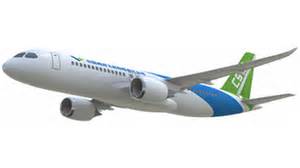 |
| Now Airborne C919 Will Be A Major Player |
An article in USA Today in the fall of 2009 focused on the planned C919, a single-aisle jetliner designed to seat up to 190
passengers, called the "big plane" project. It will directly challenge
U.S.
plane-making giant Boeing and European rival Airbus which until now have
dominated the global jetliner market.
The C919 project is a showcase
for China's ambition to be more than a low-tech producer of consumer
goods for the world. Back then the article reported the first flight wasn't scheduled until 2014, and the jet wouldn't be available commercially until
2016. But even back then the Chinese manufacturer claimed the
twin-engine, narrow-body design of the C919 is superior to its competition the Boeing 737, the best-selling jetliner in the
world, and its competitor, the Airbus A320. COMAC
(Commercial Aircraft
Corp. of China) also says it can bring the C919
in at a price lower than the $50 million range that Boeing and Airbus
charge for each of their planes.
Unfortunately, time has a way of quickly slipping by, so we fast forward to today and find that at
the end of 2015, at that time COMAC finally delivered its first new "Advanced Regional Jet
for the 21st Century," dubbed ARJ21. The buyer, local carrier
Chengdu Airlines contracted to buy 30 of these new planes and across China, more than 300 orders from
various airlines and airplane-leasing firms have been placed. The ARJ21 is tailor-made for the Chinese regional market, it is capable of carrying as many as 90 passengers on
trips as far as 1,300 miles. When departing from central China,
that's enough range to allow direct flights to just about any point in the country. The plane is built with about 50% U.S.supplied parts and with avionics from the well-respected Rockwell Collins and engines from General Electric. This is the result of a trade delegation led by President Obama back in 2009. This plane will not impact Boeing which doesn't play in the 90 passengers and below market but it will compete with models from Brazil’s
Embraer and Canada’s Bombardier.
On
Chinese President Xi Jinping's first state visit to the USA, he made a couple deals said to help foster relations between the two
countries. One was to order 300 Boeing aircraft for $38 billion, this was tied to Boeing building the first "aircraft completion plant" in China, it was to be Boeing's first non-U.S. plant. Considering China's knack, or shall we say, history, of taking advantage of sucking production ideas from manufacturers this move was a watershed event to many industry watchers. As noted above China is now in a far better position to realize its dreams to develop this industry because part suppliers such as GE, Pratt & Whitney, and other firms
are eager to supply the engines and other key components. The politics of globalization a few years ago have paved the way forward and makes China's effort to produce planes far more likely to succeed.
Returning to the subject of its larger plane, the Chief Designer of the ARJ21, Wu Guanghui, told China Daily
that COMAC is turning to new, lightweight carbon composites in place of
steel for the plane's construction to gain the 12% to 15% in fuel
efficiency.
Boeing, which is the pioneer in composite design,
has had difficulty in bringing its first composite plane, the 787
Dreamliner, to market, however, once a company pioneers the way we find
those following in their footsteps far a far easier time following in
their tracks. Boeing and Airbus have delayed plans to
build more fuel-efficient, narrow-body planes to replace the 737 and
A320 because in cost billions to create a new plane adding composites
alone won't contribute enough
fuel-efficiency savings to justify the move. Also, price isn't the sole factor for airlines in
buying a plane, factors such as overall quality, reliability,
maintenance and readily available replacement parts, as well as the
pilot and mechanic training that manufacturers provide, are important for airlines.
It should also be noted that building commercial
aircraft has never been a consistently profitable business
. Boeing and
Airbus risk several billions of dollars every time they try to develop a
new type of aircraft and history shows several times where they have suffered massive cost overruns and program
delays during development. The Communist government plays by a different set of economic rules and wants to
use the C919 as a springboard to develop a nationwide aviation industry,
it boasts the involvement of more than 200 companies, 36 universities
and hundreds of thousands of personnel in the plane's development.
Some optimist claim China's airline industry has become a
private-sector industry and will ignore the government's influence, just because the C919 will be
made in China doesn't mean all the Chinese carriers will stop buying
737s and A320s to buy only C919s.
They also claim it will be decades before the Chinese will be able to produce anything close to the numbers
of planes that the Chinese market will demand.
So where is this going? China is investing big in this vision with its State
media touting the "advanced technologies" that will be used throughout the
plane, from new avionics to the plane's frame partially made of light
composite materials. It is important to note that another company, Avic, is currently working on China’s first
helicopter factory. The bottom-line is that it would be incredibly naive to underestimate China's resolve in rapidly becoming a player in a field that will move it up the manufacturing food chain. With China's experience of building cities from scratch, why build just one factory when you can build twenty? This means we should not expect this industry to grow organically but it is logical it will be engineered by an aggressive government with a mission. Expect competition in this field to rapidly intensify, it is important to note the Chinese aren't alone among emerging economies
wanting to expand into the jetliner business. Russia and Brazil have
new jets coming out, too.