Sunday, March 27, 2022

Which Major Currency Will Be The First To Fall? - Could The Euro Beat The Yen In Race To Graveyard?

Before saying anything else, it is important to note, when it comes to the major currencies, it is safe to assume they are manipulated by central banks. It is in the best interest of Central Bankers to keep them trading in a rather tight pattern as so not to rock the foundation of the global financial system. On top of the stress being placed upon economies due to the war in Ukraine, the one thing bankers don't want to deal with is the growing fear the fiat monetary system is about to fail. 

The destruction of the myth that a major currency cannot fail could create a situation where we would see skittish investors dumping currencies in mass. As wealth rushed from currencies into tangible assets inflation would soar. When a currency implodes it fosters a transfer of wealth from those holding the now worthless paper to those holding other currencies or tangible assets. The group-think of all the major central banks until just recently has been concreted into a global monetary policy favoring inflation in order to support economic growth. This monetary policy is now being challenged by rising prices at the same time economies are slowing.

It is important to remember that fiat currency systems depend on the faith of its users and participants to survive. The emergence of a slew of new cryptocurrencies is an indication faith in the current fiat currencies is beginning to wane. These digital currencies that have flooded the market are disconnected from central banks. Also adding to the perception we are about to see a major shakeup in the global financial system are efforts by countries such as China and Russia to move more trade away from the dollar. This is happening at the same time we see the cost of living for the 16 nations that share the euro currency rose to 5.1% in January, a  new record high, few interest rate increases expected in 2022, and a time the German PPI is 18% and Spain’s 31%.
Recently, Zoltan Poz­sar, an In­vest­ment Strategist at Credit Suisse and is based in New York, has appeared all over the media touting a theory that would affect us all. He is touting the idea Russian sanctions combined with its relationship with China and a crisis in some commodities are threatening the dollar’s reserve status. He claims this will bring about a Bretton Woods III event where commodity collateral may repave the road to hard money

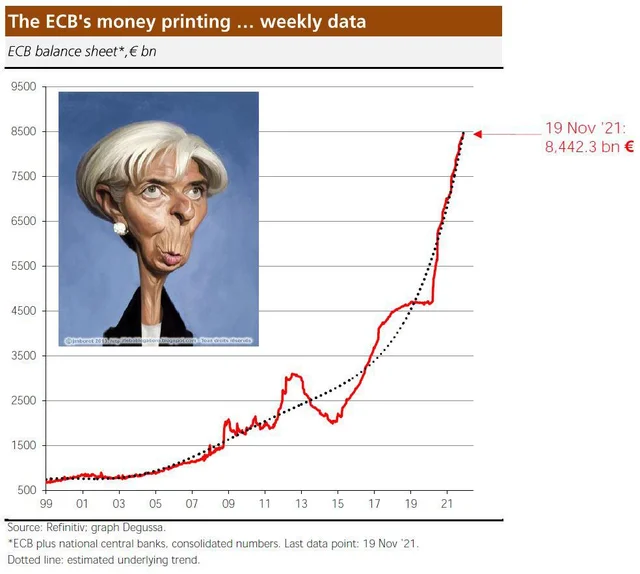
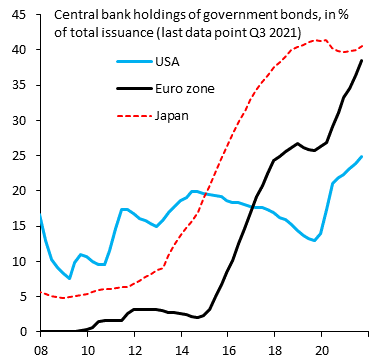
While Pozar may not be completely right, if we are moving in that direction, the effect has broad implications for all of us. It would substantially redefine the relationship between fiat currency and tangible assets. A strong argument can be made that even though the BOJ is the top dog when it comes to monetizing debt it may not be for long. The ECB is catching up in the percentage of central bank holdings of government bonds in percent of total issuance. Considering all of Europe's problems the big issue is envisioning a scenario from which an economic renaissance might flow.

To say the Euro-zone banking system deception which has been going on for many years is continuing understates the size of the fraud occurring before our eyes. A program known as "Target 2" has been the salvation of the euro and is responsible for preventing countries from collapsing. Since 2015 when Draghi started QE, the Bundesbank has been buying bonds on the market. The Italian central bank is dependent on the ECB which buys Italian government bonds. Germany then sends euros to Italy transferring the debt via Target 2 to their German bank. The growing differences in the Target 2 balance sheet are the result of the Germans taking these bonds. Italians have also added to the capital flight by liquidating their bonds and sending their money abroad. 
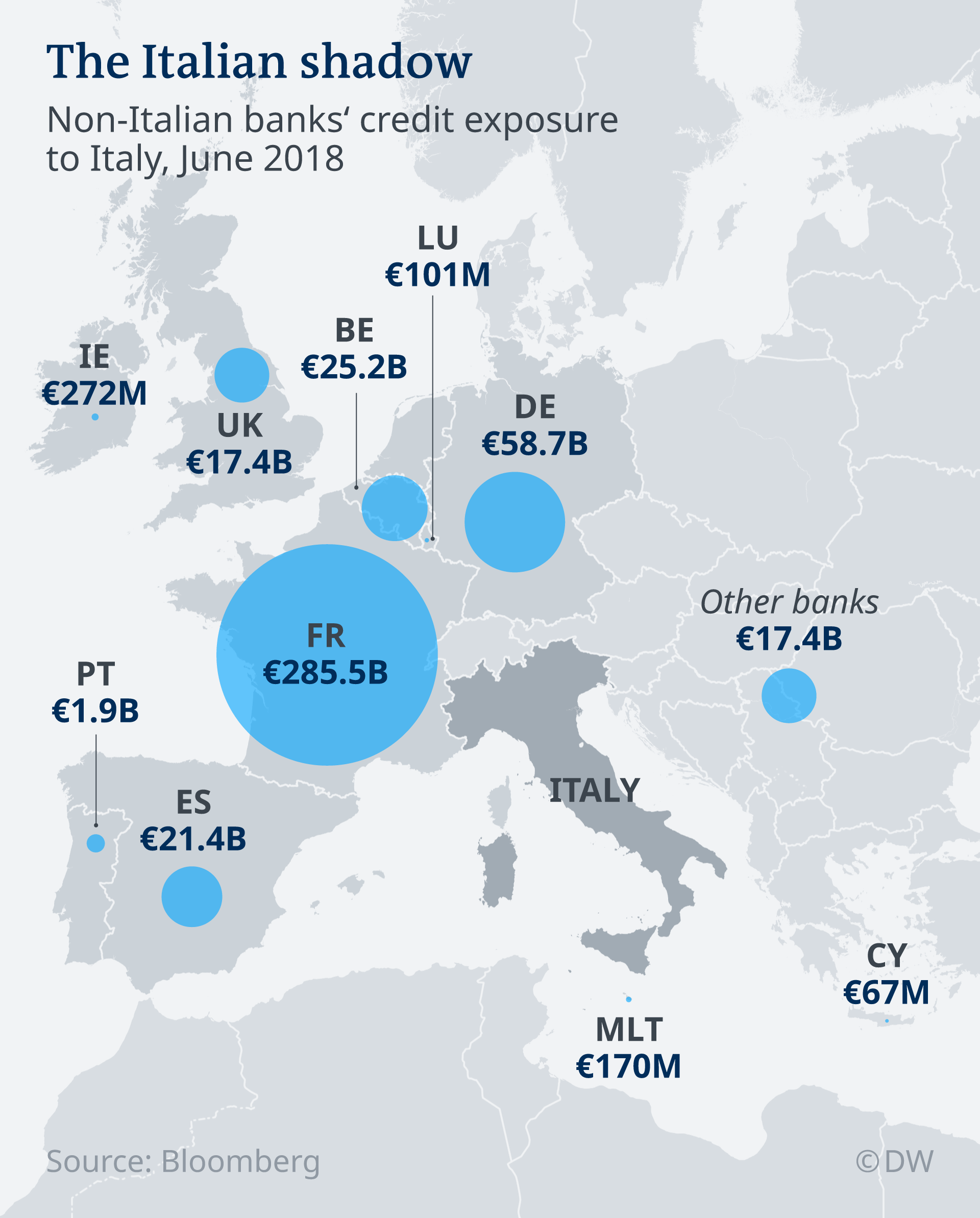
 Italy Is Far Worse Post Covid-19
Target 2 translates into enormously huge debt claims on the Germans that are not covered by any securities. In short, if Italy (or even Spain) would withdraw from the Euro-zone, the Germans would be left holding worthless paper. The bottom-line is Brussels and Germany must continue buying what could be considered, "bad debt" to keep the system afloat. All this raises the question of when the value of the euro will begin to reflect the stress which has been masked over and greatly ignored. In short, the choice of Europe has been whether to put a lot of bad debt on the balance sheet of the European Central Bank or deal with defaults and the contagion that flows from them. To be clear, many German economists criticize Target 2 and see it as a check that cannot be cashed.

As for the yen, for a long time, many investors have viewed it as a safe-haven currency, so much in fact that it has been called a "widowmaker" trade for those betting on its decline. For years Japan has been the poster child and living proof that low-interest rates do not guarantee economic growth and prosperity. Going unnoticed by many investors is that the BOJ  has been pumping up Japan's stock market by buying into the ETF market. This has morphed into a program that seems akin to Mario Draghi's fraud of doing "whatever it takes" to give the appearance their economy is moving forward. Following along the line of thought that while there is no way of avoiding the final collapse of a boom brought about by credit expansion years ago, Ludwig Von Mises wrote; "The alternative is only whether the crisis should come sooner as the result of a voluntary abandonment of further credit expansion, or later as a final and total catastrophe of the currency system involved." In short, the BOJ now has little choice but to go all-in which strips away any illusion all is well.

Japan Led The Way In This Experiment

Before the "Bernanke has all the answers" era, many of us criticized Japan for failing to own its problems. At the time the idea was that only by letting its zombie banks and industries fail could Japan clean out the system and move forward. Instead, the Government of Japan ran huge deficits and ran up massive debt. For decades Japan languished and avoided disaster only by the fact that it enjoyed a large trade surplus year after year and was able to pigtail onto the rapid growth occurring in China. Today much of that trade surplus has vanished but Japan's massive debt remains.

After 2008 Japan decided to put itself on the leading edge of an experiment to propel its economy forward. This includes the BOJ not only expanding its balance sheet but pumping up the market by jumping into the ETF market, what the country is not doing is taking big steps toward economic reform. All this has morphed into a program that seems to share a key focus on doing "whatever it takes" to keep the economy moving forward. The problem in pursuing the flawed policy of never allowing the market to slip but putting it on a path ever upward until everyone doubting the strength of the market finally capitulates is that it thwarts true price discovery.

Recently articles have surfaced exploring how the central banks and governments have distorted true price discovery in stock markets across the world. By buying stocks they are taking or transferring branches of industry or commerce from the private sector to state ownership or control. The keyword here is "ownership." This is because the state may choose to abdicate control over decisions leaving them in the hands of management. It has been estimated the BOJ holds around 35 trillion yen, accounting for roughly 80% of Japan’s ETF market. In some ways, the actions of Japan's central bank could be considered nothing more than a new model of "stealth nationalization." 

This is a course filled with moral hazard since it destroys true price discovery the bedrock of free markets. We cannot underestimate the importance between assets prices and the feedback signals they send. These are critical in determining value, especially when it comes to assets such as stocks, bonds, currencies, or paper promises which carry no utility value and can perform no useful task. When true price discovery is lost or impaired management teams no longer get market feedback as to whether an executive decision is good or bad, this dilutes the market's ability to reward and punish companies no matter how disastrous their decisions.

To keep the illusion of a viable economy alive central banks must continue expanding credit and debt so the wheels do not come off the economy. It is hard to create the illusion all is well if unemployment soars and defaults skyrocket. This means the central banks remain trapped in a box Ben Bernanke built, Janet Yellen reinforced, and Jerome Powell has not tried to escape from. It is easy to see how central bank policy, right or wrong, falsely accomplishes two things, it bolsters and supports current holdings while reinforcing the image markets are climbing higher because our economic future is getting brighter which is a narrative mainstream media is glad to provide.

This may have started as a "short-term solution" but Ben Bernanke upped the ante by setting the money printing machines on high and flooding America and the world with QE. When other central bankers embraced this solution the world embarked on a grand experiment. The big problem is momentum seems to ebb shortly after each new wave of stimulus and another fix seems to constantly be needed. Current policies are not creating true growth in productivity or real wealth but simply driving up the value of certain markets and assets. This benefits those who own or have assets but does little or even hurts the poor or those who have nothing. It also increases economic inequality and social unrest. The harsh reality central bankers, politicians, and the world must face is the medicine for curing high inflation is high-interest rates. This will not go down well and to some an unacceptable solution.

For years, Japan and Italy, both mired in debt, have been on artificial support. Not only the size of the debt, but the quality of the debt, suggest a huge drop in the values of their currencies must occur. Weakness in the euro or even the yen almost certainly will result in a stronger dollar which could be the catalyst for a crisis in currencies issued by emerging market economies. In short, there is the potential to see such an incident over to the rest of the developed world and evolve into a global deleveraging event. This will most likely be seen as part of the great reset many of us have come to expect will occur at some point. Meaning, promises will be broken and rules will be rewritten as we go through the wash. If I'm correct this reset will involve a massive transfer of wealth with many people having their assets rinsed away as society gets put through the wringer.

                                                                                 This blog is not written for money
                                                                                 or profit but as a way to share ideas
                                                                                 and thoughts. If you liked this post
                                                                                 feel free to E-mail it to a friend
                                                                                 or join to receive future articles.


Footnote; For more on this subject, see the articles below.

https://brucewilds.blogspot.com/2019/03/euro-zone-banking-deception-continues.html https://commodity.com/data/italy/debt-clock/                                                       https://www.youtube.com/watch?v=pNIE7qUePq8                                  https://brucewilds.blogspot.com/2019/09/eu-trade-deficit-with-china-destined-to.html  

 (Republishing of this article welcomed with reference to Bruce Wilds/AdvancingTime Blog)

Saturday, March 19, 2022

The “Wealth Effect,” Is Failing As A Key Fed Policy Driver

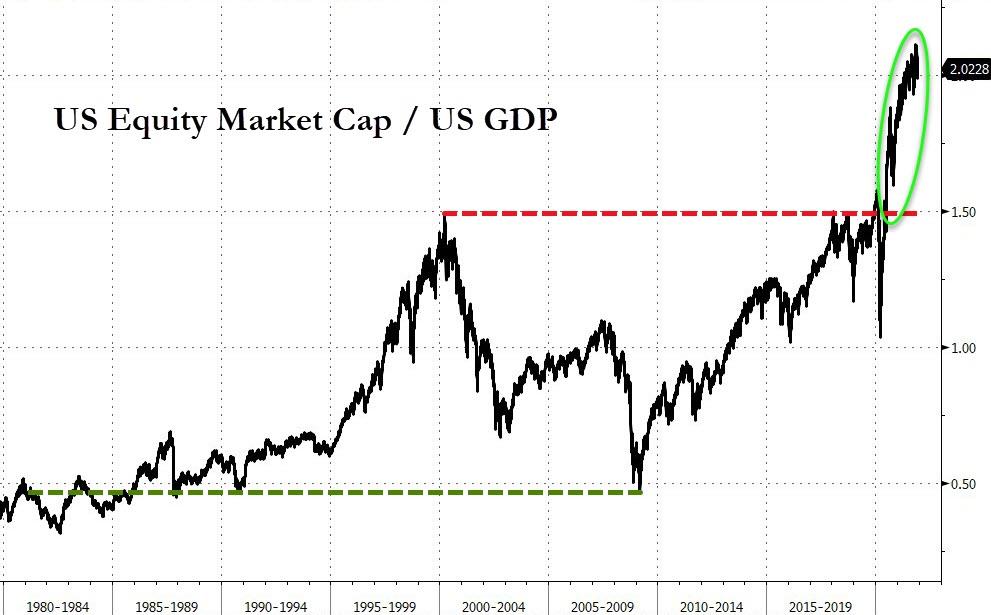
In a world where optimism and hope have dominated the investment landscape for over a decade, we should be prepared for reality to raise its ugly head. This time is not different and debt does matter. As pointed out by many economists over the years, low-interest rates and easy money, do not always result in a strong vibrant economy. Japan's failure to recover from its bubble bursting decades ago remains proof of this.

Much of the rationale behind QE has been that it creates what the Fed calls a “Wealth Effect.” For years this has been a key driver of central bank policy. This view is firmly embedded in the macro-econometric models used by the Fed. The notion, widely adopted by central bankers, is that by inflating asset prices to make the wealthy (the asset holders) even wealthier, these people will spend more of what they see as free money from asset price inflation. The premise is that this additional spending will create additional demand for goods and services thus providing jobs for the masses. 

Sadly, several times over the years the wealth effect formula has slid off the tracks and most likely will again. Consumption does not create wealth, it creates debt. The example that stands out in the minds of most people is from back in 2008. By loaning money against homes with little scrutiny as to the borrower's ability to repay them the Fed created a financial bubble with broad implications. It could be argued that since 2008, Fed policy has never really addressed that mess but attempted to paper over it by printing money and expanding debt through quantitative easing.

Wealth Effect Policies Have Failed To Generate Enough Growth

Looking back at how pursuing policies that breed the Wealth Effect can slide off track or lose their effectiveness, we see it always centers on the risk they create. At some point, the combination of easy-to-borrow money at low-interest rates tends to morph into a high-risk environment of increased speculation and leverage. In short, savers and investors seeking a return on their savings are forced out of traditional accounts because such investments get ravaged by inflation.

Many Consumers Bought Into This
The 2008 financial crisis resulted in the worst economic disasters in modern times and caused the biggest recession since the great depression of 1930. It is also referred to as the global financial crisis (GFC). Over the last several years, the Fed has been getting a great deal of well-deserved bad press for driving inequality and fracturing society. Since 2008 it has become apparent the Fed has created an unfair system that is broken, unfair, and corrupt. This has affected different generations in rather specific ways.

It is again becoming very apparent the wealth effect policies are failing. Not only have they failed to create a healthy economy but they have brought the financial system to the brink of collapse. Following the GFC the Federal Reserve and the Bush administration spent hundreds of billions of dollars to add liquidity to the financial markets. They worked hard to avoid a complete collapse. They almost didn't succeed. Today we are spending not billions, but trillions of dollars to keep the same corrupt policy moving forward. 

History shows investors should treat the wealth effect with caution because it is susceptible to reversals. Since the GFC, attempt after attempt has been put forth to change the tide, but still, we have watched the middle class shrink. The elephant in the room when it comes to growing the economy is how "the broken window theory" is spun and interpreted. The gist of this theory is that if a window is broken, the subsequent repair expenditure will have no net benefits for the economy. Still, it is not uncommon to see destruction touted as a good thing because it promotes spending. In truth, the idea destruction is good discounts several facts. 

One has to do with where the money is coming from but whether it is from an insurance company or someplace else, it still means the money is diverted from being used on another purchase. Repairing a broken window is maintenance spending which doesn’t improve growth because it doesn’t improve productivity. This expenditure would have occurred anyway. The only thing a broken window does is  cause maintenance spending to occur earlier and lower the useful life of the window. Maintenance spending may keep the economy going it doesn’t provide a boost. Instead, it is better to invest the money in something which creates wealth by increasing productivity.

Many people and even economists have real misconceptions as to how the economy works. Where money flows and who it enriches is a key component of economics. The failure to consider this is a blind spot many people have. Years of being told everything revolves around spending has diminished the important role savings plays in the scheme of a balanced economy. Fans of Keynesian economics that encourage government spending to stabilize the economy during a downturn tend to discount the importance that where and how money is spent matters a great deal. 

Wealth Effect Policy Has A Poor Record
In the end, this all comes back to the fact current policies are presenting us with diminishing returns while increasing risk. Sadly, financial corruption has played a huge role in getting us here. Never before in our history have Presidents, Fed Chairs, and politicians in general been able to exploit their power and gained massive wealth following their time as so-called public servants. A big part of our current problems is the elite top-down efforts to control our society has created a permanent government. Today an army of government workers, most un-elected have been empowered to nibble away at our rights.  

Bubbling up to the surface is the recognition the Fed has to shoulder a huge responsibility in pushing inequality higher. Powell has even gone so far as to claim there was little demand for loans below $1 million. Sadly, the same policies that dump huge money into larger businesses because it is an easier and faster way to bolster the economy give these concerns a huge advantage over their smaller competitors.

The long-term ramifications of destroying smaller businesses will hurt America in the long run. It eliminates competition, reduces opportunity, and over time fuels inflation. This drives my angst directed at companies such as Amazon and big tech. The policy of making people feel better so they spend more than they can afford is part of voodoo economics.  So is sending jobs abroad and increasing our consumption of imported goods which has resulted in a massive trade deficit. Good economic policy encourages personal responsibility and is rooted in saving not spending. 


(Republishing of this article welcomed with reference to Bruce Wilds/AdvancingTime Blog)
Wednesday, March 9, 2022

Turning The Wealth Pyramid Upside Down

When we look at upside down wealth pyramid at the left, I have a big problem with the picture it promotes. It is clearly based on someone's opinion of what investments are safe. The one thing it does well is to scream that some investments have a high degree of risk and it is best not to put all our eggs in the same basket. 

Another issue is how a 401 or pension will fare during hard times or if we do see a huge number of defaults. Consider this an indication that placing your wealth into paper promises means it has the potential to vanish or be converted into something to would never agree to. Again, the devil is in the small print or the fact "they" can change the rules at any time.

While a great deal of speculation has been showered upon us concerning inflation turning to deflation, we will not know the true direction of things until they occur. One thing to keep in mind is that government employs a tremendous number of people that will never accept a cut in pay. This will put a solid net under falling prices. Combined with the refusal of many workers to consider working for anything near minimum wage helps push away the notion of deflation. In fact today, my local paper announced the City Council in Fort Wayne, Indiana just approved retroactive COVID-19 hazard bonuses for all city workers.

It is important to move towards forecasting based on probability rather than predictions. Keep in mind a great deal of how we deal with the options before us is centered on how we position ourselves. This can result in a lot of study and hard work or, in the case of many people, be a duty we cast off to other people. The harsh reality is that there is no guarantee that any strategy we choose will be able to stand up to the barrage life throws at us. 

If we are indeed about to enter a body-slamming bear market that will reshape the financial landscape, what many people want to hear is how to make a million dollars overnight in a bear market. This is far more difficult to do than say. So much depends on timing and the direction the dominoes fall. Sadly, the inverted pyramid above should give us little reassurance we are in control of our own destinies. 

While overall I see investing in precious metals in a positive light, even investing in gold has a slew of drawbacks. The same holds true with bonds and cash. With bonds, there is the huge risk that they will be repaid in deflated or less valuable dollars or defaulted on. When it comes to holding cash in its truest form, not only are you bludgeoned by inflation but risk it will be stolen or lost. 

Old Chart, Derivatives Are Now Much Bigger

Interestingly, the widest and most perilous area of where to stash your wealth is that of derivatives. On occasion, it is important to revisit issues that have been swept under the rug or simply overlooked. For most people, the derivatives market falls into this category, partly because they don't understand exactly what derivatives are or why this market is so important. The problem is the derivative market has the potential to explode like a bomb.

Derivatives are financial contracts, set between two or more parties, that derive their value from an underlying asset, group of assets, or benchmark. These contracts hold the power to unleash a great deal of pain and grief during volatile markets. Years ago, Paul Wilmott who holds a doctorate in applied mathematics from Oxford University has written several books on derivatives. At the time, Wilmott estimated the derivatives market at $1.2 quadrillion, to put that in perspective it is about 20 times the size of the world economy. 

Since then, the derivative market has only grown larger. today, the world’s annual gross domestic product is around 100 trillion dollars. Trying to regulate this complex market is easier said than done. While QE was able to halt an implosion of derivatives and the resulting contagion and shock that would have spread throughout the financial system following the 2008 financial crisis this time we may not be so lucky. 

Returning to the inverted wealth pyramid, I see little to spur optimism going forward, add in geopolitical tensions and slowing economic growth across the world and it is very easy to envision risks pushing things over the edge. If history is any indication, the idea this time is different will prove to be false. Contagion seeping over from one sector of the economy to another has the potential to create a rather grim future in which we are forced to pay for our past sins of excessive greed and arrogance.

Several things are moving down a path I saw coming but like many of you, I'm shocked by the twist and speed things are moving. The one big surprise is how a little war can rapidly turn things upside down and be declared as the catalyst for our economic downfall. I have not been writing much as of late because I've been spun by much of what is happening, however, I plan to settle back in and crank out a few new articles soon. Stay safe, and remember this is not the time to take on new risks or believe the propaganda being thrown at us.


Footnote; Below are a few YouTube videos worth a quick look.

In a special update, co-founder and CEO of Real Vision Raoul Pal shares with us how he’s approaching the market amid this incredibly chaotic environment. Raoul outlines several scenarios for how the Russia-Ukraine situation could play out.    https://www.youtube.com/watch?v=klOSrrN4ETU

 (Republishing of this article welcomed with reference to Bruce Wilds/AdvancingTime Blog)

Wednesday, February 23, 2022

Is Tunnel Vision Hiding How Bad Things Are?

As eager as many of us are to put Covid-19 behind us we as a society simply have not turned the corner. Mainstream media has us in a stranglehold as it continues what is news and how to report it. Not seeing the bigger picture is something many people seem to suffer from. It occurred to me the other day that tunnel vision may be hiding just how bad things are.  

I See Nothing - It Looks Alright To Me

A lot of the problems I hear about come from those around me during conversations. These have to do with things the mainstream media is ignoring or not putting into proper perspective. Whether this is intentional or proof the media gets a big fail for keeping us informed is up for debate. The one thing that is clear is they seldom address the ramifications flowing from the events they report and how one problem also compounds another.  

Another way to look at this is that it is becoming more difficult to reconcile all the lies and misconceptions floating around out there. Since most people are not deep thinkers, they seldom tie the consequences resulting from events together. It is necessary to do this to form a reasonable opinion as to whether something is good or bad. Simply taking the word of some babbling bias idiot from the news media has its drawbacks and adds to the dumbing down of society. 

All this has clowns coming out of the woodwork with predictions. Call them wild, call them pure speculation, call them anything you like. The one thing I do know is that they can't all be right and some will prove to be very very wrong. Some of these predictions are very specific, such as the one being thrown out there by Felix Zulauf. He claims we will see a 20% plus drop in the markets by summer, then a huge bull market lasting through 2024 caused by the Fed pivoting as we drop into recession. 

We even have some economy watchers putting forth the idea inflation is about to max out or will start to fall since the numbers are based on year-over-year figures. Still, it is difficult to discount other pressing issues that remain. One of these is what will happen to overall incomes with many people still not planning to return to work. Another has to do with the fact supply chains remain a mess and may get far worse if social unrest continues to spread. 

An example of this, hidden from much of America by the media is highlighted by how the Canadian truckers, protest has brought freight shipments in Canada to a standstill. Also, we  are seeing a substantial slowing in many countries and segments of the economy. Another thing we must look at is "liquidity," it is important to remember money is not distributed equally. If Fed tightening does occur, certain segments of the economy will suffer far more than others. 

Headlines twisted to give a positive spin on things, such as, "U.S. industrial production jumps in January on demand for heating" tend to mask the fact this is not good for most people. This headline just came across my page, while it sounds upbeat, it is economically problematic. In short, it means consumers are paying more to heat their homes and that they will have less money to spend on other items. 

It is somewhat amazing that in the last few days, the situation that has brewed so long in Ukraine is being used as the primary excuse for the market moving lower. More incredible is that people are accepting this, that narrative pushes away the bigger issue of the Fed tightening and raising interest rates at the same time the economy is slowing.

The one thing I do know is that most Americans are poorly equipped to handle the  economic storm heading our way. When things are too ugly to look at, people ignore them and choose not to "handle" the truth. So many people have accepted as fact five major economic myths that allow them to brush aside reality. They are; 

  • Government is for and by the people
  • Financial planning means you only have to start saving a little money each year to guarantee an easy retirement
  • You have rights and we are not slaves
  • Your life will progress and move along pretty much as you have planned
  • Those in charge or above you care about you and will protect you 
The ugly truth is pensions are bankrupt and so is our government, but we are not alone. In fact, in many ways America is still far better off  than many or should we say most other countries. The volatility we have seen in the market as of late has left many investors whipsawed out of their money and the worst is probably yet to come.  I see this as an indication we may be closer to the end of this euphoric bull market than many investors think.  Those that have been buying market dips should remember that markets climb a wall of worry but when they crash, it can come fast and furious.


 (Republishing of this article welcomed with reference to Bruce Wilds/AdvancingTime Blog)

Monday, February 14, 2022

Inflation Lowered By Investment In "Intangible Goods"

Inflation ahead will be contained in certain sectors of the economy. How much inflation we see is still up in the air. From a Main Street perspective, people and businesses are saying that inflation is here to stay and is not a short-lived or transient issue. Still, it is also important to remember that as supply and demand have taught us, what goes up can and often does come down. I contend and envision most of the inflation that takes place will be in hard assets and it will be the result of people losing faith in fiat currencies. 

When money is created or printed it has to go somewhere, and it has been fueling the "everything bubble." While feeding the "wealth effect" and inequality, a bubble is not necessarily inflationary. All this can be a difficult concept to grasp. The important point to remember is that everything is relevant and values and prices change. Up until now, much of the newly created money has not resulted in massive inflation. This is because it has been diverted from goods everyone needs to live and into intangible assets not included in the consumer price index.

The way people view fiat currencies way be about to change in a big way, they are generally a poor place to store wealth. To be clear, I view the dollar as the best of the four fiat currencies, however, I expect all of them to come under more pressure in the near future with the yen and euro being the biggest losers. The amount of interest in cryptocurrencies and other inflation hedges is an indication many investors are losing faith in the central banks and fiat currencies. The result may be a monetary crisis and chaos that shifts people into tangibles and a self-feeding inflation loop.

None of this means cryptocurrencies are the answer. This article is being written to point out our normal inflation model totally misses an important point. Most economists and analysts are oblivious to the point that with so many people willing to invest in intangible assets they have dampened inflation. By not buying tangible and real items people help minimize inflation. This is a very important part of the inflation puzzle. 

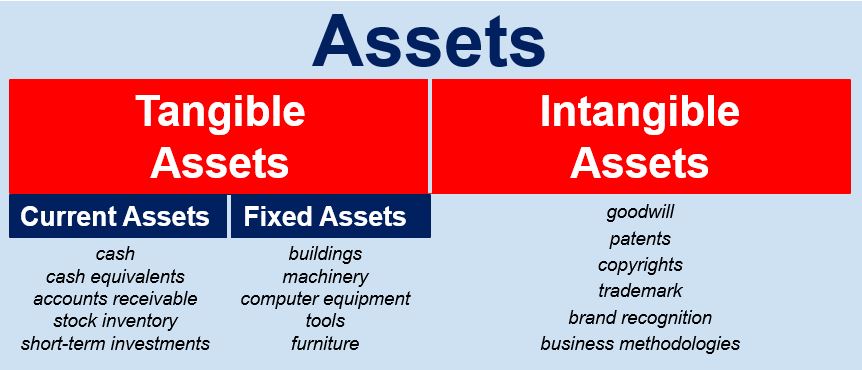
To many investors, the difference between these two very different asset classes has been blurred over time. An intangible asset is a useful resource that lacks physical substance. Examples are patents, copyrights, trademarks, and goodwill. Such assets produce economic benefits but you can’t touch them and their value can be very difficult to determine. These intangible assets are often in sharp contrast to physical assets like machinery, vehicles, and buildings. 

This Does Not Tell The Whole Story

Most tangible assets can be easily converted to cash, this is why most people include as "tangible" the amount of money in a bank account. Even though money held by a bank is a paper promise, it falls into a "grey area" in that it holds the characteristic of being rapidly converted to something real like property such as cars, houses, or boats. Some of these accounts can also be used as collateral in case you want a loan. 

Over the years investors have shown little resistance to being steered away from tangible assets. It is easier to own intangibles than deal with taking care of "real things." This could account for some of the mismatch in growth between these two kinds of assets. In our modern economy, another example of intangible assets, or at best, quasi-intangibles are shares in a company. When you buy what is known as stocks, what do you really have? You no longer get a certificate as in days of old, this should send the fear of God into those that worry about hackers. 

Owning stocks is very similar to holding a fiat currency in that much of its value is based on faith. What you get is a glorified memo in a computer base somewhere, good luck proving what you have if things go bad. Most likely even getting a government official to listen will be a huge task. If you do get action most likely it would be years before you get any of your money back. This is important when you consider the massive importance stocks plays in the overall economy.  

At the same time, it is also important to factor in the massive importance of other quasi-intangible "financial instruments" such as bonds, pensions funds, retirement programs, and more, play in our modern economy. Enough said. All of the paper and promises sold as assets remove inflationary pressure off the price of tangible goods. They also give us the warm fuzzy feeling we are protected from an uncertain future. Sadly, they are more of an illusion of security than things of substance. We often accept these substitutes for holding real goods because society makes it so doggone easy and even encourages us to do so. A major problem with assets that are not tangible is that they are easily prone to manipulation and are even capable of vanishing before our very eyes.  

 
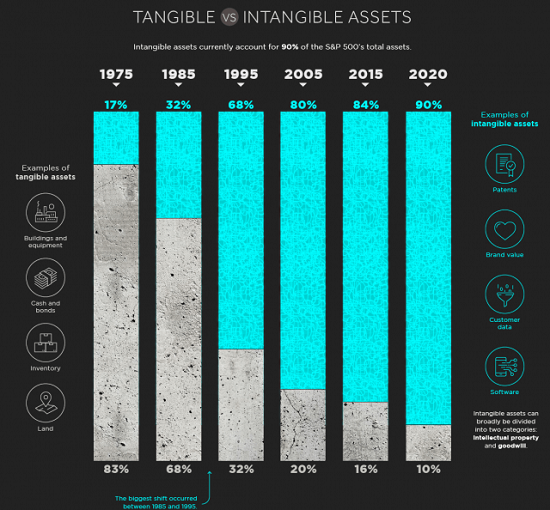
Intangible Asset Growth Has Vastly Exceeded That Of Real And Tangible Assets

The chart above shows how over the decades the growth in intangible assets and the money supply has vastly exceeded the growth in real and tangible assets. This is problematic. Currently, the gap is so large that even if you allow for a great deal of the wealth stored in intangible assets to be washed away there will still be enough cash and credit available to create inflation. Ironically a huge washout in the value of this type of asset could be become a driver of inflation by igniting a shift into hard assets.

Time after time history has revealed how Ponzi schemes operate in plain view and are often heralded as a great investment until they are not. Adding to the problem with intangible investments and buying a promise is that so many of these transactions are now being done online and placed in the clouds.  This means many investors may someday pay a very high price for their faith in a financial and political system with a history of failing to keep its promises. For those fleeced out of their money, our rapidly failing, slow-moving, and expensive legal system seldom distributes justice.  

Circling back to the idea laid out in the title of this article where people place their money matters. The Fed, the government, and a lot of institutions love the fact so many of us are willing to accept paper and promises in exchange for our wealth. The problem is, these groups may not be in any hurry to return this wealth. As proof of how deep this is rooted in our system just look at the growth of the financial sector over the last few decades. On the other hand, obstacle after obstacle has been thrown and placed in front of those buying tangible assets. Just remember, not investing in "tangible goods" helps to minimize inflation but it also puts your wealth farther away from your control and that may prove detrimental to your financial health.    


 (Republishing of this article welcomed with reference to Bruce Wilds/AdvancingTime Blog)

Wednesday, February 9, 2022

Examples Of One Mistake And Your FUBARed

Over the year several of my articles have contained the theme that life can turn upside-down without warning. One moment you are on top and the next you are on the bottom and being treated like pond scum. Life can be very unforgiving. I write this in the hope someone reading this will take this message to heart or make an effort to pass it on to some young soul that is under the impression life is their oyster. 

The world is your oyster is a saying often told to young people about to embark on adult life. It simply means that everything is open to you and each day will bring with it new opportunities. With a bit of luck, the possibilities to create a great life are endless. The upbeat message flowing from this tends to downplay the darker side of life and the role hard work plays in getting us to where we want to be.

To be clear, one mistake in judgment or simply bad luck has the potential to become a watershed event that changes your life forever. This is something I have tried to pound into the head of those young people and it is a good reason to develop and exercise discipline throughout life. Over time discipline pays huge dividends, this is something many people fail to realize.

A lack of discipline is akin to a lack of focus, and a lack of focus often results in bad things transpiring. It is apparent in little everyday acts such as forgetting or losing your phone or locking yourself out of your house. It also extends to missing deadlines, being constantly late, and making promises which never get honored. While none of us are perfect, people with little discipline tend to border on dysfunction.  

The fragility of our lives is highlighted by the fact that one incident can have dire consequences. In many ways, society has never been so forgiving, that is of course unless you happen to get trapped in the system. In this case, I'm referring to the sticky bureaucratic monster put in place to corral and control each of us. 

The system has a way of not forgetting or forgiving us for what could be written off as minor infractions. A favorite of mine is how former President Clinton will always be remembered for saying, "I did not have sexual relations with that woman, Miss Lewinsky." It is amazing that politicians can lie, steal, sell us out, and heap all kinds of injustices upon us but this is the sort of thing we focus on.  

When I was younger I had several mentors. These people advised and helped guide me forward, sadly their advice was not always spot on. Still, several of the ideas they put forth have proved very useful and important, others proved problematic. We should remember even those we consider older and wiser misstep, also, what may have been good advice yesterday may not bring good results in the future.

If I may get philosophical for a minute here are a few thoughts about some of the things that matter, did you have fun getting to where you are. Living a full life rather than wasting it sitting on your hands generates a lot of interesting memories. Nobody will remember or care about you in 50,000 years. Still, with that idea in mind, remember that life is a marathon, not a fifty-yard dash. 

There Is A Reason They Call It Gambling
Two areas that people are prone to make toxic mistakes are in matters related to money and love. Both are a minefield. Choosing a good partner in life should be a priority, people that are more interested in taking than giving should be avoided like the plague. Another thing to avoid is the feeling good luck will protect you from your own stupidity.

Like most investors, I have been bent over and beaten up by various markets over the years. It is easy to get overconfident and forget there is probably one more unsuspecting twist in the learning curve that you simply forgot, or to underestimate just how corrupt and rigged things are when it comes to financial markets. The rules are made for them and not us, and they have no problem changing them at any time.

When things are going well it is easy to add a bit of leverage. Sadly, leverage is a double-edged sword that cuts you to shreds when markets turn against you. One of the best pieces of advice I have ever received is to put aside certain paid-for parts of your nest egg into an area marked, NEVER TOUCH! The "no touchy" strategy is based on the idea that it is far easier to reboot and move forward after a major setback if you do not lose it all. Starting over is both demoralizing and more difficult than most people think. 

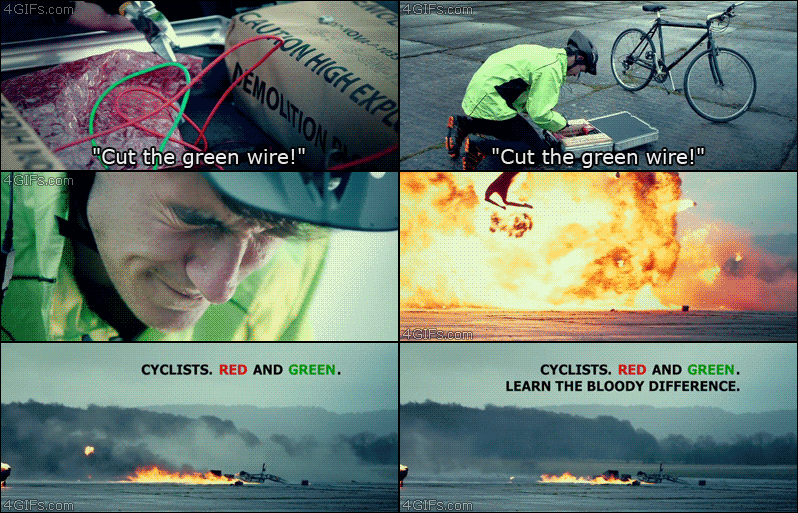
Circling back to the theme of this article, one mistake in judgment or simply bad luck has the potential to become a watershed event, please take the short piece below to heart. It is an example that illustrates how making what could simply be one mistake can leave you FUBARed.

Picture Of Bomb Squad Cutting A Wire


Please note, Fred cut the wrong wire!

(Republishing of this article welcomed with reference to Bruce Wilds/AdvancingTime Blog)

Sunday, February 6, 2022

China - Expect Change To Bubble Up From Below

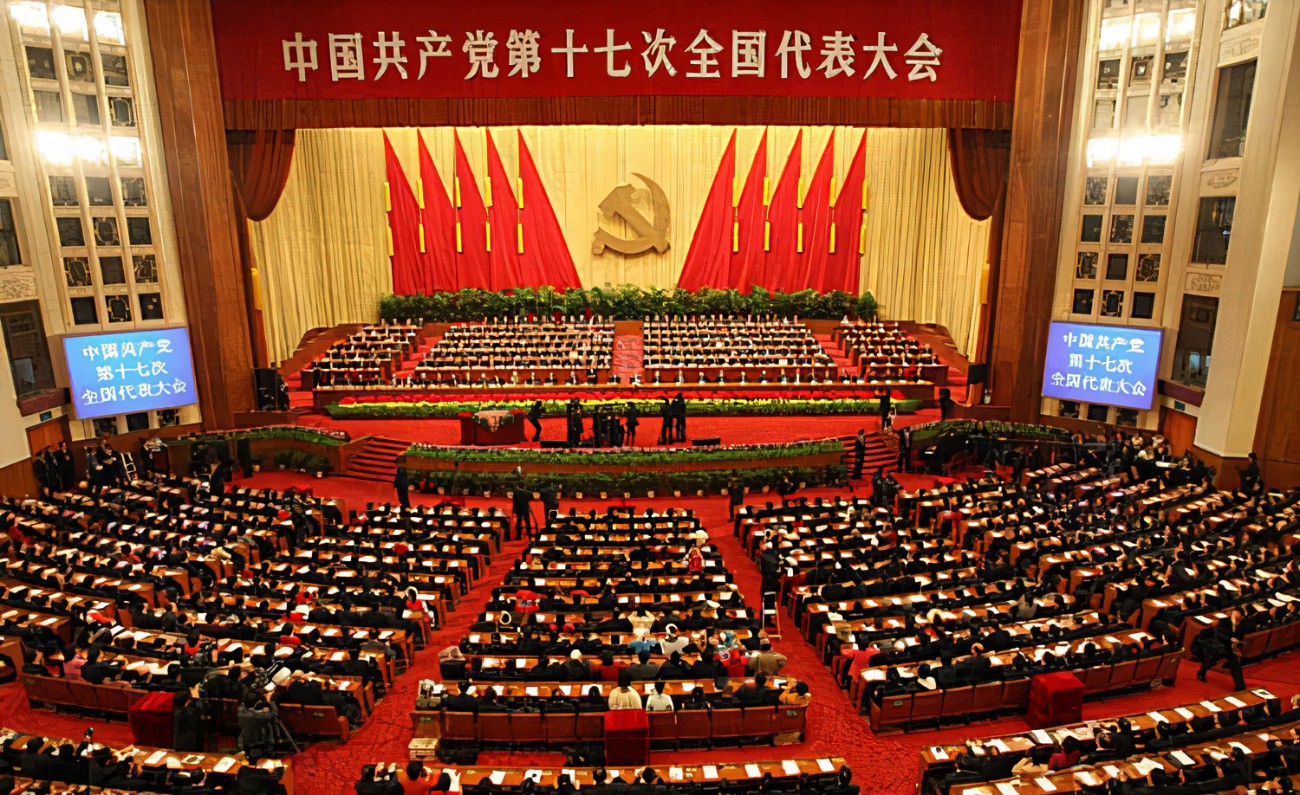
Events in China are already being influenced by the fact that in the fourth quarter of 2022, the Chinese Communist Party (CCP) will hold its 20th National Party Congress. With the 14th Five-Year Plan being drafted a great deal of attention is being paid as to who will carry it out. This is no small matter considering those trained to carry out the goals of the Party-State and disseminate and enforce the official indoctrination are most likely engaged in a ruthless power struggle behind the scenes. 

As the National Party Congress nears it raises the probability that China's reaction to things that occur in coming months will be rooted in politics rather than economics. Currently, China is struggling with a huge number of issues including the hosting of the Olympics. A resurgence of Covid-19 has complicated this. With the eyes of the world focused on China, everything is about politics and the one thing its leaders don't want is to be publicly humiliated or embarrassed.

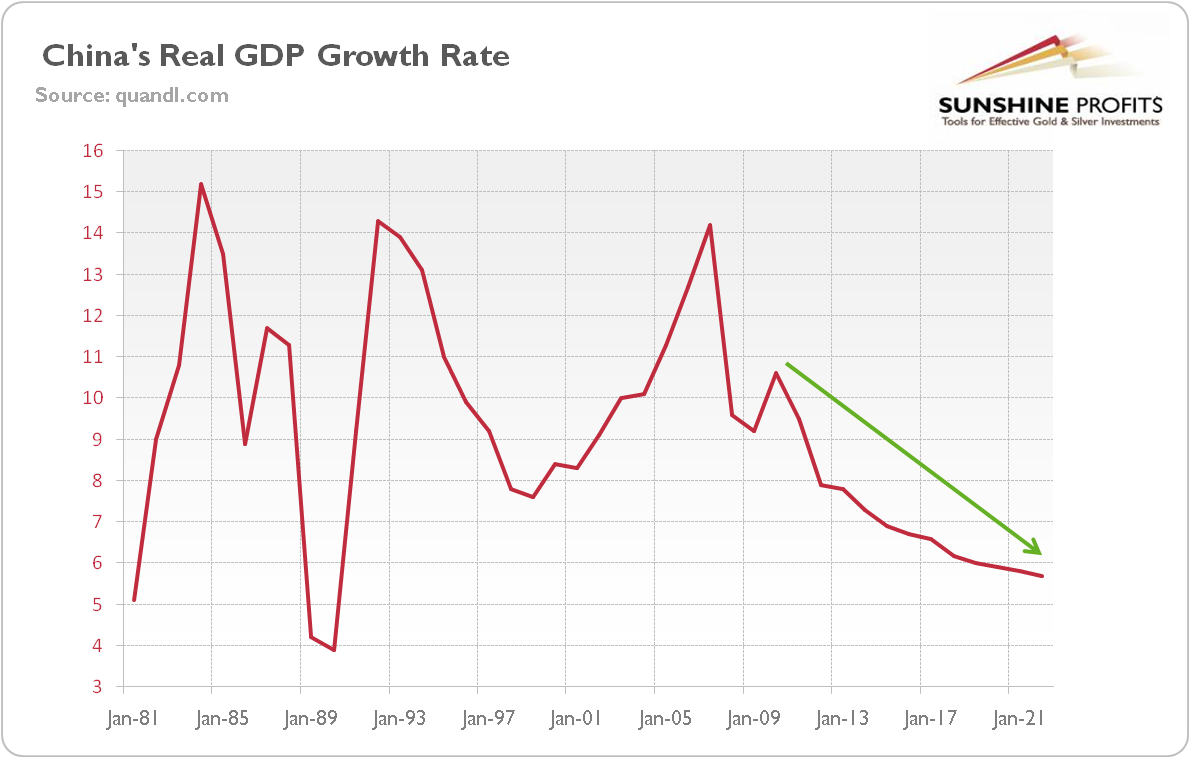
Growth In China Is Rapidly Slowing
While America has squandered much of its wealth on its war machine, offshoring jobs, and by purchasing cheap poor quality consumer goods from other countries, China has its own sectors of waste. The country faces huge challenges when it comes to political, economic, and social issues. China has so many problems it is difficult to catalog them all and slowing economic growth is making things worse. Below is just part of the list.

  • Integrating Hong Kong into the mainland
  • The continued fallout from its zero-Covid policy
  • Tensions continue to escalate between Taiwan and the mainland 
  • Power shortages have become common
  • Corruption and policies that encourage poor quality growth
  • Pollution is a big problem
  • The currency, the yuan, is struggling 
  • China lacks the natural resources to support its large population  
  • Growing inequality 
  • The demographics of one child has resulted in an aging population 
  • It continues down the path of growing social control and repression 
  • It remains guilty of human rights abuse
  • And it is facing a collapsing housing market that will destroy wealth and savings 

The list above is why China cannot declare victory and the next five-year plan is so important. It appears China's goal of common prosperity and dual circulation has run into a wall. In short, China is not a "better place to be." Over the last several decades, the West has transferred trillions of dollars of wealth into China. Much of this has been poorly spent and squandered building ghost cities and bridges to nowhere. 

Then, there is the issue of One Belt One Road or OBOR. Emboldened by an influx of wealth from the West, China has played fast and loose with creating and loaning out new funds. China has lent trillions of dollars to countries. The Center for Global Development, a Washington-based think tank, has highlighted in a report entitled Examining the Debt Implications of the Belt and Road Initiative from a Policy Perspective, it underlined the problems of extending credit to poor or unstable countries. These loans have the potential to saddle weak countries with “excessive debt and low-quality projects.” The question has been raised as to whether this initiative will pay off or whether it is just a game Of Debt Diplomacy where China tries to put countries in a debt trap so it can steal their natural resources.

With growth in China slowing, it is predicted to grow 4.8% this year, down 0.8 percentage points from earlier estimates, it could be argued the country is facing long-term stagnation. Much of China's resources have been flowing into the wrong sectors of the economy, this is evident in the financial stress now apparent among its property developers. Another large factor contributing to productivity had been infrastructure investments based on planning, but the efficiency of these has fallen over the years. Part of this has been due to corruption and the incentive to just build it to promote growth.

Returning to the issue of the CCP 20th National Party Congress, this is where the decision will be made whether Xi Jinping stays for an unprecedented third term or his political power is neutered. So many cracks are beginning to appear in China's economy that it puts the leadership position in play. The notion Xi Jinping will remain in power is not carved in stone and his removal would signal a major change. Political fortune can change very quickly in Chinese politics, this is something most westerners often forget.

It is important to remember that China’s future institutional path depends on the relationship between its national system of economic development and the CCP cadre system. This cadre system is the most stable political institution in China and plays into everyday life. Those that make up the Politburo contention have waited their entire lives to receive the  political appointments they seek. They have served different factions and politically survived through decades of policy and institutional change. 

This Is A Problem!
Those wielding power in China are far from timid and most likely not blind to the failings and problems noted above. This is why China's strength must be questioned by people without an agenda if we truly wish to understand the world. It could be argued that only gargantuan credit injections have prevented a total economic collapse in the world's second-largest economy and only ever greater credit injections are keeping China alive. This underlines the fact that size should never be interpreted as strength.

Considering the difficult path China faces, do not be surprised if the change that comes, bubbles up from below. Such change often flows from necessity rather than choice and is not always good. Companies based in China also owe foreigners a great deal of money based on dollar-denominated agreements. Whether we are talking about Democracy, Communism, Socialism, or Fascism the strong link they share is one of dominance and a desire to control. Whatever changes in policies China chooses to undertake, expect them to be shaped by the desire to control. 


Footnote; Again, I recommend those wanting more of an "on the ground" view of China view the following YouTube video;  https://www.bing.com/videos/search?q=https%3a%2f%2fwww.youtube.com%2fwatch%3fv%3dlKbLB_T-IjY&&view=detail&mid=C60E8FEB6236A8A53EE5C60E8FEB6236A8A53EE5&&FORM=VDRVRV


(Republishing of this article welcomed with reference to Bruce Wilds/AdvancingTime Blog)