Tuesday, March 27, 2018

Tesla Update - Model 3 Production And Cash Burn Worry

Tesla Needs Some Good News As Concerns Grow
It has been a while since we have heard any good news flowing from Tesla. This is making some people wonder if the company is slowly losing its aura. It does not help that we are now hearing about how a Tesla Model X driving on Highway 101 near Mountain View, California was involved in a gruesome crash. The Tesla hit a carpool lane barrier, leading two more cars to crash into it. This caused the lithium-ion batteries powering the vehicle to ignite and explode, at which point the vehicle burst into flames, the driver was later pronounced dead.

As expected Tesla's competitors have not been sitting on their hands or surrendered the electric car market to the upstart. An article on "autoevelution" delves into how not all new Model 3 owners are happy with the quality of their new cars after the feeling of pure euphoria has passed Tesla owners have started noticing flaws. This means Tesla has been swamping its already busy service centers by rolling out flawed cars rather than slowing down production to maintain their standards. This bodes poorly for Tesla's reputation and how people feel about the brand but Tesla has decided to put quantity over quality must keep production moving. If Tesla can't produce as many good quality cars as promised then eyes will quickly turn towards the fact Tesla is burning through cash at an alarming rate. Goldman Sachs estimates the burn rate to be as high as one billion dollars per quarter this year.

It is reported that Bloomberg is tracking the Model 3 rollout with an experimental tool that estimates production using Vehicle Identification Numbers (VINs). Currently, their model estimates that Tesla is making 805, Model 3s a week, for a grand total of 10,636 cars so far and they are showing that significant improvement is about to come. This estimate is thought to be a bit low by some Tesla watchers who think it’s possible that Tesla could already be producing more than 1,000 a week and climbing. Still, for many investors Tesla’s first-quarter production failures loom extremely large. The company said at the beginning of 2018 it was already capable of building 1,000 Model 3s a week and would be cranking out 2,500 a week by quarters end. An even bigger problem is that it is impossible to forget Tesla originally had said it would get to 5,000 Model 3 sedans a week in 2017 and then on to 10,000 a week in 2018. 

This explains why Tesla's unsecured bond, which has no direct claims on Tesla's asset base and depends entirely on cash flows is not behaving well. This debt which represents Tesla’s first venture in pure bonds was sold at the height of excitement about the Model 3 and amid lofty company promises over how fast they would ramp up production.  Moody's rated that bond assuming 300,000 Model 3 deliveries would be made this year. Last week Tesla's $1.8bn unsecured bond, which reached a near all-time high yield of over 6.5 percent.  Issued at par with a yield of 5.30 percent in August, the bond's price has been grinding downward. This means its yield has been moving higher. Again, the blame is being placed on the botched rollout of Tesla's Model 3. It has been so troubled that Tesla was forced to stop production for a week in February in an effort to address "bottlenecks" slowing the line.

Debt Has Risen While Free Cash Falls (click here)
Soon we will know if Tesla has been able to reach its reduced goal of producing 2,500 Model 3s per week by the end of the first quarter but the indications are it will fall far short. This raises concern about it hitting its 5,000 cars a week target for the end of June. Tesla's failure to do so brings forth a bigger issue and that is they will run out of cash. This means they will have to raise money and deal with rolling over short-term debt at a time interest rates are on the increase. This is exacerbated because analysts expect Tesla to burn through $2.7 billion of cash this year and because Tesla's debt has jumped, especially after it took on SolarCity Corp.'s obligations. This caused interest expenses to more than double in 2017 and is occurring at a time when Tesla is moving closer to a maturing wall of $3.7 billion of bonds and credit lines that need to be refinanced by the end of 2020.

Some $1.7 billion of this debt consists of three convertible bonds falling due between this coming November and the next one. Almost half of it that was inherited from SolarCity and is very far out of the money, with conversion prices starting at $560. The remainder of it, a $920 million convertible due next March, has a conversion price of just under $360. Tesla closed Friday trading at around $302. The good news for Tesla is that compared to its market cap the company still has relatively little debt and in the past when Tesla sold $546 million of auto lease-backed bonds demand was huge. These ABS bonds were tied to leases of Model X and Model S vehicles. These investors had to weigh uncertainties about the resale value of electric cars where very little data exist against the fact that lessees on average had high credit scores and the bonds mature in less than three years.

While we can debate what has brought Tesla to where it is today we must certainly give much of the credit to QE, tax incentives and a slew of other factors that would be difficult to recreate at any other time in history. A recent Seeking Alpha article pointed out that in a head-to-head comparison in Motor Trend, three reviewers compared the Tesla Model 3, Chevy Bolt, and Nissan Leaf in a test, and only one person picked the Tesla. Many people would be surprised to know that the reviewers were comparing the base versions of the Leaf and Bolt, which cost $30,000-35,000, to the fully loaded Model 3 that costs more than $60,000, all this comes at a time when a fair number of unflattering articles have begun to surface questioning Elon Musk's ability to hold all his ventures together. This indeed raises the question of how long those shareholders enamored with Tesla or creditors will be willing to hang on if the stock begins to tank.


Footnote; The articles below look at several different aspects of the Tesla story and why the car company is in itself a cultural phenomenon.
    http://brucewilds.blogspot.com/2017/02/elon-musk-and-tesla-motors-overview.html
    http://Traits Jeff Bozos, Elon Musk, And Mark Zuckerberg Share html
    http://Elon Musk Continues to Razzle Dazzle The Masses html

Media And Politicians Rush To Blame Social Media

Zuckerberg And Facebook Are In The Hotseat!
Oh, the irony of it all as mainstream media and politicians rush to blame social media for our cultural woes. Facebook has stepped into the sunlight and has found transparency to be rather unflattering. While I'm not a fan of Mark Zuckerberg the computer programmer and Internet entrepreneur who co-founded Facebook, demonizing him does little to remove the guilt they all share. Zuckerberg has apologized to Facebook users after he was backed into a corner and painted as uncaring and even accused as having a very low opinion of the customers that have trusted him and his company, however, that apology seems to have fallen on deaf ears.

Currently, Facebook faces multiple investigations to find out just how far over the line they went in abusing the trust of those with accounts and information these individuals posted. Unfortunately, many reasons exist to question the motives of those seeking power and Zuckerberg reeks of such ambition. Zuckerberg recently traveled throughout the United States to fulfill his 2017 “personal challenge” to “learn about people’s hopes and challenges.” During his travels we have seen him drive a tractor, meet with recovering heroin addicts, don a hard hat and speak out against the staggering wealth inequality that his personal fortune so clearly represents. This trip attracted a great deal of attention and sent rumors flying and even created speculation that Zuckerberg might be considering running for President.

Zuckerberg's Character Is Being Questioned, Is He A Shmuck?
Some people might be happy and content to be the founder and chief of one of the world’s biggest tech companies while still in their early 30s but not Zuckerberg. The CEO of Facebook has spent the last couple of years casting himself in various roles such as a global philanthropist, however, some detractors point out he has given away a very small part of his wealth and this is being done as the cafeteria workers at his company struggle to make ends meet.  

While Mark Zuckerberg criticizes the government for failing to build adequate infrastructure for Silicon Valley workers it has been pointed out that perhaps they cannot afford such infrastructure because of the huge lengths companies like Facebook, go to in order to avoid paying the taxes that needed to pay for such projects. Zuckerberg has also praised the idea of a universal basic income, an unconditional income paid by the government to all citizens, regardless of whether or not they work. This brings up the question of whether Zuckerberg has the right to pronounce what the welfare state should look like while Facebook takes very aggressive measures to minimize its tax burden, to those people, the term "hypocrite" quickly springs to mind.

As for social media being used to collect data and in effect spy on us who do you think allowed and gave them this power? Just as unsettling is the alliances companies like Amazon have made with the government and the big contract their cloud division, Amazon Web Services, has with the CIA. In the case of Amazon the fact its CEO also owns the Washington Post, America's most influential newspaper, should send shivers down the back of those believing in freedom and limited government. The power of such a news outlet shapes both public opinion and the narrative of events of all kinds. It is impossible to state how much power the mainstream media has through influence peddlers like the Washington Post in shaping public opinion. An article that highlights this claims the Post was purchased by Jeff Bezos as a propaganda mouthpiece to enhance his political influence. This again circles us back around to the topic of fake news, false flags, and a slew of problems that plaque both America and the world.

All these players constantly stirring the pot contribute to the cultural rot that leaves all of us wondering who and what to believe. Governments, corrupt politicians, the media, fools and clowns, all vying for our attention. The source of much of the polarization we face may, in fact, flow from the same mainstream media that is almost giddy over the problems Facebook has created by playing fast and loose with data from its followers. When it comes to the issue of whether we are a society of thinkers, sadly the answer comes in as a resounding NO! Most people would rather turn it all over to artificial intelligence and be fed through a straw while living in a world of virtual reality rather than face the complex problems that lay before us in coming years.

As for the answer as to how much power any individual screaming at the top of their lungs on social media really moves the needle, most likely the true answer is very little. This does not mean the format of social media cannot be manipulated by "bots, trolls, and evildoers" (mostly their words not mine) but in comparison to those who really control the narrative, they have little power. In part this is because society is so polarized we could not agree on anything if our lives depended on it. The bottom-line is that after all the finger pointing and blame, Zuckerberg and Facebook most likely will not get the award for being "The Worst," and eventually they will probably only merit a badge for being bad. This is because when it comes to the total cast of bad actors, and all is said and done, they have some very tough competition.

Sunday, March 25, 2018

When Buy The Dip Becomes, "Sell the Rally"

Markets Have A Way Of Drawing Us In
In every market there comes a day when it runs out of steam and tops out. That is when, in this case, "Buy The Dip becomes, Sell the Rally" or better yet maybe "get the hell out of the market." The mistakes people make while playing the investment game are too many to list, and for many market players, the game often ends in tears. Few of us possess the self-discipline required to follow the plans we previously laid out when shit actually hits the fan. Whether it is a slow change in market sediment that leaves us like the proverbial frog in a pot as the water temperature continues to rise or total panic with everyone rushing to the exit losses are hard to take.

Many of us really long time traders don't really love the market unless we just happen to be, shall we say, a natural trader, and there are really very few of those. These are the people that can often sense a change in the air and always seem to be on the right side of a trade. I'm not talking about stock brokers but rather traders. I have never met a broker that could call the market. If someone was really that good they would most likely be in the market themselves and not babysitting people who do not understand that the financial markets whether we are talking stocks, bonds, commodities or even options are cruel places that should be avoided.

Markets Climb A Wall Of Worry Then Fall Like A Stone
Without a doubt the markets are alluring and the chance to run with the big dogs can suck you in as well as the thought of picking up some easy money. This is why so many of us keep coming back into markets that seem to be rigged against us, maybe its stupidity, hope, tenacity, or because it is the hardest game in town and we think if we play it long enough we will finally be able to master it.

A great number of witty sayings have grown out of the woes people experience when they roll the dice at the casinos on Wall Street. Things like, "bulls make money, bears make money, pigs get slaughtered" or, Do you know how you make a small fortune on Wall Street? the answer is, start with a big one. We also have the "trading systems" we have systems based on chart trendlines, timing market cycles, studying market fundamentals, and everything in between. Many books have been written on the subject of making money in the markets and we have market gurus that will make the calls for us, however, it is not uncommon for many of these to remind us when they were right but forget when they were wrong and we paid the price.

When Buy The Dip Becomes, "Sell the Rally"
While things can be going well and a trader making money it does not take long to lose years of profit and a great deal more when things turn south. Even traders that have cautiously diversified their portfolio may find they suffer greatly during such an event. It is said markets climb a wall of worry as they climb higher but history shows that when they decline the rate of the decline is often fast and harsh, that is why they call such a move a crash. The pain is often increased by the fact many traders leverage their position by playing on margin which allows them to maximize the number of shares they control.

Plans can go awry when you are in the market and when they do it seems that bad luck lingers around every corner just waiting to strike. When all is said and done more lives and fortunes have been destroyed by markets than made. The markets giveth and the markets taketh away but it tends to taketh faster. This means simply riding it out may be easier said than done. Many of us who have entered this arena and tried to catch a falling knife (pick a bottom in a falling market) will tell you it wasn't our finest moment. I'm reminded of that line from a song, "What's to painful to remember we simply try to forget."

I'm not arrogant enough to declare we are at the point where I guarantee the market has put in its top, however, as I have forever and a day, I urge extreme caution. Even the idea that we can protect ourselves by being diversified has a way of proving to be a myth when Murphy's law that "everything that can go wrong will" takes effect. We are in uncharted waters and how this market plays out we will not know until afterward, and then we will ask, why didn't I see this coming? The bottom-line here is that we don't want to be that guy.


Footnote; I have been bearish and wrong about how far this market could rally for a long, long time. The fact that a broken clock is right at least once a day is not something that I find reassuring. Several articles that relate to the post above are listed below.
    http://Stock Buybacks Driving Market-Where It Might Take Us!html
    http://Thoughts On This Time Is Different.html
    http://Flash Crash On Steroids Is Possible .html
    http://Capital Preservation Is Job One.html

Saturday, March 24, 2018

The Omnibus Bill Represents Washington's Failure

 Omnibus Means "Everything In"
The Omnibus Sending Bill just passed and signed into law represents all that is wrong with Washington and its failure to face the problems confronting America. An omnibus bill by its nature covers a number of diverse or unrelated topics. Omnibus is derived from Latin and means "for everything" this means an omnibus bill is a single document that places or packages together several measures into one or piece of legislation. Since modern copying techniques and newer printing technology came into use, Washington has gone completely insane replacing quality with quantity. Today they copy and paste together in just a few hours the final details of massively complex legislation that runs into thousands of pages of incomprehensible dribble. Adding to the insanity nobody has the time to read these bills before they are voted on and passed into law. President Trump told the American people during the presidential campaign that as a businessman he would clean up wasteful government spending, this bill is a monument to his failure. Even Trump's claim he would never sign such a bill again will not insulate him from this folly.

Rand Paul Holds 2,232 Page Omnibus Bill
Despite the efforts of Rand Paul and a handful of other conservative Senators to kill it the bill, the upper chamber easily passed the long-awaited $1.3 trillion omnibus spending bill early Friday morning. With a 65-32 vote, they sent to the Presidents desk the bill that would lock in federal spending for the remainder of the fiscal year. The final bill that exceeded more than 2,200 pages was printed and released Wednesday morning following a week of all-night bargaining sessions and repeated delays. This means again lawmakers can hide behind claims they had to make the tough choice and accept a flawed compromise or be responsible for a damaging government shutdown that might hurt the economy.

Other than the poor spending decisions omnibus bills are bad in that things often get slipped into them that don't belong there. With little notice after Trumps signed the bill into law a profound change in how the U.S. government treats cloud data became law with little or no debate. It seems that at the last minute Congress tacked the CLOUD Act onto the massive spending bill Wednesday night just ahead of the vote and it also became law Friday morning. The CLOUD Act clarifies how the U.S. government can access data of U.S. citizens needed for law enforcement investigations that is stored on cloud servers outside the country. The CLOUD Act which is tech-backed has raised concerns from privacy and human rights groups in that it changes the way foreign governments request information from U.S. tech companies for similar investigations on their own citizens.

The law calls for the executive branch of government to strike mutual legal-assistance treaties with foreign governments, who would then contact tech companies directly with their requests instead of routing through the DOJ. Tech companies would be able to push back on those requests, but the CLOUD Act removes a layer of judicial review from the process, which critics feel gives too much power to the executive branch in terms of which countries get to be in our information-sharing club. Privacy advocates are worried that some of the protections against signing treaties with countries with poor human-rights records are weak. Foreign governments will also be able to turn over data on U.S. citizens gathered in the course of investigating their own citizens to U.S. law enforcement without a warrant, according to the ACLU.

Returning to the overall idea of the so-called Omnibus Bill.  "It sucks," Senator John Kennedy, a Louisiana Republican who opposed the bill said of the spending measure. "No thought whatsoever to adding over a trillion dollars in debt." The truth is Paul and other conservatives pointed out this budget would've been adamantly rejected by Republicans if Obama was still in the White House. Instead, we see Republicans claiming victory because of an $80 billion increase in military spending while Democrats boasted they had included a much needed additional $63 billion in domestic spending. President Trump touted this as the largest increase in military spending ever and signed the bill into law after causing a stir shortly before its passage by threatening to veto it because he says it doesn't protect Dreamers or fully fund his border wall. The bottom-line is that while Trump and the other creatures of Washington think people are too stupid to notice they have failed us again the fact is we do notice.

Wednesday, March 21, 2018

How Much Wealth Will Escape the Next Economic Crisis?

The Shell Game Of Wealth Transfer
How much wealth will escape the next large economic crisis is very important because it will set the bar that determines the rate of inflation or deflation in coming years. If you believe we did not solve many of our financial problems after 2008 but merely masked them with a huge amount of newly printed money you are likely to embrace this concept. Wealth and how things are valued is not constant but fungible and constantly changing, constantly moving and comes in many forms. Wealth can be held in the form of paper, promises, or as something more tangible and real such as property or goods. Some items such as a tool hold "utility value" and its value may be based on how much work it can perform or the revenue it can produce. Replacement cost, supply and demand, and factors such as whether something can spoil or might grow obsolete over time also help determine its value as a place wealth can be stored.

Wealth is defined as the abundance of valuable resources or valuable material possessions. An individual, community, region or country that possesses an abundance of such possessions or resources to the benefit of the common good is known as wealthy. Defining wealth is one thing but it is important to actually delve into its nature to truly understand just how elusive it can be. Imagine your life as the poorest person in a very rich and wealthy society versus how you might live as the richest person in the poorest and wretched place. When you do the former might be preferable.

Don't Be Naive, The System Cares Not
Pensions, annuities, and even investments in stocks and such all fall into the area of paper promises that are often recorded somewhere far from sight as a digital entry on a computer. These intangible stores of wealth based on faith have grown at a massive rate during the last several decades and were relatively minor players until recently. Currencies, also known as fiat money, are also just IOUs or paper promises. The idea of a currency free society in my mind tends to break the bonds that link us to wealth but that is for another post.

In the past I have written several pieces about subjects such as, writing off the rising amount of bad debt, how debt is like a mirage moving into the distance, how bad debt is resolved, and how precarious the vessels where we store our wealth can be, however, the crux of this article centers around what will or might be left after stress pushes the global economy to the brink or into total collapse. A great deal will depend on how such an event unfolds, this means what kind or type of value and wealth is the first to vanish. I will be the first to admit the answer is unknown but this is more of an exercise of the mind where I am asking you to consider and question such a possibility.

Be Skeptical, Be Cautious, Get Smart!
Taking a "follow the money" approach to this exercise, I ask you to think about the many or multitudes of places your wealth might vanish into or how it could seep away. Much like a shell game where wealth is transferred in our modern society wealth is always on the move. It zips across borders at the click of a button and just because you deposit it with a local institution does not mean it stays in your community. We saw shades of this decades ago during the savings and loan crisis when huge beautiful buildings were constructed in certain areas from wealth transferred in from other parts of the country. Needless to say when as the dust settled the big winners were the areas with the new buildings and not those forced to pay for them when the loans used to build them went into default.

Today some market watchers claim that the stock market is being held at lofty levels while the smart money is rushing to the exits. Today tens of trillions of dollars are sitting in offshore banking accounts in places such as the Cayman Islands. Today government and businesses are borrowing hundreds of billions of dollars each year by issuing bonds some that will not return investor's money for decades. Today homes, apartments, and buildings are being built, some poorly constructed, with loans guaranteed more or less by the American people. Today America's national debt stands at 21 trillion dollars and is rising. Today currencies such as the euro and yen are even more fundamentally flawed than the dollar. I could do this a bit longer but I suspect I've made the point.

We must never forget the world is full of crooks, evil politicians, and that it sports judicial systems where true justice is a rare commodity. Again, returning to the focus of this article. what is indeed important is what or how much wealth survives an economic crisis and in what form because when that wealth comes out of hibernation it will soak up all the tangible assets on the planet. This will be the determining factor of whether we face inflation, deflation, or some crazy mix of the two. Remember it is the nature of those in charge to throw the masses under the bus when things go sideways. This means the average person should expect little in the way of protection in any coming storm. The economic landscape we face following such an event will without a doubt be shaped and depend on what wealth survives and how much vanishes following a tsunami of defaults and /or a monetization of debt where government debt disappears and inflation takes its place. A word to the wise should be sufficient and cause any person prudent or interested in protecting their wealth to consider the many ways wealth can vanish and that it can without a doubt happen to you.


Footnote; I hate to blow a hole in the idea that you can safely tuck your money away in an offshore banking account but I have to ask where all the money deposited in the Caymans really is. Banks do not just sit on deposits and keep them safe.

Sunday, March 18, 2018

Stock Buybacks Driving Market - Where It Might Take Us!

This is the second part of a two-part series. The first explored how stock buybacks have been instrumental in driving this market higher since QE fueled easy money starting in 2009. This part focuses on what is ahead and how the recently passed Trump tax plan has supercharged this trend just as it may have been reaching its natural conclusion.

 A research report from JP Morgan published last week revealed that S&P 500 companies will buy back a record $800 billion of their own shares in 2018, far exceeding the current high of $530 billion that was recorded in 2017. David Stockman thinks the number may be low and projects the current buyback rate at a record $1 trillion this year but just as important Stockman doesn’t see this rate as being sustainable. If indeed, "The later stages of the 2009–2017 bull market are a valuation illusion built on share buyback alchemy" then we can only speculate as to the downside potential of this market.

2018 Slated To Blow Away Past Stock Buyback Record
Without a doubt, the tax bill will disproportionately benefit companies sitting on a great deal of cash. The fact is the richest 10% of companies control 80% of the $1 trillion offshore cash hoard. If we view this in the same way a pig would pass through a python it becomes important to ask not only how long this will last but what happens after the infusion of this money into the markets has ended and liquidity tightens. Also as the cost of debt increases will the buyback spending of the strong be enough to offset the turbulence caused by weaker companies.

When a person accepts the idea share buybacks are a major contributor to the low volatility regime because a large price insensitive buyer is always ready to purchase the market on weakness they also have to recognize how this has added to distorting and disrupting true price discovery. As more proof buybacks are sustaining this market, since 2009, the largest equity drawdowns that occurred in August 2015, January to February 2016, and two weeks ago all took place in or right after the share buyback blackout period. Even less surprising, after February 5, 2018, corporations stepped in and bought the dip which immediately suppressed volatility. If more confirmation is needed consider that Goldman Sachs’ unit that executes share buybacks for clients had its busiest week ever, seeing roughly 4.5x its average daily volume over 2017. According to BofA CIO Michael Hartnett, a record $43.3 billion was put into equities this week as investors shrugged off trade war risks that had initially sent stocks reeling, even as those very risks returned.

Suddenly It All Becomes Clear! (click here)
Obviously a huge share of this "wall of money" is coming from stock buybacks, however, do not expect all stocks even within a general classification or group to react the same. The hope that companies would plow the money they saved on taxes and brought back from overseas into capital expenditures like new buildings, products or equipment is rapidly fading. With real demand remaining weak many of those in positions of corporate leadership has decided to squander the money in an obvious bubble by buying back stock and line their pockets instead. The temptation is strong for leaders in any company currently mired in debt to take the money and run leaving the company default after you are gone.

As of 2015, just 30 firms accounted for half the profits of all publicly-listed U.S. companies, down from 109 in 1979. Only by accumulating debt have many laggards been able to afford the buybacks necessary to keep stock appreciation stable. The IMF warned last year that 22% of U.S. corporations are at risk of default if interest rates rise. History has provided countless examples of inopportune, if not reckless buybacks as they put the short-term benefits of buybacks before debt-management. Ironically or as expected like deer caught in the headlights corporations tend to retreat from buybacks at times of market uncertainty. The only year in the last 14 in which big U.S. companies spent less on buybacks than dividends was 2009. Reuters reported recently that “Share buybacks proliferate when the market is rising but evaporate when the market collapses.” In many ways, the decision way back in 1982 to again allow stock buybacks may highlight the true meaning of the phrase. "Been there, done that, learned nothing."


If you missed the first part of this series and would like to read it, CLICK HERE.

Footnote; It is logical that these so-called bright spots that have pulled the market higher also have the most room to fall when valuations do retreat. The article below explores why the FANG stocks may suffer most. Other stocks sometimes considered as part of this category of high flyers are stocks like Tesla. The bottom-line is that unless a company is loaded with cash caution is in order.
http://brucewilds.blogspot.com/2018/02/the-fang-stocks-have-potential-to.html

Saturday, March 17, 2018

Stock Buybacks Driving Market - Its Current Status!

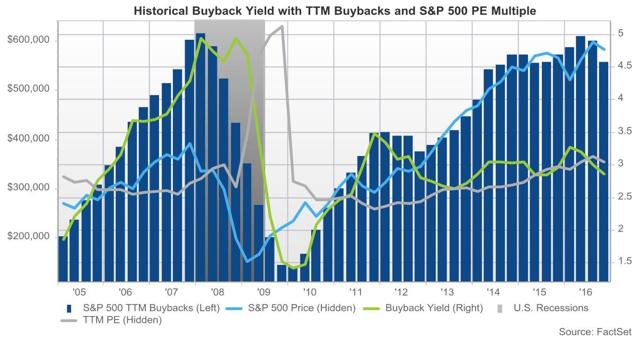
A slew of stories and articles have hit the news recently about how companies buying back their own stock are driving the market higher. I would be amiss not to comment on this and point out the impact and importance of stock buybacks and how they add to both low volatility and at the same time support the already crazy high valuations. Decades ago stock buybacks were illegal because they were considered to be a form of stock market manipulation. They were legalized in 1982 by the SEC and since then have become a tool for companies and management to boost share prices. Buybacks have been described as "smoke and mirrors," because when a company buys back shares of their own stock they reduce the "share float" and increase earning per share.

Buybacks Have Created A Dangerous Illusion (click here)
Buybacks should be viewed as a double-edged sword with great power in that they reduce the number of shares over which earnings are divided at the same time they add to market demand. This gives the impression the companies earnings are increasing while in reality, overall earnings may be flat or even on the decline. The deregulation of buybacks years ago has returned to haunt us because it tends to create a dangerous illusion that draws less sophisticated investors into a market that is not nearly as strong as it appears. The new recently passed tax law which lowers corporate taxes and encourages repatriation of cash that has been stored overseas is feeding fuel into the share buyback frenzy.

To be perfectly clear, buybacks are a tool corporate boards and CEOs use to manipulate the prices of their own shares higher. This means insiders can get out or hedge their positions before reality sets in and prices fall back to earth. Call it a well constructed exit strategy if you like. This is where I remind you it is major investors that sit on the board or hold executive positions and the same CEOs and other top managers who have received much of their compensation over the years in stock options. Yes, these are often the shareholders in the company that have reaped the largest benefits of QE over the years and added to inequality.

Buybacks Have A Darkside And Drive Inequality
This is already causing a backlash among politicians as they learn the talk about the money corporations saved from the tax cut would flow to develop businesses. They are not building new plants, developing new products or boosting wages, it was simply a lie. Murmurs are beginning to grow in Washington this situation needs to be addressed, however, do not expect any action soon. This issue sits low on the agenda of a dysfunctional government and lawmakers that are already slammed by more pressing matters. Casting their eyes towards coming elections, however, this is an area of law Democrats will focus on during the mid-term election cycle but the fact is a Democrats would need a massive victory before a law could be passed that would end buybacks. I suspect the issue will not be addressed until long after the damage is done and investors have been raped and plundered.

Several unusual currents are running through the market right now, one of those is low volatility of which share buybacks are a major contributor. This is because buybacks are insensitive to price and simply steps in and are ready to purchase on any weakness. With this in mind. it is important to remember that much of the buyback action over the last several years prior to the Trump’s tax changes has been financed from debt raised by selling corporate bonds. This means many companies will not have the money to keep their stock flying when the market begins to fall and leveraged companies will get hammered. These most likely are not the companies with cash stockpiles overseas that can now be repatriated cheaply and to make matter worse they now face higher interest rates.

Buybacks are why we have been hearing so many analysts touting the line that stocks are not overvalued and how earnings are growing. What they are referring to is earnings per share, and what is really doing better in that fraction is the denominator. Records show U.S. firms have spent roughly $4 trillion on buybacks since 2009, this means corporations have been the biggest single source of demand for U.S. shares during the so-called recovery. It is reported by 13D Research that buybacks have “accounted for more than 40% of the total earnings-per-share growth since 2009, and an astounding +72% of the earnings growth since 2012. Simply put, many corporate boards have made the decision to drain the company coffers in order to buy back shares, often from themselves and sometimes even in special deals offered only to themselves off the general market.

This is why according to an IMF estimate from last spring that large U.S. corporations have experienced a negative net equity issuance of $3 trillion since 2009. Linked to these share buybacks we have seen U.S. corporate debt to soar to an all-time high of $13.7 trillion. Companies are not investing this money because the demand for new production simply does not exist, sure a few upgrades are in order but that is already figured into business on a year by year basis. Also, little reason exists to buy a competitor or attempt a takeover while stock prices are so high.

Instead what we have seen and continue to see is that companies are plowing money into stock buybacks. All this reinforces what I and many others thought regarding the strong tilt of Trump's tax bill towards rewarding America's wealthy. The bill was not about tax reform and will only add to the trend of growing inequality. The fact is Trump's tax reform has prompted a surge in buybacks courtesy of offshore cash repatriation. It is estimated this will boost EPS growth by more than twice what U.S. economic growth would do. This, of course, does little in the way of creating real economic growth. Tomorrow in part two of this series titled; "Stock Buybacks Driving Market - Where It Might Take Us!" I will put forth some ideas on where this stock buyback mania will eventually end.


Part two has now been published. To continue reading, (CLICK HERE)